This game from Tom Watson is great fun: you’re presented with a succession of people, places, and things with associated dates that you have to correctly place in chronological order, like so:
All the data is pulled from Wikipedia and it gets harder as you go along because the gaps in time between dates already on the timeline get shorter. Did the discovery of radium happen before or after Queen Victoria’s death? Was Jane Austen born before or after the American Revolution? I know everyone is all about Wordle right now, but this game is much more my speed (and I can’t stop playing). (via waxy)
Update: For fans of this, there are at least two board games that are similar: Chronology and Timeline.
You may have also noted that the data is a little…wrong in places. The dangers of building a game based on a non-structured dataset. Think of it as an unintentional “hard mode”. (thx @bobclewell & peter)
Wikipedia is a constantly changing entity with hundreds of edits occurring every minute and now you can experience that dynamism as ambient music: Listen to Wikipedia. Additions, subtractions, and new user signups to the site are tracked as they happen and represented as different tones — here’s a video recording from a few years ago:
Bells indicate additions and string plucks indicate subtractions. Pitch changes according to the size of the edit; the larger the edit, the deeper the note. Green circles show edits from unregistered contributors, and purple circles mark edits performed by automated bots. You may see announcements for new users as they join the site, punctuated by a string swell.
In a recent interview at SXSW, YouTube’s CEO Susan Wojcicki said the company planned to use information from Wikipedia to counter misinformation in YouTube’s videos. In the NY Times, John Herrman wrote about the potential burden of a massive company like Google leaning so heavily on a relatively small non-profit organization like Wikipedia.
Then there’s the issue of money. As important as Wikipedia may be to some of the richest companies in the world, it is, in financial terms, comparatively minuscule, with a yearly budget of less than $100 million — a rounding error for big tech. (It should be noted that Google has made one-off contributions to Wikipedia in the past and includes the Wikimedia Foundation in a program through which it matches employee donations, which netted the foundation around $1 million last year.)
I consider it a subscription fee to an indispensable and irreplaceable resource I use dozens of times weekly while producing kottke.org. It’s a business expense, just like paying for server hosting, internet access, etc. — the decision to pay became a no-brainer for me when I thought of it that way.
I also called on other companies to support Wikipedia on a recurring basis:
Do other media companies subscribe to Wikipedia in the same fashion? How about it Gawker, NY Times, Vox, Wired, ESPN, WSJ, New York Magazine, Vice, Washington Post, The Atlantic, Buzzfeed, Huffington Post? Even $500/month is a drop in the bucket compared to your monthly animated GIF hosting bill and I know your writers use Wikipedia as much as I do. Come on, grab that company credit card and subscribe.
Wikipedia is a shared online resource that we all would sorely miss if it went away, people and companies alike. We should all pitch in and support it.
In this century, most people use “humanist” to mean something like “atheist, but nice about it.” That’s not what I’m talking about. I’m thinking about Renaissance Humanism, but applied, updated, or translated to digital technology in the 21st century.
In the Renaissance, Humanism is a complicated umbrella term for different, sometimes contradictory intellectual movements. The most consistent attributes in these humanists are these three things:
they were really into old books and manuscripts, the weirder the better;
they tried hard to save and preserve these texts;
they worked hard to disperse these texts and the ideas inside them to as many people as possible.
And once the printing press came along, they were off to the races.
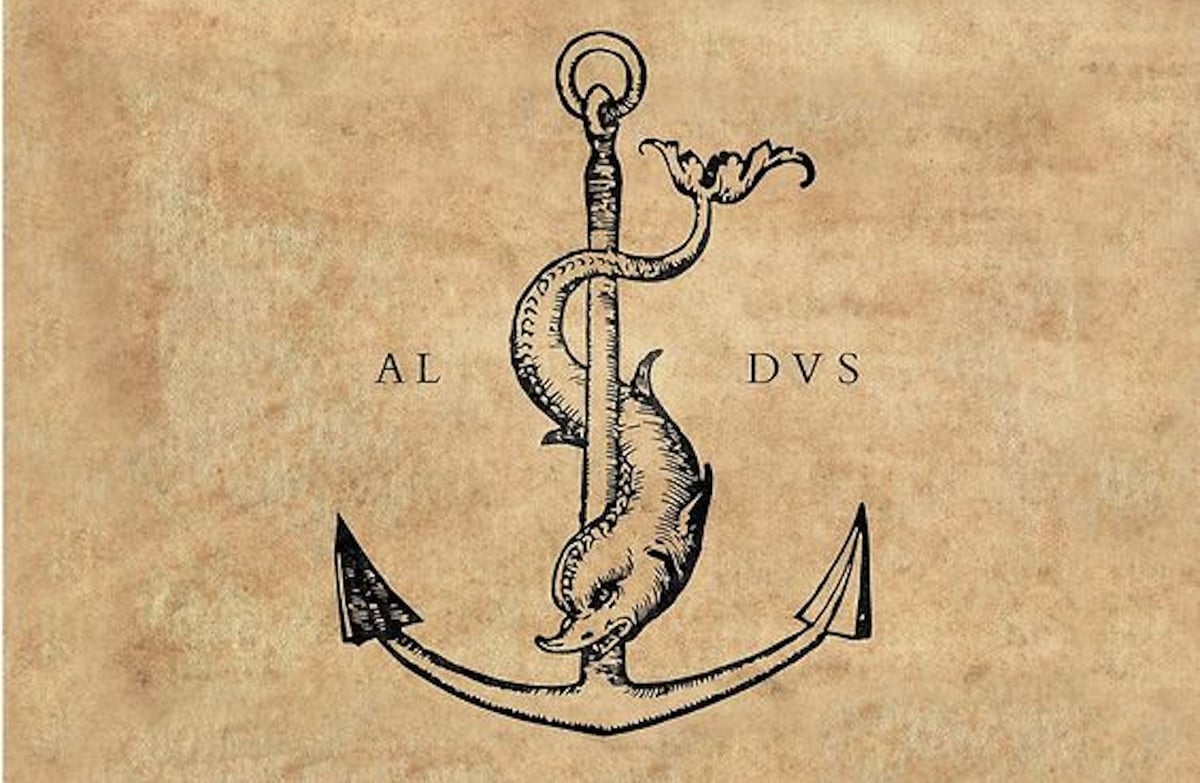
Aldus Manutius might be my favorite humanist who didn’t write very much. He edited and published classical texts in slim, portable, affordable printed volumes, and invented or popularized a bunch of typographical conventions, like italics, commas, and semicolons.
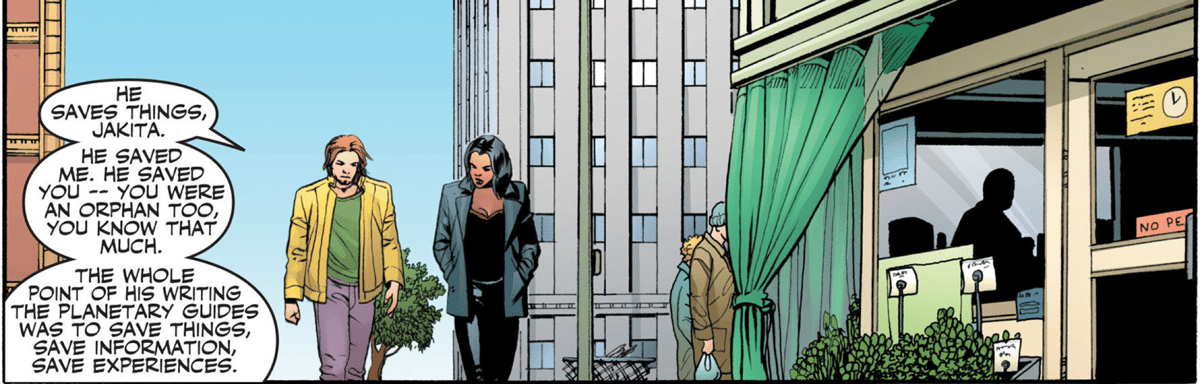
In the metaphor of the all-in-one machine, Humanists were first and foremost scanners. They translated knowledge from one technology, and its attendant modes of thinking, into another. They took old things and made them new.
[From Planetary by Warren Ellis, John Cassaday, and Laura Martin]
All of the genuinely great works of the 21st century have been acts of digital humanism. And of those works, three stand out as the purest and maybe the best, both to me and (in their suggestions) the readers of Kottke.org.
Wikipedia, Google Books, and The Internet Archive. These three projects, imperfect as they are, are the best attempts we’ve made to save what we know and make it available in new forms to as many people as possible.
Here are some other projects that readers mentioned:
Project Gutenberg offers free digital copies of books in the public domain.
RECAP makes public legal documents more accessible to nonlawyers.
UbuWeb is a digital archive of writing and other art that leans conceptual or avant-garde.
Newgrounds is a Flash games and animation site I spent way too much time on in the mid-2000s.
The Internet Review is a project that reviews web trends and events from the year before and turns them into a printed book, and was a big influence on this idea of a time capsule for the web. (More of a “print” than a “scan.”)
Colossal is a visual culture blog with an emphasis on handmade art and design.
Pastebin stores code and other text for easy sharing.
Pinboard is a social bookmarking site that’s still independent and still going strong.
Github is the best place to find and make open-source software.
The Lively Morgue is a New York Times project to upload photos from its archives.
We’ve already talked about Flickr. And I’m sure we can list many more.
Every day, sometimes visibly and sometimes not, people work to save all of the things we’ve built on the web. It’s probably the most massive, audacious, unlikely project in the history of the written word. If we ever do build a time capsule for the internet, we’ll only have anything left to save because someone else worked to save it first.
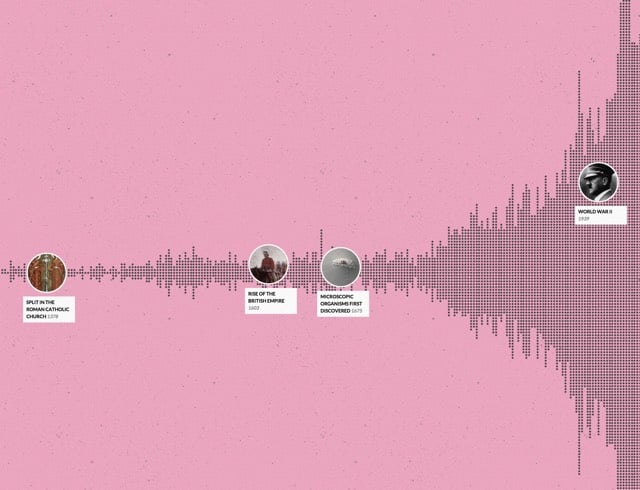
Whoa, Histography is a super-cool interactive timeline of historical events pulled from Wikipedia, from the Big Bang to the present day. The site was built by Matan Stauber as his final project at the Bezalel Academy of Arts and Design. This is really fun to play with and I love the style.
“Give me money, Emily,” Wales begged, “then go back to researching Beyonce lyrics.”
“Excuse me, Jimmy,” I wanted to say, “I don’t appreciate being watched as I read about how her song “Baby Boy” includes a lyrical interpolation of “No Fear” by O.G.C.”
Later, Wikipedia replaced Wales with other employees of the Wikimedia Foundation, which maintains Wikipedia with grants and donations. They moved me about as much as Wales did, which is to say not at all.
Today, while scanning my third Wikipedia article in as many hours, I saw the beggi…. er, note was back. It’s at the bottom now, without the pleading visage of a Wikipedian, and now includes an option to pay monthly.
I was annoyed, again. That’s the first instinct of anyone who spends time on the Internet and is constantly bombarded by pleas for money. But then I realized something: My annoyance was a symptom of my dependence on Wikipedia. I rely on it utterly. I take it completely for granted.
I found her argument persuasive, so much so that I just signed up to give Wikipedia a monthly amount as well. I consider it a subscription fee to an indispensable and irreplaceable resource I use dozens of times weekly while producing kottke.org. It’s a business expense, just like paying for server hosting, internet access, etc. — the decision to pay became a no-brainer for me when I thought of it that way.
Do other media companies subscribe to Wikipedia in the same fashion? How about it Gawker, NY Times, Vox, Wired, ESPN, WSJ, New York Magazine, Vice, Washington Post, The Atlantic, Buzzfeed, Huffington Post? Even $500/month is a drop in the bucket compared to your monthly animated GIF hosting bill and I know your writers use Wikipedia as much as I do. Come on, grab that company credit card and subscribe.
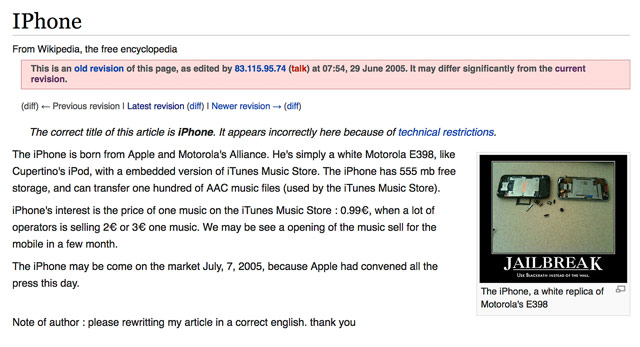
John Overholt, a curator of early modern books and manuscripts at Harvard’s Houghton Library, has started a new blog called First Drafts of History that features the first versions of Wikipedia articles. Here’s the first draft of the iPhone entry, dated more than a year and a half before it was introduced.
I’m sure there were many giggles about this kind of thing in the Britannica offices back then. Wikipedia has come a long way.
The Gloucestershire-based photographer now claims that the decision is jeopardising his income as anyone can take the image and publish it for free, without having to pay him a royalty. He complained to Wikimedia that he owned the copyright of the image, but a recent transparency report from the group, which details all the removal requests it has received, reveals that editors decided that the monkey itself actually owned the copyright because it was the one that pressed the shutter button.
But shouldn’t Wikipedia take it down anyway because they don’t have the monkey’s permission to release the photo into the public domain? (I mean, probably not…monkeys don’t have any rights under the law, yes?) (via @capndesign)
Update: A previous version of this post stated that Wikipedia said that the monkey held the copyright. They said no such thing…that was my poor paraphrase. In the US at least, monkeys obviously can’t hold copyrights. From the Compendium II of Copyright Office Practices, section 202.02(b) states:
The term “authorship” implies that, for a work to be copyrightable, it must owe its origin to a human being. Materials produced solely by nature, by plants, or by animals are not copyrightable.
Interesting phrase, “owe its origin to”…perhaps Slater has a point. (via @stvnrlly)
The US Copyright Office, in a 1,222-page report discussing federal copyright law, said that a “photograph taken by a monkey” is unprotected intellectual property.
“The Office will not register works produced by nature, animals, or plants. Likewise, the Office cannot register a work purportedly created by divine or supernatural beings, although the Office may register a work where the application or the deposit copy state that the work was inspired by a divine spirit,” said the draft report, “Compendium of US Copyright Office Practices, Third Edition.”
Update: PETA has filed a lawsuit on behalf of the monkey photographer, seeking to award the copyright and any sales proceeds to the monkey. Alt headline: PETA Thinks Famous Monkey Photographer Is Too Stupid To Manage Own Money.
The timeline of the far future artice is far from the longest page on Wikipedia, but it might take you several hours to get through because it contains so many enticing detours. What’s Pangaea Ultima? Oooh, Roche limit! The Degenerate Era, Poincaré recurrence time, the Big Rip scenario, the cosmic light horizon, the list goes on and on. And the article itself is a trove of fascinating facts and eye-popping phrases. Here are a few of my favorites. (Keep in mind that the universe is only 13.75 billion years old. Unless we’re living in a computer simulation.)
50,000 years: “Niagara Falls erodes away the remaining 32 km to Lake Erie and ceases to exist.”
1 million years: “Highest estimated time until the red supergiant star Betelgeuse explodes in a supernova. The explosion is expected to be easily visible in daylight.”
1.4 million years: “The star Gliese 710 passes as close as 1.1 light years to the Sun before moving away. This may gravitationally perturb members of the Oort cloud; a halo of icy bodies orbiting at the edge of the Solar System. As a consequence, the likelihood of a cometary impact in the inner Solar System will increase.”
230 million years: “Beyond this time, the orbits of the planets become impossible to predict.”
800 million years: “Carbon dioxide levels fall to the point at which C4 photosynthesis is no longer possible. Multicellular life dies out.”
4 billion years: “Median point by which the Andromeda Galaxy will have collided with the Milky Way, which will thereafter merge to form a galaxy dubbed ‘Milkomeda’.”
7.9 billion years: “The Sun reaches the tip of the red giant branch, achieving its maximum radius of 256 times the present day value. In the process, Mercury, Venus and possibly Earth are destroyed. During these times, it is possible that Saturn’s moon Titan could achieve surface temperatures necessary to support life.”
100 billion years: “The Universe’s expansion causes all galaxies beyond the Milky Way’s Local Group to disappear beyond the cosmic light horizon, removing them from the observable universe.”
1 trillion years: “The universe’s expansion, assuming a constant dark energy density, multiplies the wavelength of the cosmic microwave background by 10^29, exceeding the scale of the cosmic light horizon and rendering its evidence of the Big Bang undetectable.”
1 quadrillion years: “Estimated time until stellar close encounters detach all planets in the Solar System from their orbits. By this point, the Sun will have cooled to five degrees above absolute zero.”
10^65 years: “Assuming that protons do not decay, estimated time for rigid objects like rocks to rearrange their atoms and molecules via quantum tunneling. On this timescale all matter is liquid.”
10^10^56 years: “Estimated time for random quantum fluctuations to generate a new Big Bang, according to Caroll and Chen.”
Read the whole thing, it’s worth the effort. (via @daveg)
Author Philip Roth was unable to correct an error on the Wikipedia page for his novel The Human Stain because, while Wikipedia agrees “the author is the greatest authority on their own work,” they “require secondary sources.” To create this secondary source, Roth wrote an open letter explaining the error, and posted it on The New Yorker’s site.
Roth was motivated in 2012 to explain the inspiration for the book after he noticed an error in the Wikipedia entry on The Human Stain. His efforts to correct the entry were thwarted by Wikipedia editors because he was told he did not have a secondary source for his inspiration. He was responding to claims, given prominence in this entry, by Michiko Kakutani and other critics that the book was inspired by the life of Anatole Broyard, a writer and New York Times literary critic. Roth has repeatedly said these opinions are false. In 2008 Roth explained that he had not learned about Broyard’s ancestry until “months and months after” starting to write the novel.
The Best of Wikipedia blog collects interesting entries from Wikipedia. Some recent entries include Lawsuits Against God, Missing White Woman Syndrome, and Dead Cat Bounce.
“The more test materials are promulgated widely, the more possibility there is to game it,” said Bruce L. Smith, a psychologist and president of the International Society of the Rorschach and Projective Methods, who has posted under the user name SPAdoc. He quickly added that he did not mean that a coached subject could fool the person giving the test into making the wrong diagnosis, but rather “render the results meaningless.”
To psychologists, to render the Rorschach test meaningless would be a particularly painful development because there has been so much research conducted - tens of thousands of papers, by Dr. Smith’s estimate - to try to link a patient’s responses to certain psychological conditions. Yes, new inkblots could be used, these advocates concede, but those blots would not have had the research - “the normative data,” in the language of researchers - that allows the answers to be put into a larger context.
I was not aware that the inkblot tests were even in use anymore…seems like an antiquated technique.
The Dancing Plague (or Dancing Epidemic) of 1518 was a case of dancing mania that occurred in Strasbourg, Alsace, France (then part of the Holy Roman Empire) in July 1518. Numerous people took to dancing for days without rest, and over the period of about one month, most of the people died from heart attack, stroke, or exhaustion.
Wikipedia is great but I like to dig back into the “primary” sources. A Discovery News article tells of a book called A Time to Dance, a Time to Die whose author says that the dancing was a result of mass hysteria caused by high levels of psychological distress in the community. That article also mentions the Tanganyika laughter epidemic:
The epidemic seems to have started within a small group of students in a boarding school, possibly triggered by a joke. Laughter, as is commonly known, is in some sense contagious, and for whatever reason in this case the laughter perpetuated itself, far transcending its original cause. Since it is physiologically impossible to laugh for much more than a few minutes at a time, the laughter must have made itself known sporadically, though reportedly it was incapacitating when it struck. The school from which the epidemic sprang was shut down; the children and parents transmitted it to the surrounding area. Other schools, Kashasha itself, and another village, comprising thousands of people, were all affected to some degree. Six to eighteen months after it started, the phenomenon died off.
Genital retraction syndrome (GRS), generally considered a culture-specific syndrome, is a condition in which an individual is overcome with the belief that his/her external genitals — or also, in females, breasts — are retracting into the body, shrinking, or in some male cases, may be imminently removed or disappear. A penis panic is a mass hysteria event or panic in which males in a population suddenly believe they are suffering from genital retraction syndrome.
George is seen naked by Jerry’s girlfriend Rachel, to whom he tries vainly to explain that, having just gotten out of the cold water, he is a victim of penile “shrinkage.”
Penis panic put me in mind of a similar phenomenon and after a couple of failed searches — “afraid to pee”, “pee in public” — I finally found it: paruresis, aka “pee shyness, shy kidney, bashful bladder, stage fright, urophobia or shy bladder syndrome”.
Paruresis […] is a type of phobia in which the sufferer is unable to urinate in the (real or imaginary) presence of others, such as in a public restroom. It can affect both males and females. The analogous condition that affects bowel movement is called parcopresis.
Paruresis has been referenced in several movies, TV shows, books, and other media.
Why I love Wikipedia, reason #4193: the entry for buttock cleavage. Also called the “coin slot”, “builder’s bum”, “plumber’s butt”, or “Dagenham smile”.
Off the top of my head, I’d say you’re looking at a Boesky, a Jim Brown, a Miss Daisy, two Jethros and a Leon Spinks, not to mention the biggest Ella Fitzgerald ever.
Wikigroaning: comparing sparse Wikipedia entries about high culture topics with the more fleshed-out entries about low culture topics. For instance, compare the entries for Hammurabi, who wrote some of the world’s first legal codes, and Emperor Palpatine, who ruled the Empire in the Star Wars movies.
The McMansion page on Wikipedia is surprisingly detailed. Other terms for a McMansion include Faux Chateau, Frankenhouse, Starter Castle, and Parachute Home. The Lawyer Foyer refers to “the two-story entry space typically found on many McMansions which is meant to be visually overwhelming but which contributes little to the useful space of the house”.
A suggested entry for New York City for Conservapedia, a Wikipedia without the liberal bias. “The city’s population is often reported by the mainstream media to be as high as 8 million — but a rigorous count of actual Americans, using the methods of Adjusted Freedom Demography pioneered by Smorgensen in the Patriot Census of 2005 (i.e., excluding immigrants, Jews, ivory-tower communists, and nonrepresentational artists, and counting only three-fifths of descendants of African slaves, as originally intended by the Framers), reveals that New York City’s population of legitimate Americans is actually only 312.”
The letters to the editor section of the New Yorker this week contains a correction to Stacy Schiff’s piece in the magazine about Wikipedia from July 2006. The piece included an interview with Essjay who was described in the article as a tenured professor with a Ph.D. Turns out that Essjay wasn’t exactly who he said he was:
At the time of publication, neither we nor Wikipedia knew Essjay’s real name. Essjay’s entire Wikipedia life was conducted with only a user name; anonymity is common for Wikipedia administrators and contributors, and he says that he feared personal retribution from those he had ruled against online. Essjay now says that his real name is Ryan Jordan, that he is twenty-four and holds no advanced degrees, and that he has never taught.
Wikipedia explains R&B: “She orders a milkshake and begins to blow bubbles into it (a possible allusion to oral sex). She continues to prance throughout the restaurant and walks into the kitchen, ‘helping’ the chef remove biscuits from the oven as she purposely moves her buttocks (which the biscuits are shaped like) near his face to possibly make him wish to have sex with her, yet he shows no interest in her and she leaves in dismay.”
All links on Wikipedia now automatically use the “nofollow” attribute, which means that when Google crawls the site, none of the links it comes across get any PageRank from appearing on Wikipedia. SEO contest concerns aside, this also has the effect of consolidating Wikipedia’s power. Now it gets all the Google juice and doesn’t pass any of it along to the sources from which it gets information. Links are currency on the web and Wikipedia just stopped paying it forward, so to speak.
It’s also unclear how effective nofollow is in curbing spam. It’s too hard for spammers to filter out which sites use nofollow and which do not and much easier & cheaper just to spam everyone and everywhere. Plus there’s a not-insignificant echo effect of links in Wikipedia articles getting posted elsewhere so the effort is still worth it for spammers.
Related to the rules for calling shotgun is the five-second rule, referring to the foods that fall on the ground or chair-claiming rules at parties and not the obsolete ice dancing rule or estimating the distance of a lightning strike. “The five second rule is sometimes called the three-second rule, seven-second rule, 10-second rule, or the 15-second rule, to some extent depending on locale, the quality of the food involved or the intoxication level of the individual quoting the rule.” See also cooties: “Other than avoiding those with the fictional disease, there are a variety of ways to cure or prevent cooties. A ‘cootie shot’ can be administered in a variety of ways. The most common is to draw two circles and two dots with a finger on one’s arm, while saying the rhyme ‘Circle circle, dot dot, now you have a Cootie shot.’”
The entry for calling shotgun on Wikipedia. There are almost 60 special amendments to the “official” rules, including “Amendment IX: Australian Shotgun. Originally from Australia, if two people tie for shotgun, then the first person to put their thumb on their head is awarded shotgun. If they both do this at the same time, then an immediate pissbolt (race) to the car is required.” (via zach, who says “best Wikipedia entry ever?”)










Stay Connected