kottke.org

...is a weblog about the liberal arts 2.0 edited by Jason Kottke since March 1998 (archives). You can read about me and kottke.org here. If you've got questions, concerns, or interesting links, send them along.

125 kottke.org posts about architecture


Wooden skyscraper

Nikolai Sutyagin decided to build himself a home befitting the owner of a lumber and construction company. This resident of Archanglesk, Russia, built a regular Izba, or wooden country dwelling, that was the standard two stories, because anything higher is considered a fire hazard by law. Once complete, he began to add to the roof bit by bit, using leftover lumber from his company. Eventually his home teetered at an unbelievable 12-15 stories, tall enough to view the White Sea from the top. Though Nikolai ran into some trouble with an embezzling employee and jail time for beating up said employee, he and his family are rumored to still dwell in the timber tower, which looks like something out of an Edward Gorey etching.

The vomitorium myth

The ancient Roman vomitorium, or vomitoria, were supposedly places where diners could go and void their stomachs during a meal, in order to make room for more delicacies. There are even detailed descriptions of the rooms, stating that they had large slabs or pillars to lean over that would better facilitate voiding the stomach. Though it might come as a disappointment to preteen boys studying Latin, the vomitorium of such lore is a myth. A true vomitoria is actually a well-designed passage within an ampitheater that allowed large numbers of Romans to file in and out of large spaces quickly. The root of the word, vomere, translates to "spew out," which makes sense when applied to hurried exits.

Bookcase stairs

A couple in London have found the ultimate space-saving solution for a city-dwelling book lover: a staircase bookshelf. UK-based Levitate Architects came up with the page-turning passage as a unique way to augment a loft sleeping space in the attic with discreet storage. If they could create a record crate bathroom, I'd be ready to move in.

By Ainsley Drew    Sep 30, 2009    architecture   books   stairs   UK

Smart structures

There are some architects who theorize that intuitive, adaptable buildings are in our future. These structures might be made of components that adjust to certain variables: a particularly rainy evening, a raucous Super Bowl party on the third floor, or a brutally cold December day. Says German architect Axel Ritter:

Buildings of the future will be able to change colour, size, shape and opacity in reaction to stimuli. Architects will be able to design buildings that change their geometry according to the weight of the people inside.

The use of these reactive materials would alter the relationship between architecture and building behavior. If you're lucky, it might also improve your apartment's laughable square footage.

Picturing Burj Dubai in midtown Manhattan

What would the world's tallest building look like in NYC? Probably something like this.

Burj NYC

Wow. (thx, ethan)

Update: And here are some images from Google Earth on what the Manhattan views from Burj Dubai would look like. The Top of the Rock one is crazy.

Michael Jackson Monument Design Competition winners

Winners in the Michael Jackson Monument Design Competition have been announced. Evan Roth, a noted Michael Jackson enthusiast, came in first. I like the second place entry only slightly more:

A gold-plated wind turbine powers an interactively-lit dance floor and speaker system. Michael Jackson's music plays day and night for the fans that congregate in these remote sand flats.

The mushroom tunnel of Mittagong

Li-Sun Exotic Mushroom Farm grows their mushrooms in a disused railway tunnel just outside of Sydney, Australia; the varieties grown there have been bred specifically for growing in the tunnel..."they are species designed for architecture".

He keeps his mushroom cultures in test-tubes filled with boiled potato and agar, and initially incubates the spawn on rye or wheat grains in clear plastic bags sealed with sponge anti-mould filters before transferring it to jars, black bin bags, or plastic-wrapped logs; (middle) Shimeji and (bottom) pink oyster mushrooms cropping on racks inside the tunnel. Dr. Arrold came up with the simple but clever idea of growing mushrooms in black bin bags with holes cut in them. Previously, mushrooms were typically grown inside clear plastic bags. The equal exposure to light meant that the mushrooms fruited all over, which made it harder to harvest without missing some

Reclaiming suburbia

There are some fine ideas among the finalists in the ReBurbia competition.

Calling all future-forward architects, urban designers, renegade planners and imaginative engineers: Show us how you would re-invent the suburbs! What would a McMansion become if it weren't a single-family dwelling? How could a vacant big box store be retrofitted for agriculture? What sort of design solutions can you come up with to facilitate car-free mobility, 'burb-grown food, and local, renewable energy generation? We want to see how you'd design future-proof spaces and systems using the suburban structures of the present, from small-scale retrofits to large-scale restoration--the wilder the better!

The Root Bridges of Cherrapungee

In one hilly area in the rainforest of northeastern India, they build bridges out of living trees. Specifically the roots.

Cherrapungee Bridge

The root bridges, some of which are over a hundred feet long, take ten to fifteen years to become fully functional, but they're extraordinarily strong -- strong enough that some of them can support the weight of fifty or more people at a time. In fact, because they are alive and still growing, the bridges actually gain strength over time -- and some of the ancient root bridges used daily by the people of the villages around Cherrapunjee may be well over five hundred years old.

Why are famous paintings worth more than famous houses?

David Galbraith calculates that if buildings by famous architects were priced like paintings, a Le Corbusier building would be worth more than the entire US GDP.

The top floor of Corbusier's Villa Stein (one of perhaps the top 500 most important houses of the late 19th/early 20th centuries - i.e. a Van Gogh of houses) is for sale for the same price per sq.ft. (approx $1400) as buildings in the same area of suburban Paris, designed by nobody in particular. Meanwhile, Van Gogh's Portrait of Dr. Gachet sold for an inflation adjusted price of $136 million yet a poster of similar square footage and style costs around $10.

In terms of signaling, it's difficult to hang a house on one's parlor wall...buying a Corbusier means living in it wherever it happens to be located, at least part of the year.

The house that used to be there

From Marcus Buck, imprints of demolished houses left on other houses.

Ghost House

Photo is from Pruned. (via janelle)

Update: Medianeras, series of photos of "party walls" by José Antonio Millán. (via artifacting)

The architecture of Star Wars

The Architects' Journal selected their top 10 structures from the Star Wars films.

Not quite a building, but the monumental quality of its form and its polygonal facades lend this Jawa Sandcrawler a building-like presence. These large treaded vehicles have inspired buildings from a Tunisian hotel to Rem Koolhaas' Casa de Musica in Porto.

(thx, janelle)

Nine reasons why the High Line sucks

Oobject interrupts the High Line hug fest with a list of nine reasons why the High Line sucks. He missed James Kunstler's assertion that the whole thing should have remained a railroad.

Nail houses

Inspired by Carl Fredricksen's house in Up, which was holding up construction of a massive building complex, deputydog uncovers some more such houses, which are actually called nail houses.

Another nail house is actually a nail church. Citicorp Center was built without corner columns to accommodate St. Peter's Church, which occupied one corner of the block on which the skyscraper was built. The engineer who built Citicorp Center made a mistake related to the church's accommodation and famously corrected it after the building was built.

By Jason Kottke    Jun 15, 2009    architecture   movies   up

The real-world architecture of the internet cloud

The internet cloud is actually "giant buildings full of computers and diesel generators".

Yet as data centers increasingly become the nerve centers of business and society -- even the storehouses of our fleeting cultural memory (that dancing cockatoo on YouTube!) -- the demand for bigger and better ones increases: there is a growing need to produce the most computing power per square foot at the lowest possible cost in energy and resources. All of which is bringing a new level of attention, and challenges, to a once rather hidden phenomenon. Call it the architecture of search: the tens of thousands of square feet of machinery, humming away 24/7, 365 days a year -- often built on, say, a former bean field -- that lie behind your Internet queries.

Build Your Own New York

Build Your Own New York offers instructions and free models to help you build cardboard replicas of many of NYC's famous landmarks. See also Build Your Own Chicago. (via @zigged)

By Jason Kottke    Jun 10, 2009    architecture   Chicago   NYC

Must the evil lair emanate evil?

Jim Rossignol writes about the architecture of evil lairs in video games for BLDGBLOG.

Conveniently, evil already has a visual language. Put another way: I have seen the face of evil, and it is a caricature of gothic construction. There's barely a necromancer in existence whose dark citadel doesn't in some way reflect real-world Romanian landmarks, such as Hunyad or Bran Castle. The visual theme of these games is so heavily dependent on previously pillaged artistic ideas from Dungeons & Dragons and Tolkien that evil ambiance is delivered by shorthand. (Of course, World of Warcraft's Lich King gets a Stone UFO to fly around in -- but it's still the same old prefab pseudo-Medieval schtick inside). Where the enemy is extra-terrestrial, HR Giger's influence is probably going to be felt instead.

Hellish housing

Oobject has collected 15 housing projects from hell.

Despite the title of this list, several of these housing projects were designed by some of the world's most famous architects and lauded at the time. The undeniable squalor of 19th Century slums combined with modernism to produce and attempt to clean things up and create a crystalline utopia. The end result was often an anti-septic vision of hell, a place devoid of organic spaces and evolved social interaction.

Instant walls of sand

Magnus Larsson has proposed building an ingenious structure in the Sahara Desert: a 6,000 km-long wall of sandstone made by flushing bacillus pasteurii through loose sand. The bacteria quickly solidifies the sand, thereby providing a wall to stop the advance of the desert or even structures for people to live in.
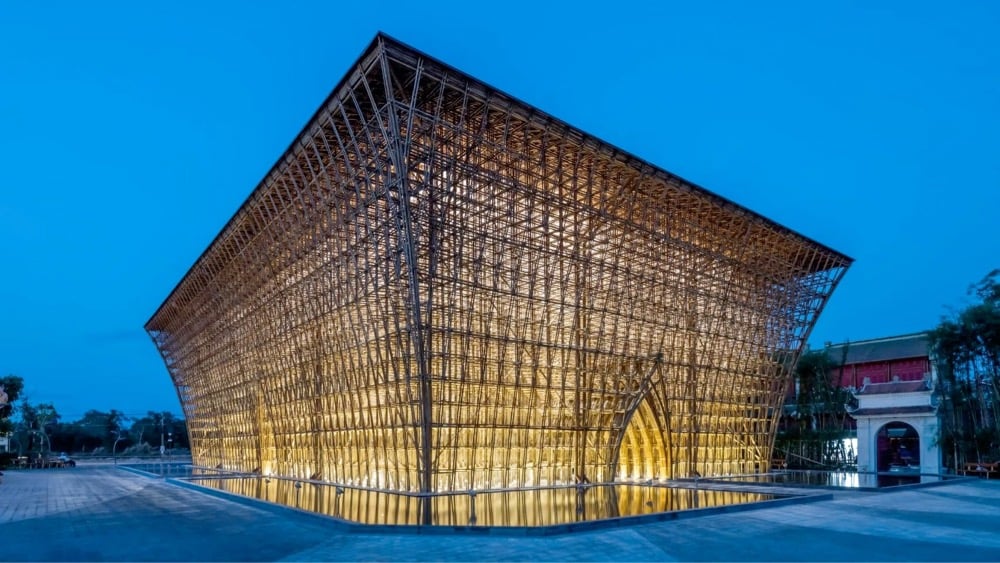
I researched different types of construction methods involving pile systems and realised that injection piles could probably be used to get the bacteria down into the sand -- a procedure that would be analogous to using an oversized 3D printer, solidifying parts of the dune as needed. The piles would be pushed through the dune surface and a first layer of bacteria spread out, solidifying an initial surface within the dune. They would then be pulled up, creating almost any conceivable (structurally sound) surface along their way, with the loose sand acting as a jig before being excavated to create the necessary voids.

This sounds more like sculpting or baking than architecture.

Gairville

In 1879, Brooklyn papermaker Robert Gair developed a process for mass producing foldable cardboard boxes. One of the paper-folding machines in his factory malfunctioned and sliced through the paper, leading Gair to the realization that cutting, creasing, and folding in the same series of steps could transform a flat piece of cardboard into a box.

Gair's invention made him a wealthy man and turned his company into an epicenter of manufacturing in Brooklyn. From Evan Osnos' New Yorker article about Chinese paper tycoon Cheung Yan:

Gair's box, a cheap, light alternative to wood, became "the swaddling clothes of our metropolitan civilization," Lewis Mumford wrote. Eventually, the National Biscuit Compnay introduced its first crackers that stayed crispy in a sealed paper box, and an avalanche of manufacturers followed. Gair expanded to ten buildings on the Brooklyn waterfront. Massive migration from Europe to the United States created a manufacturing workforce in Brooklyn, to curn out ale, coffee, soap, and Brillo pads -- and Gair made boxes right beside them.

Gair's concentrated collection of buildings eventually led the area between the Brooklyn and Manhattan Bridges to be called Gairville. That area is now known as Dumbo and, in addition to tons of residential space, the neighborhood is home not to manufacturing but to architecture firms, web companies, and other creative industries.

The Gair Company's most iconic building was also its last: the Clocktower Building, also known as Gair Building No. 7. I tracked down several of the other Gair buildings and put them on this Google Map.

Can you help fill in the holes? Email me with additions/corrections and I'll fill them in on the map. Thanks!

Update: I found a photo of some of the buildings that comprised Gairville on Google Books. The map has a couple of additions as well.

By Jason Kottke    Apr 6, 2009    architecture   cities   DUMBO   maps   NYC   robertgair

Found underground

A family in Porterville, California recently discovered that their new home has an unmapped addition. An underground lair.

They noticed what they suspected was a small sink hole at the corner of a concrete patio slab. As they checked on the hole, Edwards was pulling some weeds nearby.

"His foot just sunk," Barton said, "and that's when we thought we saw a dead body."

Turns out it wasn't a dead body, but some foam insulation. Beneath it, a large space. Everybody thinks it's a subterranean grow room. They're afraid their four-year-old son Ethan will want to play down there.

Also recently unearthed, tunnels belonging to crusaders were found under Malta. Unlike the marijuana-propagating sanctum, these structures are believed to have been designed to facilitate Crusades-era sanitation and to bolster the water supply for the Knights of Malta. Ethan, play here instead.

By Ainsley Drew    Mar 31, 2009    architecture   crime   news

More than meets the I-beam

The Prada Transformer building in Seoul was designed to accommodate events in the spheres of art, architecture, film, and fashion, and it does so in a wholly unusual way: the entire structure somersaults.

From the site's press release:

The Transformer combines the four sides of a tetrahedron: hexagon, cross, rectangle and circle into one pavilion. The building, entirely covered with a smooth elastic membrane, will be flipped using cranes, completely reconfiguring the visitor's experience with each new programme. Each side plan is precisely designed to organize a different event installation creating a building with four identities. Whenever one shape becomes the ground plan, the other three shapes become the walls and the ceiling defining the space, as well as referencing historic or anticipating future event configurations.

The building was designed by cranium-cracking architect Rem Koolhaas and the Office for Metropolitan Architecture. No word on whether the company that manufactures Dramamine was an investor.

[via Inhabitat]

From Porch to Patio

From Porch to Patio, a 1975 piece by Richard Thomas, discusses the transition in American society from the semi-public gathering place in front of a house to the private space in the back.

When a family member was on the porch it was possible to invite the passerby to stop and come onto the porch for extended conversation. The person on the porch was very much in control of this interaction, as the porch was seen as an extension of the living quarters of the family. Often, a hedge or fence separated the porch from the street or board sidewalk, providing a physical barrier for privacy, yet low enough to permit conversation.

When people started moving out to new buildings in the suburbs, the patio emerged to provide the privacy for these urban refugees.

The patio was an extension of the house, but far less public than the porch. It was easy to greet a stranger from the porch but exceedingly difficult to do so from the backyard patio. While the porch was designed in an era of slow movement, the patio is part of a world which places a premium on speed and ease of access. The father of a nineteenth-century family might stop on the porch on his way into the house, but the suburban man wishes to enter the house as rapidly as possible to accept the shelter that the house provides from the mass of people he may deal with all day.

(via front porch republic)

How to write like an architect

How to hand print letters like an architect (with a pen). It's a little different if you're using a pencil. (via rebecca's pocket)

A house floats near Brooklyn

Here's an unusual bit of NYC sightseeing for tomorrow morning. Between 7:30 and 8:30am tomorrow, a house designed by influential architect Robert Venturi will be floating under the Brooklyn Bridge.

In a bid to avoid the wrecking ball, Venturi's Lieb House is traveling by barge from the New Jersey coast to the north shore of Long Island. During the two-day trip, the house will journey through the Atlantic Ocean, across New York Harbor, up the East River, and into Long Island Sound -- a distance of about 75 miles, as the seagull flies.

The floating house will be shown in an upcoming documentary about Venturi, his wife, and their architectural practice. (thx, ed)

The Social Life of Small Urban Spaces

A tantalizing 10-minute clip of an hour-long video called The Social Life of Small Urban Spaces.

The clip shows an analysis of the plaza of the Seagram Building in NYC and what makes it so effective as a small urban space.

A busy place for some reason seems to be the most congenial kind of place if you want to be alone. [...] The number one activity is people looking at other people.

The video was adapted from a book of the same name by William H. Whyte, who is perhaps most well known as the author of The Organization Man. The video is largely out of print -- which is a shame because that clip was fascinating -- but I found a DVD copy for $95 (which price includes a license for public performance). (via migurski)

Form follows finance

When the money dries up, so too do the plans for tall buildings by big-name architects. In the late 1920s, a number of buildings in NYC were scrapped in the planning stage or built significantly lower than planned.

By Jason Kottke    Feb 24, 2009    architecture   cities   NYC

Bye bye Dubai

I didn't watch the clip he links to but I can't imagine anything is more entertaining than David Galbraith's scathing goodbye to Dubai. He opens with:

Short of opening a Radio Shack in an Amish town, Dubai is the world's worst business idea, and there isn't even any oil. Imagine proposing to build Vegas in a place where sex and drugs and rock and roll are an anathema. This is effectively the proposition that created Dubai - it was a stupid idea before the crash, and now it is dangerous.

What's the biggest problem with Dubai? It doesn't have the cultural bedrock needed to support a destination city.

It looks like Manhattan except that it isn't the place that made Mingus or Van Allen or Kerouac or Wolf or Warhol or Reed or Bernstein or any one of the 1001 other cultural icons from Bob Dylan to Dylan Thomas that form the core spirit of what is needed, in the absence of extreme toleration of vice, to infuse such edifices with purpose and create a self-sustaining culture that will prevent them crumbling into the empty desert that surrounds them.

One tiny apartment, dozens of rooms

Hong Kong architect Gary Chang has renovated his tiny apartment four times since he's owned it. The most recent renovation is called "The Domestic Transformer".

The wall units, which are suspended from steel tracks bolted into the ceiling, seem to float an inch above the reflective black granite floor. As they are shifted around, the apartment becomes all manner of spaces -- kitchen, library, laundry room, dressing room, a lounge with a hammock, an enclosed dining area and a wet bar.

Chang's Suitcase House uses many of the same principles as his apartment.

The height of Burj Dubai

Nobody knows how tall Burj Dubai is going to be when completed later this year, only that it will be the world's tallest building by a comfortable margin. Of the mystery height, the builder has only this to say:

If you put the Empire State Building on top of the Sears Tower then it's reasonable to say you'll be in the neighbourhood.

SkyscraperPage.com says it'll top out around 2650 feet...that's 550 feet shorter than the ESB + Sears but still more than half a mile. (via things magazine)

Passive houses

Passive houses -- homes that use "recycled heat" to heat themselves, rather than a furnace -- are growing more popular in Germany and slowly spreading elsewhere in the world.

The concept of the passive house, pioneered in this city of 140,000 outside Frankfurt, approaches the challenge from a different angle. Using ultrathick insulation and complex doors and windows, the architect engineers a home encased in an airtight shell, so that barely any heat escapes and barely any cold seeps in. That means a passive house can be warmed not only by the sun, but also by the heat from appliances and even from occupants' bodies.
Best architecture of 2008

Paul Goldberger, the New Yorker's architecture critic, lists his ten favorite buildings of 2008.

In time for the 2008 Olympics, the world saw the fruits of China's decision to put aside nationalism, hire the greatest architects from around the world, and let them do the kind of things they could never afford to do at home. That brought us two of the greatest buildings of the year, Herzog and de Meuron's extraordinary Olympic Stadium, the stunning steel latticework structure widely known as the Bird's Nest; and Norman Foster's Beijing Airport, a project that was not only bigger than any other airport in the world, but more beautiful, more logically laid out, and more quickly built. And the headquarters of CCTV, the Chinese television network, by Rem Koolhaas and Ole Scheeren, of the Office for Metropolitan Architecture -- a building which I had thought was going to be a pretentious piece of structural exhibitionism -- turned out to be a compelling and exciting piece of structural exhibitionism.

Big disagree on Eliasson's NYC waterfalls...they were underwhelming.

Libeskind's Met Life Tower plans

When I profiled the Metropolitan Life Tower (and an unusual postscript) a couple of months ago, I mentioned that Daniel Libeskind was working on an addition to the building that would dwarf the iconic clock tower. New York magazine has a rendering of what the building might look like, taken from the architect's new book.

Initial designs show a glass-curtained tube with cutaways spiraling up and around the facade to reveal segments of terraced verdure, like cultivated patches on the side of a steep alpine slope. "We didn't just fill up the tower," the architect says. "We've taken space away [from the apartments] to create the gardens," which are actually balconies tucked within the envelope. "It's as if nature has come back into the city," he says.

Update: More photos and details here.

Half-scale WTC tower in Oklahoma

The Bank of Oklahoma Building in Tulsa, Oklahoma is (nearly) a half-scale version of the World Trade Center towers. The building was designed by the WTC architect and completed just three years after the Twin Towers.

For the BOk building, Yamasaki reprised the scheme of a Twin Tower at almost exactly half the scale: 52 stories and 667 feet tall, to the Twin Towers' 110 floors (1,362 and 1,368 feet). It has 31 steel perimeter columns per side, to the Twin Towers' 59, producing the same eye-boggling vertical lines on each face. (As Jean Baudrillard noted of the more famous pair, well before its destruction, it is "blind," with no side presenting a facade.) The BOk, too, has a bilevel lobby, whose height is matched by arched windows. But the arches are big and round, like a child's plain wooden building blocks, rather than the Venetian Gothic ogees that, in the World Trade Center, flowed directly into the perimeter columns.

By Jason Kottke    Nov 26, 2008    architecture   NYC   oklahoma   wtc

Building bridges with rockets

The world's highest bridge, the Siduhe Grand Bridge, is nearing completion in China's Hubei province. The bridge is so high off the ground that the Empire State Building could fit under it with over 350 feet to spare. To get the initial cable from one tower to the next, the builders used precisely aimed rockets!

so you've erected the enormous towers on each side of the deep valley, deeper than any valley previously bridged. how do you get a pilot cable from one tower to the next? previous solutions have included: attaching the cable to a kite and flying it over (e.g. niagara falls suspension bridge), carrying one end by helicopter (e.g. akashi kaikyo bridge) and floating one end on a boat (e.g. brooklyn bridge). the brains behind the siduhe bridge decided to ignore all those options and break another record instead. they attached the 3200ft cables to rockets and accurately fired them over the valley, becoming the first people to do so.

Silver Towers get landmark status

Filed under things I really don't understand: Silver Towers/University Village, part of a residential superblock complex in Greenwich Village and designed by I.M. Pei, has been granted landmark status by New York City Landmarks Preservation Commission. Said the Greenwich Village Society for Historic Preservation, who battled to preserve the buildings:

Silver Towers is the first post-war urban renewal superblock development in New York City to be landmarked. While such urban renewal projects rarely receive high marks for design, Silver Towers is considered a watershed moment for one of the late 20th century's most respected and influential architects. The design won awards from the American Institute of Architects and the City Club, was dubbed "one of ten buildings that climax an era" by Fortune Magazine, and was cited as a basis for which Pei received the 1983 Pritzker Prize -- the most prestigious award for architects -- for his body of work up to that time. Landmarking Silver Towers not only helps preserve an eminently livable place and honors a great work of architecture, but it also acknowledges the importance of our city's past efforts to create affordable housing and public art.

These may or may not be great buildings, but that whole complex is just this big sucky void between the Village and Soho that no one can get rid of now. Blech.

By Jason Kottke    Nov 19, 2008    architecture   cities   impei   NYC

Ant architecture

It's worth sitting through the annoying "in a world..." narration to see the structure of an immense colony of ants. The scientists poured 10 tons of concrete down into an abandoned ant colony, waited for it to harden, and then spent weeks excavating the results.

During the construction of the giant structure, it's estimated that the ants hauled 40 tons of dirt out of the holes, the equivalent of building the Great Wall of China. (via cyn-c)

Update: The ant colony was not abandoned. Nice work, scientists!

By Jason Kottke    Nov 18, 2008    ants   architecture   science   video

Cool new Dutch coin

Matthew Dent's new coinage for the UK was pretty great, but this Dutch commemorative coin is a fully contemporary chunk of wow.

Dutch Coin

On the front, the names of famous Dutch architects form an image of the queen while some Dutch architecture books on the back form an outline of The Netherlands. The design was done using free software running on Ubuntu/Debian. (via design observer)

Photographic buildings

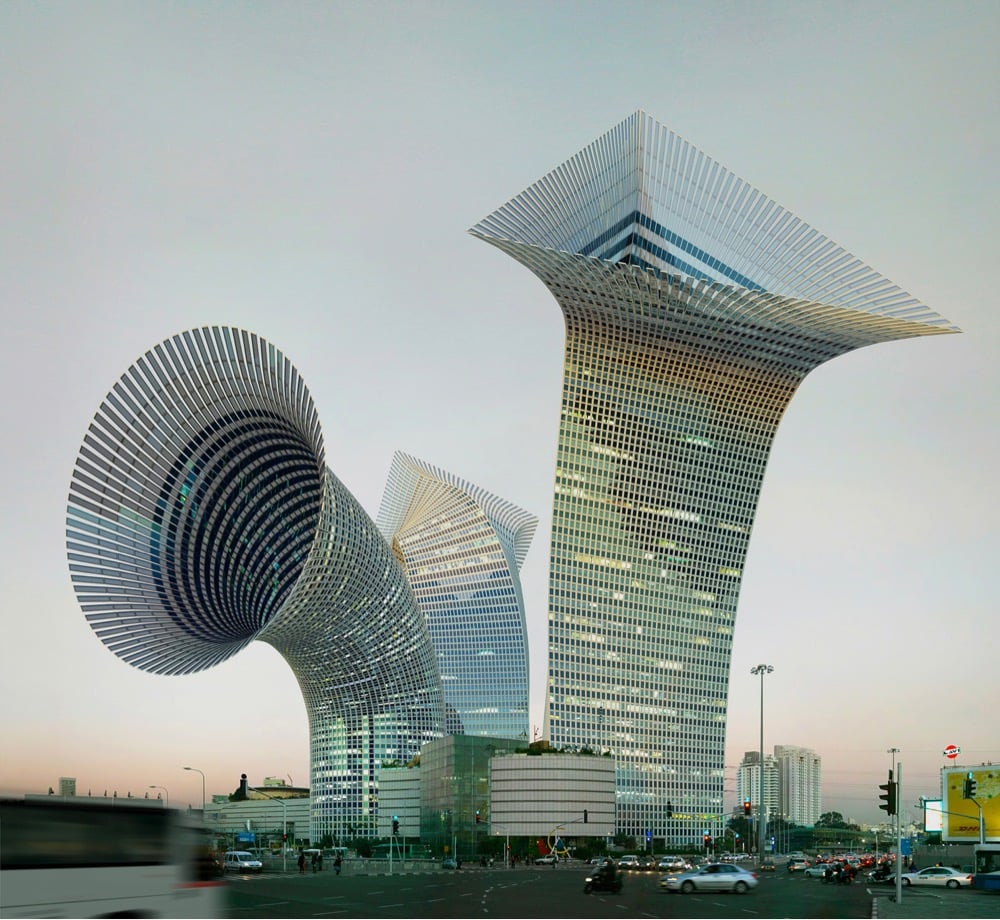
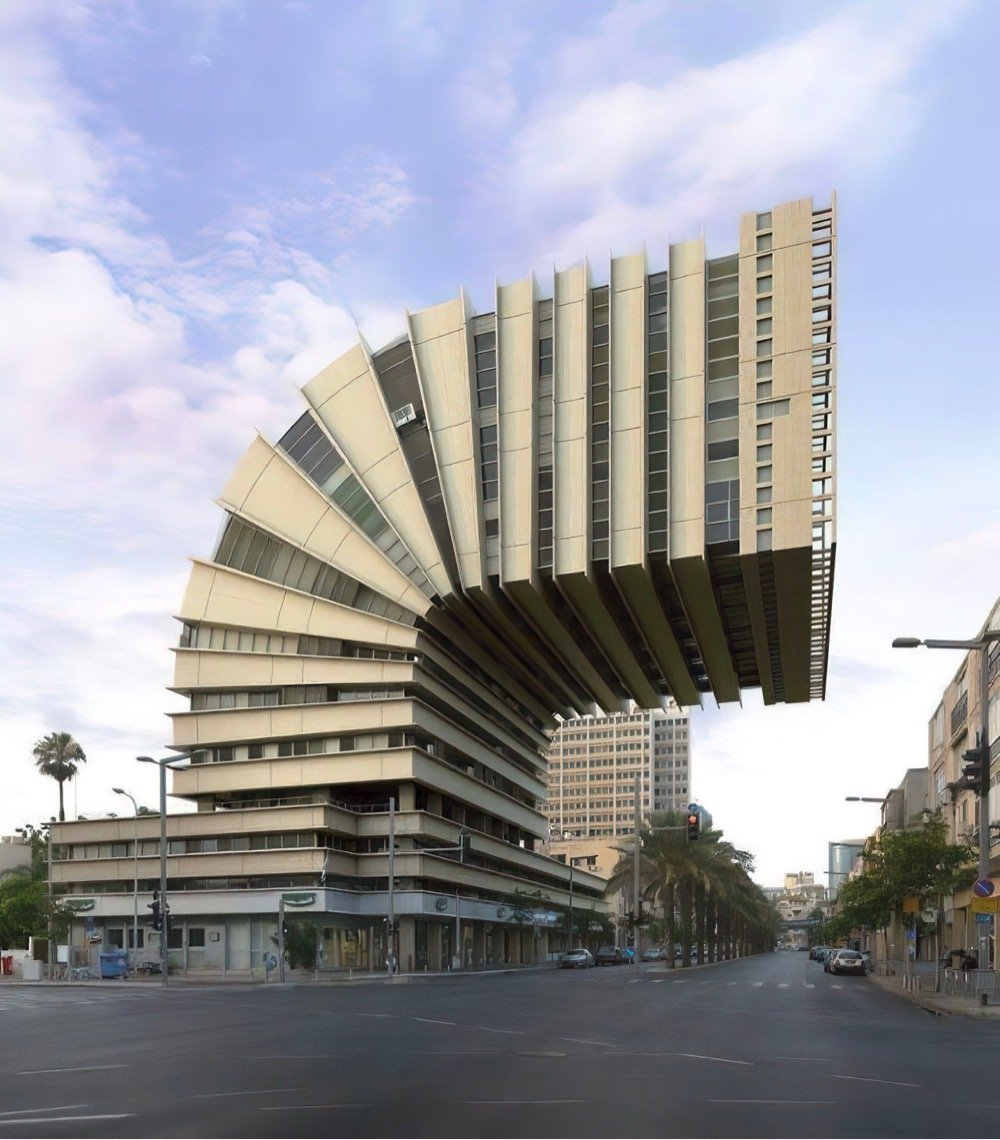
Filip Dujardin samples photos of buildings to create new photographs of improbable, impossible, or fantastical buildings.

Filip Dujardin

These are great.

Update: More fictional architecture, this time by Philipp Schaerer. (via today and tomorrow)

The completed Metropolitan Life Tower

Shorpy has posted a photo of the Metropolitan Life Tower taken in 1909, the year the building was completed. I recently wrote posts about the building and about an odd death that occurred there. (thx, finn)

Modulex: Legos for grown-ups

In the 1960s, the designer of the modern Lego brick formed a new company to make a product for adults called Modulex.

In the early 1960's Godtfred was building a new house and, naturally, he tried to model the structure with Lego bricks. The problem was that the Lego brick, with an aspect ratio of 6:5, was different than standard European construction modules of 1:1. Rather than contend with the problems of using regular Lego bricks he simply had new, special bricks molded for him. Bricks that would allow him to more closely copy his architectural plans.

The blocks were intended for use by architects. Reference Library has another look at these Legos for grown-ups. (via things)

The Metropolitan Life Tower

The Metropolitan Life Tower is located on the east side of Madison Square Park at 1 Madison Avenue. It has quietly become one of my favorite buildings in the city; I find myself peering up at it whenever I'm in the area. (I took a photo of the building while in line at the Shake Shack last spring...it's a lovely color in the late afternoon light.) Inspired by a photo posted recently to Shorpy that shows the tower under construction -- and before the addition of the building's iconic clock -- I did some research and discovered three things.

Metropolitan Life Building

One. Modeled after the bell tower of St. Mark's Basilica in Venice, the Metropolitan Life Tower was completed in 1909 and at 700 feet, it was the tallest building in the world until the Woolworth Building was completed four years later.

Two. The NY Times ran a story in December 1907 about the eventual completion of the structure and how it would take over as the world's tallest building, surpassing another then-unfinished building, the Singer Tower. In the era before widely available air travel, the building's vantage point was remarkable.

The view from the top was of a new New York. No other skyscrapers obstructed the vista in either direction. Passing the green roof of the Flatiron Building, the gaze literally spanned the Jersey City Heights and rested on Newark and towns on the Orange Mountains, fifteen miles away.

To the southward the skyscrapers bulked like a range of hills in steel and mortar, the Singer tower rising in the midst, a solitary watch tower on a peak. This hid the harbor, but to the left beyond the bridges, reduced at this height to gray cobwebs, the eye caught the sunlight on the sea -- a long strip of shimmering silver beyond Coney Island and the Rockaways.

Three. Star architect Daniel Libeskind is allegedly working on an addition to the Metropolitan Life Building, an addition that by some accounts would reach 70 stories. You can guess how I feel about the prospect of one of those residential glass monstrosities literally and emotionally dwarfing the existing 50-story clock tower, Libeskind or no. Of course, the Metropolitan Life Tower may never have become so iconic had Metropolitan Life's plans for a 100-story tower one block north not been scrapped because of the Great Depression. They only finished 32 floors of that building, which today houses the celebrated restaurant, Eleven Madison Park.

NYC buildings that should go

NY Times architecture critic Nicolai Ouroussoff chooses a list of NYC buildings that are so bad they should be torn down to make way for other possibilities.

So the list will not include affronts that are merely aesthetic. To be included, buildings must either exhibit a total disregard for their surrounding context or destroy a beloved vista. Removing them would make room for the spirit to breathe again and open up new imaginative possibilities.

Penn Station, Madison Square Garden, and the Javits Center are deservedly included.

The recent architectural development of NYC

Not sure I agree with all of it, but New York magazine's interesting piece about all the new development that has been going on in NYC for the past few years is certainly worth a read.

In the last 25 years, the city's population has increased by a million people, and another million will be here 25 years from now. The question is not whether to make room for them but how. We could, in theory, rope off most of Manhattan to new development and push new arrivals to the city's fringes. Had we done that years ago, we would have created a museum of shabbiness. Even doing so now would keep the city in a state of embalmed picturesqueness and let the cost of scarce space climb to even loonier heights than it already has. In its 43-year existence, the Landmarks Preservation Commission has tucked more than 25,000 buildings under its protective wing, which seems about right. Protect every tenement, and eventually millionaires can no longer afford them.

If you can't take all the text, read it Playboy-style...there are over fifty great before-and-after photos of various new buildings around town, just keep scrolling down.

By Jason Kottke    Sep 12, 2008    architecture   cities   NYC

Rich people rooftops NYC

A photo series of some elaborate roof decks and gardens in NYC. (thx, rob)

How Buildings Learn TV series

In 1997, the BBC aired a three-hour documentary based on Stewart Brand's book, How Buildings Learn. Brand has posted the whole program on Google Video in six 30-minute parts: part one, part two, part three, part four, part five, part six.

If you're hesitant about whether to watch the series or not, check out this two-minute appetizer of perhaps the meatiest tidbit in the book: the oak beam replacement plan for the dining hall of New College, Oxford. (via smashing telly)

Update: An old version of the New College web site says that the oaks were not planted specifically for the replacement of the ceiling beams even though they were used for that purpose. (thx, emily, david, and phil)

221B Baker Street

Overhead view of 221B Baker St, the fictional abode of Sherlock Holmes. An annotated version is available. The address didn't exist when Doyle wrote the Holmes stories but after the extension of Baker St, a building close to where that address would be started to get a lot of mail addressed to Holmes.

Almost immediately, the building society started receiving correspondence to Sherlock Holmes from all over the world, in such volumes that it appointed a permanent "secretary to Sherlock Holmes" to deal with it. A bronze plaque on the front of Abbey House carries a picture of Holmes and Conan Doyle's narrative detailing Holmes and Watson moving in at 221B.

Algorithmic architecture

Here's a video detailing the algorithmic architectural technique used to design a hotel in New Zealand. The program spits out ~18,000 possible solutions, of which one is chosen. The video notes that the final solution is implausible but that improvement could be made by using the best solutions to generate better offspring. (via smashing telly)

Harley-Davidson Museum

The new Harley-Davidson Museum in Milwaukee looks pretty nice.

The museum sits on a twenty-acre reclaimed industrial site directly across the Menomonee River from downtown Milwaukee and has been conceived as an urban factory ready-made for spontaneous motorcycle rallies. The three-building campus includes space for permanent and temporary exhibitions, the company's archives, a restaurant and cafe, and a retail shop, as well as a generous amount of event and waterfront recreational space. The museum's indoor and outdoor components were inspired by the spirit of Harley rallies in towns like Sturgis and Laconia, where thousands of riders congregate every year.

High Line park news

Two bits of news about the High Line and its impending park.

1. Curbed has new renderings of what the park is going to look like. Here's phase 1 (Gansevoort St. to 20th) and phase 2 (21st to 30th). They're calling it a park but from the drawings it seems more like a glorified sidewalk.

2. Photos of the High Line taken last weekend show how much progress is being made on construction.

Architecture scavenger hunt

A wonderful story about how an architect took it upon himself to build a scavenger hunt into one of his client's apartments, all without telling them.

Finally, one day last fall, more than a year after they moved in, Mr. Klinsky received a letter in the mail containing a poem that began:

We've taken liberties with Yeats
to lead you through a tale
that tells of most inspired fates
iin hopes to lift the veil.

The letter directed the family to a hidden panel in the front hall that contained a beautifully bound and printed book, Ms. Bensko's opus. The book led them on a scavenger hunt through their own apartment.

And it wasn't an easy hunt either.

In any case, the finale involved, in part, removing decorative door knockers from two hallway panels, which fit together to make a crank, which in turn opened hidden panels in a credenza in the dining room, which displayed multiple keys and keyholes, which, when the correct ones were used, yielded drawers containing acrylic letters and a table-size cloth imprinted with the beginnings of a crossword puzzle, the answers to which led to one of the rectangular panels lining the tiny den, which concealed a chamfered magnetic cube, which could be used to open the 24 remaining panels, revealing, in large type, the poem written by Mr. Klinsky.

(thx, john)

Chicago Spire

The stunning Calatrava-designed Chicago Spire is due to be completed in 2011 and will, ahem, tower over the Sears Tower by more than 500 feet. Check out the view from the 140th floor.

High Line construction progress

Curbed has some photos of the construction progress on the High Line. Compare and contrast with some photos I took in early 2004.

Alpine camping gear

BLDGBLOG on the architecture of alpine camping gear.

Viewed architecturally, these examples of high-tech camping gear -- capable of housing small groups of people on the vertical sides of cliffs, as if bolted into the sky -- begin to look like something dreamed up by Archigram: nomadic, modular, and easy to assemble even in wildly non-urban circumstances. This is tactical gear for the spatial expansion of private leisure.

Don't miss the gorgeous accompanying graphic.

Mukesh Ambani's expensive house

Mukesh Ambani, the fifth richest man in the world, is building the most expensive single family residence ever, a $2 billion -- yes, BILLION -- 27-story skyscraper in downtown Mumbai.

Atop six stories of parking lots, Antilla's living quarters begin at a lobby with nine elevators, as well as several storage rooms and lounges. Down dual stairways with silver-covered railings is a large ballroom with 80% of its ceiling covered in crystal chandeliers. It features a retractable showcase for pieces of art, a mount of LCD monitors and embedded speakers, as well as stages for entertainment. The hall opens to an indoor/outdoor bar, green rooms, powder rooms and allows access to a nearby "entourage room" for security guards and assistants to relax.

Photos here. In fairness, the place sounds like a combination corporate HQ with an incorporated family living space, but still. Not noted in the article is the expensive laboratory-grade scanning electron microscope that Ambani uses to locate his teensy penis, for which the 27-story house is compensation.

BLDGBLOG has some photos of luxury hotels

BLDGBLOG has some photos of luxury hotels that were abandoned mid-building.

With images by Sabine Haubitz and Stefanie Zoche of Haubitz+Zoche, the show looks at "the concrete skeletons of five-star hotel complexes" abandoned on Egypt's Sinai Peninsula. They are resorts that never quite happened, then, with names like Sultan's Palace and the Magic Life Imperial. This makes them "monuments to failed investment."

Four chefs talk about how their kitchens

Four chefs talk about how their kitchens are laid out in this month's Metropolis. Here's Dan Barber talking about his role at Blue Hill at Stone Barns:

At the same time, I don't think the cooks look at me as a real community member. I'm not that cozy paternal figure. I'm always doing different things, and it creates this atmosphere where the cooks are on the balls of their feet. They're thinking, Where's he going next, what's happening next? There's a little bit of confusion. I think that's good. It's hard to articulate, because you think of the kitchen as very organized; and, like I said, the more control you have, the better. But a little bit of chaos creates tension. And that creates energy and passion, and it tends to make you season something the right way or reach for something that would add this, that, or the other thing.

The other chefs are Alice Waters, Grant Achatz, and Wylie Dufresne. The one thing they all talked about is the importance of open sight lines, both between the dining room and kitchen and among the chefs in the kitchen.

Princeton Architectural Press is offering a most

Princeton Architectural Press is offering a most unusual publication called Materials Monthly. Each month or so, a small box arrives on your doorstep containing not just a printed magazine about architecturally interesting materials but samples of the materials themselves, including fabric swatches, tiles, wallpaper, glass, and steel. Dan Hill recently received his issue and has a nice review and unboxing.

Benoit Mandelbrot and Paola Antonelli talk about,

Benoit Mandelbrot and Paola Antonelli talk about, among other things, fractals, self-similarity in architecture, algorithms that could specify the creation of entire cities, visual mathematics, and generalists.

This has been for me an extraordinary pleasure because it means a certain misuse of Euclid is dead. Now, of course, I think that Euclid is marvelous, he produced one of the masterpieces of the human mind. But it was not meant to be used as a textbook by millions of students century after century. It was meant for a very small community of mathematicians who were describing their works to one another. It's a very complicated, very interesting book which I admire greatly. But to force beginners into a mathematics in this particular style was a decision taken by teachers and forced upon society. I don't feel that Euclid is the way to start learning mathematics. Learning mathematics should begin by learning the geometry of mountains, of humans. In a certain sense, the geometry of...well, of Mother Nature, and also of buildings, of great architecture.

Cutaway drawings of the interiors of various

Cutaway drawings of the interiors of various Star Trek starship bridges. (via ffffound)

The Navy Federal Credit Union has embraced

The Navy Federal Credit Union has embraced green architecture, but not for any of the usual reasons.

"You've been asking for data," Ebbesen says to me. "Well, we definitely have energy savings: we've had one study that said 25 percent and another that said 40 percent. We pay a lot of attention to the energy model because we want to be efficient, because that leads to less pollution. But that's not where the savings are. The savings are all related to productivity." Navy Federal's wealth (they don't exactly have trouble getting long-term financing) means that Ebbesen could swallow higher up-front costs if it means a longer life span-and indeed this building is designed for a 40-year cycle (generous for its type). But to be conservative he sticks to 30 years for the following calculation: over that time 92 percent of the organ-ization's costs goes to employees, 6 percent go to maintenance and operation, and a mere 2 percent are represented by the initial construction investment. "When I show that on a slide," Ebbesen says, "it's kind of like, 'Duh, now are you paying attention?'"

With their new environmentally friendly buildings, Navy Federal has reduced their annual employee turnover rate from 60% to 17%.

Eiffel Tower to get flowery-looking viewing stand

Eiffel Tower to get flowery-looking viewing stand glomed onto the top of it.

The design is already causing controversy, with critics questioning the wisdom of tinkering with the famous silhouette and spending money on upgrading a tourist attraction which attracts 6.9 million visitors a year.

(via spurgeonblog)

Update: The architect who submitted the above design says that it was an unsolicited "spontaneous design". (thx, tim)

David Serero, principal of Serero Architects, said in a telephone interview that his firm's proposal was merely a spontaneous design it had submitted to the Eiffel Tower management group in view of the tower's approaching 120th anniversary and, he said, was neither a response to a design competition nor solicited by the tower's management.

Update: Here are the "spontaneous designs" done by Serero.

Forgotten Architects.

Forgotten Architects.

Nearly 500 Jewish architects were working in Germany before 1933; today the fate of most of them is unknown. Following is a look at 43 of these architects whose groundbreaking work is sadly forgotten.

Here's some context about the project.

Photo slideshow of an architecture office fashioned

Photo slideshow of an architecture office fashioned out of the rusted carcass of an auto repair shop.

A thoughtful memorandum from the archives of

A thoughtful memorandum from the archives of the RAND Corporation as they contemplated designing a new building for the optimal accomplishment of work in 1950.

This implies that it should be easy and painless to get from one point to another in the building; it should even promote chance meetings of people. A formal call by Mr. X on Mr. Y is the only way X and Y can develop such a tender thing as an idea -- the social scientists have taught me to use X and Y in that bawdy manner. If the interoffice distances are to be kept reasonable, the building must be compact. It need not be circular; a square is often a good substitute for a circle, and even a rectangle is not bad, if the aspect ratio does not get out of hand.

The memo's author even gets into lattice theory in attempting to keep inter-office travel times down. As a contemporary example, Pixar's office in Emeryville was designed to bring the company's employees randomly together during the day:

I was the first person from the group of journalists to arrive, giving me plenty of time to look around the lobby, which is actually a gigantic football-field length atrium, the centerpiece of the entire building.

As it was explained to me later, Steve Jobs originally proposed a building with one bathroom, something that would drive foot traffic to a central area all day long. Obviously, they've got more than one bathroom in the building, but just standing there and watching as everyone arrived to start their day, it was obvious that Jobs had managed the feat.

The mailboxes, the employee cafe, and the common room where all the games are all open into that atrium, and people lingered, talking, exchanging ideas and discussing the various projects they're working on. It seemed like a fertile, creative environment, and I felt like Charlie Bucket holding a golden ticket as I examined the larger-than-life Incredibles statues in the center of the atrium and the concept paintings hung on the walls.

(thx, jean-paul)

By Jason Kottke    Mar 10, 2008    architecture   Pixar   rand   working

Build your own Apple Store. Oobject tracked

Build your own Apple Store. Oobject tracked down the materials, furniture, fixtures, and finishes used in the Apple Stores, giving anyone enough information to turn their living room into one.

By Jason Kottke    Jan 24, 2008    Apple   architecture   design   oobject

White House Redux is a contest to

White House Redux is a contest to design a new residence for the President of the United States. First prize is $5000 and a free trip to NYC. A fine jury too. (via bldgblog)

The mathematics of well-balanced stacks of blocks.

The mathematics of well-balanced stacks of blocks. When I was a kid, I would make stacks like these for hours on end...constructing buildings was dull in comparison.

The Past: Buried Above Us

BLDGBLOG has a fantastic post on the interconnected mountain fortifications used by the Austrians and Italians in World War One. If you thought the Maginot Line was insane, wait until you see this. Geoff Manaugh's write-up is as smart as the mountain trenches were crazy:

...the idea of the Alps being riddled with manmade caves and passages, with bunkers and tunnels, bristling with military architecture, even self-connected peak to peak by fortified bridges, the Great Moutain Wall of Northern Italy, architecture literally become mountainous, piled higher and higher upon itself forming new artificial peaks looking down on the fields and cities of Europe, that just fascinates me—not to mention the idea that you could travel up, and thus go futher into history, discovering that the past has been buried above you, the geography of time topologically inverted.

Also: great to see that BLDGBLOG has a book coming out—not so great that we have to wait until 2009.

(via Cosma Shalizi)

A visual history of giant spheres.

A visual history of giant spheres.

1850: Baron Haussmann and engineer Eugene Belgrand design the modern Paris sewer system.The sewers are regularly cleaned using large wooden spheres just smaller than the system's tubular tunnels. The buildup of water pressure behind the balls forces them through the tunnel network until they emerge somewhere downstream pushing a mass of filthy sludge.

(via i like)

BLDGBLOG talks with experimental architect Lebbeus Woods

BLDGBLOG talks with experimental architect Lebbeus Woods about his work, starting with an image he made of Manhattan with dams on the Hudson and East Rivers, which reveals a deep canyon between lower Manhattan and Brooklyn.

The Most Beautiful House in the World by Witold Rybczynski

The Most Beautiful House in the World

In a short post yesterday about where writers do their business, I mentioned that Witold Rybczynski had written about the writing room of a famous author that was purposely set away from the rest of his house. I grabbed my copy of The Most Beautiful House in the World off the shelf just now and found that I'd turned down the page containing the relevant passage back when I read the book a few years ago. The author I was thinking of was George Bernard Shaw; here is Rybczynski's description of his writing room:

But Shaw too was a builder, and the writing room that he erected in his garden was a Shavian combination of simplicity, convenience, and novelty. He called it "the Shelter," but it was really a shed, only eight feet square. It contained the essentials of the writer's trade -- a plank desk, an electric lamp, a wicker chair, a bookcase, and a wastepaper basket. Beside the desk was a shelf for his Remington portable -- like [Samuel] Clemens, Shaw was an early amateur of the typewriter. There was also a telephone (modified to refuse incoming calls), a thermometer, and an alarm clock (to remind him when it was time for lunch).

Shaw's writing hut had one other curious feature: the entire building was mounted on a pipe so that it could be rotated to take advantage of the sun's warmth at different times of the day. But the tiny building was so loaded down with books and furniture that the feature was probably never used. Pictures and more on Shaw's writing hut at BBC News, the National Trust, and Cool Tools.

Rybczynski also mentions that Samuel Clemens wrote most often in a hilltop gazebo he'd constructed for that purpose away from his luxurious house..

The Guardian has an extensive list of

The Guardian has an extensive list of writers and the rooms in which they write (with photos and descriptions by the authors). For whatever reason, I became very interested in writers' rooms after reading Witold Rybczynski's The Most Beautiful House in the World, in which he describes several rooms built by writers specifically for working in, including one author who built a completely separate room apart from his house which combined his need for solitude with a short commute. (thx, youngna)

Meant to post about this last week,

Meant to post about this last week, but going on right now in NYC: Postopolis. "Postopolis! is a five-day event of near-continuous conversation about architecture, urbanism, landscape, and design. Four bloggers, from four different cities, will host a series of live discussions, interviews, slideshows, panels, talks, and other presentations, and fuse the informal energy and interdisciplinary approach of the architectural blogosphere with the immediacy of face to face interaction." More about the event from City of Sound and BLDGBLOG.

Last 100 posts, part 8

Here are some updates on some of the topics, links, ideas, posts, people, etc. that have appeared on kottke.org recently (previous installment is here):

The Celluloid Skyline exhibition at Grand Central is well worth checking out...I was up there this past weekend. Pentagram collaborated with Saunders on the exhibit and wrote up a brief piece on how it came together.

My short post on Nina Planck's reaction to the recent "death by veganism", as she calls it, of a baby boy is a good reminder that I don't always agree with the things I link to. My only criteria for posting a link is that it's interesting, whether I think it's right or wrong or am still trying to form an opinion about it. Anyway, I got lots of mail about this one, much of it that said that the parents' veganism was beside the point -- which the prosecutors and jury in the subsequent criminal case agreed with (thx, matt) -- and that a headline like "Death By Stupidity" was probably more appropriate. After all, you don't see "Death by Omnivorism" headlines every time a baby with a more traditional diet dies of starvation.

Debra from Culiblog pointed out that contrary to Planck's assertion that "there are no vegan societies", the Jainists practice vegetarianism and veganism. On the other side of the aisle, meat fan Michael Ruhlman chastised Planck for going too easy on vegans, saying that "Veganism is a colossal arrogance, a refusal to admit to our own nature, a denial of our humanity. Sometimes it kills people. And it's not very much fun, besides." You can imagine the discussion that generated...although it was nothing like the 300+ comment thread on MetaFilter.

My opinion of Cars improved with a second viewing.

Discover's chat bot conversation reminded a reader of this old interview with the Ask Jeeves search engine (thx david). Back in 2002, I interviewed ELLEGirl magazine's AIMbot:

jkottke: Do you do anything to celebrate or recognize the changing of seasons?
ELLEgirlBuddy: do you do anything to celebrate or recognize the changing of seasons? that's a tough choice.
jkottke: yes, to celebrate or merely recognize. that is a toughie.
ELLEgirlBuddy: yes to celebrate or merely recognize that is a toughie? i dunno.
jkottke: you seem like an actual 13 year old girl.
ELLEgirlBuddy: i haven't really made a decision 'bout that.
jkottke: growing up is tough, isn't it?
ELLEgirlBuddy: i dunno.

And whoever posted the chat bot story to Digg (5696 Diggs and counting!) used the exact wording from my original post. You're welcome!

Prime, David Burke's quarter-million-dollar Black Angus bull, has his own web site. (thx, brian)

Regarding Alex Reisner's excellent baseball statistics web site and, in particular, the pennant race graphs, here's another interesting visualization of the pennant races...you can see the teams race to the end of the year like horses. (thx, scott)

Re: my post on better living through self-deception, I've heard that pregnant women tend to forget the pain of childbirth, perhaps because "endorphins reduce the amount of information trauma victims can store". Also related tangetially is this article on research into lying and laughing, which includes this simple test to see if you're a good liar:

Are you a good liar? Most people think that they are, but in reality there are big differences in how well we can pull the wool over the eyes of others. There is a very simple test that can help determine your ability to lie. Using the first finger of your dominant hand, draw a capital letter Q on your forehead.

Some people draw the letter Q in such a way that they themselves can read it. That is, they place the tail of the Q on the right-hand side of their forehead. Other people draw the letter in a way that can be read by someone facing them, with the tail of the Q on the left side of their forehead. This quick test provides a rough measure of a concept known as "self-monitoring". High self-monitors tend to draw the letter Q in a way in which it could be seen by someone facing them. Low self-monitors tend to draw the letter Q in a way in which it could be read by themselves.

High self-monitors tend to be concerned with how other people see them. They are happy being the centre of attention, can easily adapt their behaviour to suit the situation in which they find themselves, and are skilled at manipulating the way in which others see them. As a result, they tend to be good at lying. In contrast, low self-monitors come across as being the "same person" in different situations. Their behaviour is guided more by their inner feelings and values, and they are less aware of their impact on those around them. They also tend to lie less in life, and so not be so skilled at deceit.

The skyscraper with one floor isn't exactly a new idea. Rem Koolhaas won a competition to build two libraries in France with one spiraling floor in 1992 (thx, mike). Of course, there's the Guggenheim in NYC and many parking garages.

After posting a brief piece on Baltimore last week, I discovered that several of my readers are current or former residents of Charm City...or at least have an interest in it. Armin sent along the Renaming Baltimore project...possible names are Domino, Maryland and Lessismore. A Baltimore Sun article on the Baltimore Youth Lacrosse League published shortly after my post also referenced the idea of "Two Baltimores. Two cities in one." The Wire's many juxtapositions of the "old" and "new" Baltimore are evident to viewers of the series. Meanwhile, Mobtown Shank took a look at the crime statistics for Baltimore and noted that crime has actually decreased more than 40% from 1999 to 2005. (thx, fred)

Cognitive Daily took an informal poll and found that fewer than half the respondants worked a standard 8-5 Mon-Fri schedule. Maybe that's why the streets and coffeeshops aren't empty during the workday.

The BLDGBLOG book will likely be as

The BLDGBLOG book will likely be as interesting as the BLDGBLOG blog. Topics will include "plate tectonics and J.G. Ballard to geomagnetic harddrives and undiscovered New York bedrooms, by way of offshore oil derricks, airborne utopias, wind power, inflatable cathedrals, statue disease, science fiction and the city, pedestrianization schemes, architecture and the near-death experience, Scottish archaeology, green roofs..."

Architecture idea: a skyscraper with a single

Architecture idea: a skyscraper with a single floor. See also the tower to be built in Dubai where every floor rotates.

Map of the cracks in the Guggenheim's

Map of the cracks in the Guggenheim's facade. "Since the Guggenheim Museum opened in 1959, Frank Lloyd Wright's massive spiral facade has been showing signs of cracking, mainly from seasonal temperature fluctuations that cause the concrete walls, built without expansion joints, to contract and expand."

Video of the inside and outside of

Video of the inside and outside of the just-completed new IAC headquarters. Building by Frank Gehry, his first in NYC. (via zach)

By Jason Kottke    Apr 4, 2007    architecture   frankgehry   iac   NYC

The McMansion page on Wikipedia is surprisingly

The McMansion page on Wikipedia is surprisingly detailed. Other terms for a McMansion include Faux Chateau, Frankenhouse, Starter Castle, and Parachute Home. The Lawyer Foyer refers to "the two-story entry space typically found on many McMansions which is meant to be visually overwhelming but which contributes little to the useful space of the house".

Things Magazine reports on The Pentominium, a 1670

Things Magazine reports on The Pentominium, a 1670-foot luxury residential building planned for construction in Dubai. "The building's concept (penthouse + condominium, you see) means that each apartment spans an entire floor, meaning that chance meetings with the other occupants, save in the blinding lobby areas, are out of the question."

For the past five years, artist Jackie

For the past five years, artist Jackie Sumell has been helping Herman Wallace, who has been in solitary confinement at the Louisiana State Penitentiary for the last 34 years, design his dream house, a house that will probably never be built. "Traces of a prison mindset crop up. When the placement of his computer meant his back would face the office door, Ms. Sumell said that he asked that a mirror be installed above, so he could see anyone entering the room. A sense of security is important to him, she explained. The master bedroom sits safely above the very center of the house. A wraparound porch adds a layer of perimeter, as does the surrounding garden. There is even a special door leading to an underground bunker, equipped with its own water supply." A book on the project is available for a $20 donation and this PDF gives a good overview of the project.

By Jason Kottke    Mar 11, 2007    architecture   art   books   prision

BLDGBLOG is teaming up with Materials &

BLDGBLOG is teaming up with Materials & Applications to curate an architectural film festival. "The obvious caveat is that your film has to be about architecture, landscape, and/or the built environment - or, at least, it has to involve architecture, landscape, and/or the built environment, and in a way that isn't just backdrop. Even more specifically, we'd love to show a whole bunch of architectural machinima, site animations, project fly-throughs, or other cinematic spaces." Entry deadline in April 6.

In 1940, an ultra orthodox Jewish group known

In 1940, an ultra orthodox Jewish group known as the Lubavitchers bought a building at 770 Eastern Parkway in Brooklyn. The building became so well-known and revered within the community that other "770s" have been built around the world and subsequently captured by photographers Andrea Robbins and Max Becher. (via paks)

A list of the ugliest buildings in

A list of the ugliest buildings in NYC as determined by a bunch of architects and the like.

By Jason Kottke    Feb 28, 2007    architecture   cities   NYC

A bunch of really uncomfortable women's shoes.

A bunch of really uncomfortable women's shoes. These are almost architecture, not fashion. (via ahhhhhh!!!!)

Photography of Tin Tabernacles and Other Buildings

Photography of Tin Tabernacles and Other Buildings by Alasdair Ogilvie. "Largely unnoticed and ignored, corrugated iron buildings can be discovered scattered across Britain and the Empire. [...] With not existing infrastructures, these newly created communities had an urgent need for churches, chapels and schools. Corrugated iron buildings fulfilled this demand." More photos at Ogilvie's site.

Two structural engineers pick their ten favorite man-made structures.

Two structural engineers pick their ten favorite man-made structures.

For the Designing the City of the

For the Designing the City of the Future contest held by the History Channel, New York-based architecture firm ARO developed "a vision of New York recovering from massive flooding in low lying areas of New York as a result of global warming". Photos of their entry are available on Flickr. "In order to co-exist with fluctuating sea levels, ARO proposed a new building type called a 'vane.' Part skyscraper, part viaduct, 'vanes' are built in, on, and over flooded streets, reconnecting to the classic street grid and making up for lost square footage."

Hong Kong architect Gary Chang travels so

Hong Kong architect Gary Chang travels so often that he's become an expert hotel enthusiast. I spoke with Gary at Ars Electronica this year; he showed me some of his drawings and photos (he extensively documents his hotel stays in the form of photos and hand-drawn floor plans)...really cool. Chang's Suitcase House is also worth a look.

Pruned takes us on a short tour

Pruned takes us on a short tour of grain elevators. Wonderful old industrial buildings...the small town I grew up in had a huge grain elevator rising from the center of town, like a skyscraper in a cornfield.

Hot new architecture trend: installing secret rooms

Hot new architecture trend: installing secret rooms in your home. "I always wanted one since watching Scooby-Doo way back when." (via bb)

Witold Rybczynski on the problem with underground

Witold Rybczynski on the problem with underground architecture...it's not the seamless hidden-away experience that one might think.

The Mill City Museum

In 1965, the Washburn A mill, the last operating flour mill in Minneapolis, became also the last flour mill to close its doors, having been preceded by an entire industry that, at one time, produced more flour than any other place in the U.S. The closure came when the mill's operating company, General Mills, moved its headquarters to Golden Valley, where real estate was plentiful and inexpensive. The area around St. Anthony Falls, the geological feature responsible for the beginnings of industry in the area, had long since fallen into general disrepair and it wasn't long before the Washburn A was deserted and inhabited by the homeless.

The area started to show signs of life again in the 70s and 80s after being added to the National Register of Historic Places in 1971. Old mill buildings were converted for non-industrial business and residential use as people began to recognize the unique character and history of the area around the falls. In 1991, the Washburn A building burned and part of its structure collapsed, but firefighters saved the rest of the historic building from destruction. The remnants of the building and the adjacent grain elevators remained empty for years afterwards, save for the occasional graffiti artist and urban spelunker.

I knew very little of this when I moved to the Twin Cities in 1996 and not much more when I left Minneapolis for San Francisco in 2000. Almost every weekday for two years I drove or pedaled past the shell of the Washburn A mill on the way to and from work on Washington Avenue in the warehouse district, where we manufactured web pages to fill a growing online space. Topped by the Gold Medal Flour sign, the mill became my favorite building in the Twin Cities, leading me to include it in The Minneapolis Sign Project I did for 0sil8 shortly before I left for the West Coast.

Gold Medal Flour sign on the grain elevators next to the Washburn A Mill, Minneapolis, MN

It seemed the perfect symbol of a time and industry long past, broken down but not entirely wiped away. I returned to visit Minneapolis occasionally and would drive past the Falls, wondering what would happen to my building, hoping against hope that they wouldn't eventually tear it down. With the structure in such bad shape, demolition seemed to be the only option.

Last week, Meg and I spent a day in Minneapolis on our way to visit my parents in Wisconsin, my first stay in Mpls since mid-2002. Meg wanted to investigate running trails and I wanted to sneak a peek at the Gold Medal Flour Building (as I had taken to calling it), so we walked the three blocks to the river from our hotel, housed in the former Milwaukee Depot. The Gold Medal Flour sign was visible from several blocks away, so I knew they hadn't torn down the grain elevators, but it wasn't until I saw the shell of the Washburn A building peeking out around one of the other mill buildings that I knew it had been spared as well. As more of the building came into view, I saw a glass elevator rising from the ruins, backed by a glass facade.

What the??!?

Now practically running along the river in excitement and bewilderment, dragging poor Meg along with me in a preview of her jog the next morning, I saw a wooden boardwalk in front of the building and headed for what looked like the entrance. The burned out windows and broken glass remained; except for the elevator and the 8-story glass building sticking out the top, it looked much the same as it had after burning in 1991. I scrambled through the entrance and, lo, the Mill City Museum.

Mill City Museum

And what a museum. It was just closing when we got there, but we returned the next morning for a full tour of the museum and the Mill Ruins Park. The highlight of the museum is an elevator tour of the mill as it was back in the early 20th century. They load 30 people at a time into a giant freight elevator, which takes the group up to the 8th floor of the museum, stopping at floors along the way to view and hear scenes from the mills workings, narrated by former mill workers. After the elevator tour, you're directed to an outdoor deck on the 9th floor, where you can view the shell of the mill building, St. Anthony Falls, the Stone Arch Bridge, the Gold Medal Flour sign, and the rest of the historic area.

Meyer, Scherer & Rockcastle are the architects responsible for the project, and they deserve all the accolades they get from one of the most unique museums I've ever been to. The statement from the American Institute of Architects jury explains the design of the museum:

A creative adaptive reuse of an extant shell of a mill building, with contrasting insertion of contemporary materials, weaving the old and the new into a seamless whole...A complex and intriguing social and regional story that reveals itself as the visitor progresses through the spaces. It is museum as a verb...A gutsy, crystalline, glowing courtyard for a reemerging waterfront district that attracts young and old and has stimulated adjacent development.

I still can't quite believe they turned my favorite Minneapolis building (of all buildings) into a museum....and that it was done so well. More than anything, I'm happy and relieved that the Gold Medal Flour Building will always be there when I go back to visit. If you're ever in Minneapolis, do yourself a favor and check it out.

Photos on Flickr tagged "mill city"
Photos on Flickr tagged "mill city museum"
Mill City: A Visual History of the Minneapolis Mill District was helpful in writing this post
A Washington Post review of the museum from September 2005
The new Guthrie Theater is right next door and is a dazzling building in its own right (photo, more photos)

Jane Jacobs revisited. "The mistake made by

Jane Jacobs revisited. "The mistake made by Jacobs's detractors and acolytes alike is to regard her as a champion of stasis -- to believe she was advocating the world's cities be built as simulacra of the West Village circa 1960."

Regarding the doublestrike on the Guggenheim, Design

Regarding the doublestrike on the Guggenheim, Design Observer has a little more information about it. "I don't think [Frank Lloyd Wright] ever floated text."

They're refurbishing the outside of the Guggenheim

They're refurbishing the outside of the Guggenheim and stripping away the facade reveals a doublestrike on the "T" in "The". It's like they started putting the printing on the building and then the architect stops by and says, whoa! that text is supposed to be lower, you morons.

Photographer Michael Wolf, he of the Architecture

Photographer Michael Wolf, he of the Architecture of Density photos of Hong Kong, has a new project called 100x100, which is a series of photographs "of residents in their flats in hong kong's oldest public housing estate". Each of the apartments is only 100 square feet in size so the photos show a wide variety of dense living spaces.

Cities are a "clash of scales"

NY Times architecture critic Nicolai Ouroussoff on the legacy of Jane Jacobs and why her views on cities aren't universally applicable:

The activists of Ms. Jacobs's generation may have saved SoHo from Mr. Moses' bulldozers, but they could not stop it from becoming an open-air mall. The old buildings are still there, the streets are once again paved in cobblestone, but the rich mix of manufacturers, artists and gallery owners has been replaced by homogenous crowds of lemming-like shoppers. Nothing is produced there any more. It is a corner of the city that is nearly as soulless, in its way, as the superblocks that Ms. Jacobs so reviled.

But I have a hard time believing -- as Mr. Ouroussoff does -- that:

...on an urban island packed with visual noise, the plaza at Lincoln Center -- or even at the old World Trade Center -- can be a welcome contrast in scale, a moment of haunting silence amid the chaos. Similarly, the shimmering glass towers that frame lower Park Avenue are awe-inspiring precisely because they offer a sharp contrast to the quiet tree-lined streets of the Upper East Side.

Surely we can devise better ways of introducing contrasts in scale into our cities than building Lincoln Centers.

Ouroussoff's article includes a companion audio slideshow of him talking about Jacobs and also of West Village residents sharing their views on their neighborhood that Jacbos lived in and wrote about long ago.

The Puzzle Loft

Among the many things New York is famous for is the tiny apartments of its inhabitants. Our first apartment here was about 400 square feet and somehow the people who lived downstairs from us in an apartment with the same footprint fit two people and two pitbull-type dogs into that space. In a recently released book, Apartment Therapy's Maxwell Gillingham-Ryan reveals that he and his wife live in a 250 square foot apartment in the West Village.

Having such small apartments, city residents want to make the most of the space that they have. In designing a loft apartment for his son, architect Kyu Sung Woo came up with an interesting solution to the space problem...he fit two stories into a one-story apartment. The result is The Interlocking Puzzle Loft, a surprisingly spacious two-bedroom palace crammed into 700 square feet.

As shown and described in this article from Dwell, the key element in the loft is the half-height bedroom above the kitchen and the bedroom's walkway positioned above the short downstairs hall closet and back kitchen counter, which allows the apartment's inhabitants to stand up in the bedroom. Pretty genius idea.

I can't find a permanent link to

I can't find a permanent link to it, but for the next week or so, you can see the NY Times package on the Empire State Building, which turns 75 this year. Lots of photos, rememberances, etc.

Interview with Miuccia Prada and Rem Koolhaas

Interview with Miuccia Prada and Rem Koolhaas on the occasion of the reopening the of Soho store here in NYC. In it, she rebuts the rumor that she might do a design for H&M. And 3.5 years on, Prada still doesn't know what to do with their web site. (thx, anne)

Photos of the top 15 city skylines in

Photos of the top 15 city skylines in the world. Hong Kong is #1 and I can't disagree.

Modernist prefab houses are all the rage

Modernist prefab houses are all the rage these days. "Designed by architects, constructed in factories and trucked to their sites, these houses had the look the couple wanted, at a lower price." The Dwell House had a lot to do with current interest is modern prefab housing.

The world's 12 best new buildings.

The world's 12 best new buildings.

Olivo Barbieri's tilt-shift aerial photography

Aerial photos of cities taken by Olivo Barbieri with a tilt-shift lens look like scale models. I'm familiar with the tilt-shift (Jake noodled around with one awhile back), but didn't imagine you could use it to achieve such a convincing optical illusion. (via bldgblog via waxy)

The NYTimes profiles Susan Orlean and John

The NYTimes profiles Susan Orlean and John Gillespie's new house in upstate New York (audio slideshow). It looks gorgeous.

Related to the stories about binding books

Related to the stories about binding books with human skin from earlier in the week, apparently architect Le Corbusier bound one of his favorite books (Don Quixote) with the hide from one of his favorite dogs (Pinceau). The result looks like that textbook in Harry Potter that you needed to stroke the spine to get it to open without biting you.

Things Magazine has a great link-filled post about King Kong.

Things Magazine has a great link-filled post about King Kong.

By Jason Kottke    Dec 23, 2005    architecture   kingkong   movies   NYC

Witold Rybczynski on the success of Rockefeller

Witold Rybczynski on the success of Rockefeller Center as an urban project.

Slideshow of photographs by Annie Leibovitz documenting

Slideshow of photographs by Annie Leibovitz documenting the building of The New York Times Building in NYC. (thx, michael)

Profile of architect Renzo Piano. "People are

Profile of architect Renzo Piano. "People are starting to understand that the real challenge of the next 30 years is to turn peripheries [i.e. suburbs] into cities. The peripheries are the cities that will be. Or not. Or will never be."

There's a new indoor skiing area in

There's a new indoor skiing area in Dubai the size of 3 football (soccer) fields. Photos here and official site here. Dubai is the new Las Vegas.

By Jason Kottke    Dec 6, 2005    architecture   Dubai   Las Vegas   skiing   sports

Is Taipei 101, the world's tallest building, causing

Is Taipei 101, the world's tallest building, causing earthquakes? "The considerable stress might be transferred into the upper crust due to the extremely soft sedimentary rocks beneath the Taipei basin. Deeper down this may have reopened an old earthquake fault". (thx, malatron)
Steven Johnson on the ride into Hong

Steven Johnson on the ride into Hong Kong from the airport. "The approach into Hong Kong is as breathtaking as any I've ever experienced." I agree completely.

Just looking at the Grand Canyon Skywalk (

Just looking at the Grand Canyon Skywalk (more info here) makes me go all queasy. 70 feet out from the edge of the cliff and 4000 feet down? No thanks! Genius idea though.

Prefab housing, like that designed and built

Prefab housing, like that designed and built by Rocio Romero, is growing in popularity.

Meg basically posted what I was going

Meg basically posted what I was going to say about Jim Thompson House, so head on over to read up on this interesting house.

Tall buildings

Being in Hong Kong is sufficient reason to revisit the Skyscraper Page, especially its excellent diagrams. Here are the 25 tallest buildings in Hong Kong; the tallest is 2 IFC, which is currently the fifth tallest building in the world (top 10).

Hong Kong skyscrapers

My favorite Hong Kong skyscraper is the HSBC Building. Designed by Norman Foster, it's the building that every architecture geek friend of yours tells you to check out while you're in Hong Kong. Initially, I thought yeah, yeah, how great can it be, it looks kinda like every other modern steel and glass building, and then we went inside and rode the escalator up through the glass ceiling and into a huge atrium. Pretty cool. And then I saw the building from the side and also at night when the side stairwells are lit up with alternating red and white lighted patterns, and I really started to appreciate why it's such a revered building; the Chinese even believe it's got some of the best Feng Shui in HK.

Photo of Brad Pitt and Frank Gehry

Photo of Brad Pitt and Frank Gehry building an architectural model together. What, you didn't know that Brad really wants to be an architect?

Pan of the newish MoMA building in

Pan of the newish MoMA building in NYC. I like the new building, but I agree that there are too many people sometimes; they're certainly not having a problem with that $20 admission price. (via cdl)

Update: a rebuttal by Greg Allen.
By Jason Kottke    Aug 31, 2005    architecture   art   MoMA   museums   NYC

Mock-up photos of the "East Village" retail

Mock-up photos of the "East Village" retail complex planned for Las Vegas. There's even a displaced meatpacking district and Washington Square arch.
Antarctic base will be built on skis

Antarctic base will be built on skis. The movable station "will prevent the possibility of the base drifting out into the ocean on the back of an iceberg that has 'calved' off the shelf".

Slideshow of a few of the buildings

Slideshow of a few of the buildings and such on the World Monuments Fund watch list.

An update on the development of the High Line

An update on the development of the High Line. The latest designs will be on display at the MoMA.

kottke.org, quickly...

The best way to get a sense of what kottke.org is all about is to head to the front page or check out some random entries from the archives.

Tags related to architecture:

NYC (694)    photography (822)    design (612)    books (738)    lists (646)    skyscrapers (8)    best of (372)    movies (1074)    The High Line (11)    food (667)    art (389)    David Galbraith (13)    burjdubai (2)    India (12)    lecorbusier (2)

Looking for work?

See more on the Job Board.

Tags, tags, tags

Many posts on kottke.org have been "tagged" with keywords, which activity results in collections of related posts like sports, infoviz, or best of.

Recently popular tags (last 3 weeks)

The 2000s (14)    post updates (46)    video (746)    fantasticmrfox (9)    USA (14)    movies (1074)    science (635)    books (738)    lists (646)    food (667)    photography (822)    Wes Anderson (37)    medicine (45)    maps (235)    best of (372)

All-time popular tags

movies (1074)    photography (822)    video (746)    books (738)    NYC (694)    food (667)    lists (646)    science (635)    design (612)    sports (486)    music (405)    art (389)    business (382)    best of (372)    TV (370)

Useful favorites

photography (822)    economics (202)    lists (646)    best of (372)    infoviz (163)    food (667)    NYC (694)    firstworldproblems (4)    cities (135)    restaurants (188)    video (746)    timelapse (3)    interviews (256)    language (272)    maps (235)    fashion (164)    NSFW (63)    remix (207)

Random tags

softdrinks (2)    Million Dollar Homepage (5)    music (405)    The Wrestler (2)    best of 2009 (2)    Calvin Trillin (5)    garrywinogrand (2)    SXSW (5)    taxes (6)    hallelujah (2)    Bjork (5)    endoffree (4)    cormacmccarthy (2)    theseptemberissue (2)    prefab (2)