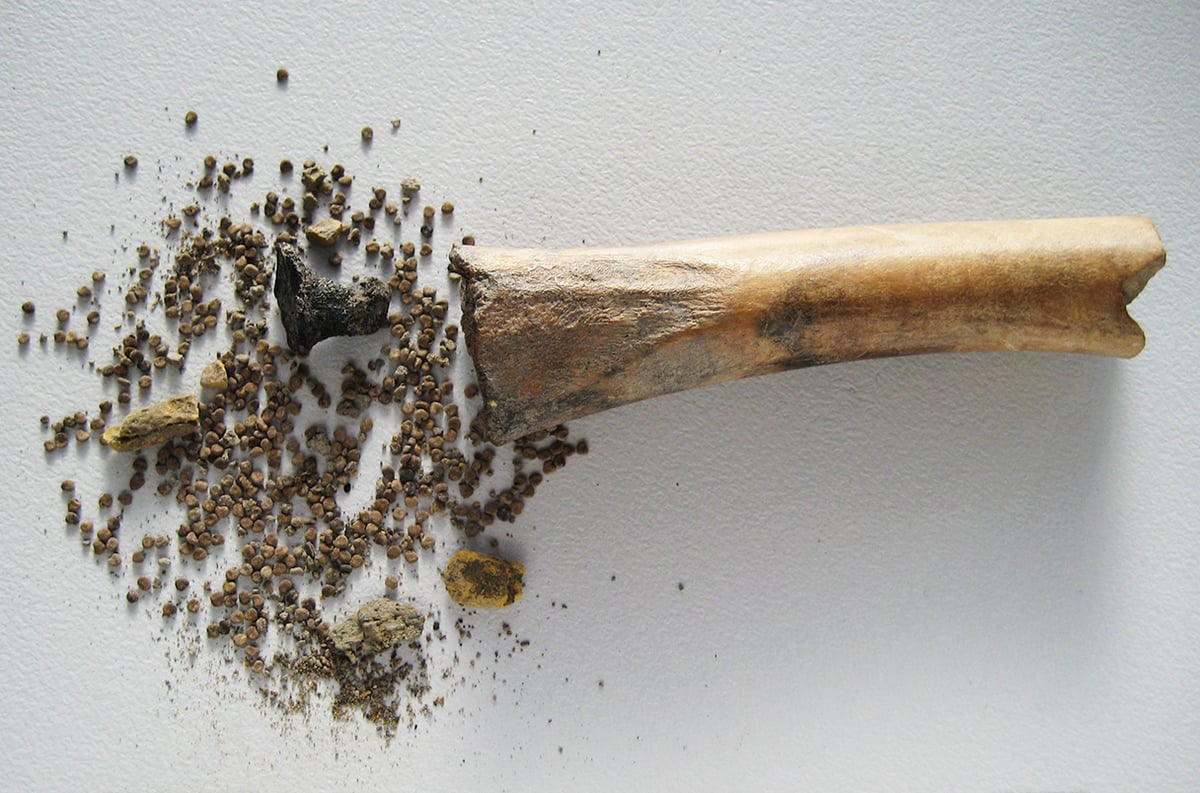
The bone container, discovered when a birch pitch plug was dislodged, was full of black hebane seeds which back in the olden olden olden days was used for “relieving pain and helping with difficult pregnancies. Yet ingesting too much, one Roman author wrote, could lead to “alienation of [the] mind or madness”.”
Ancient Roman authors were clearly familiar with the plant. Pliny the Elder, Plutarch, and others wrote about black henbane, along with its closely related but less potent relatives, white and yellow henbane. These plants—in the form of ointments, potions, or burning smoke—were prescribed for everything from earaches and toothaches to flatulence and “pains of the womb.” Ancient scholars also warned against taking too much because of the potential for hallucinogenic effects; Pliny counseled physicians to avoid it entirely.
This quotation submitted without comment: “When you think about how much was in there, your imagination really goes wild.”
Earlier this year, she began taking semaglutide, also known as Wegovy, after being prescribed the drug for weight loss. (Colloquially, it is often referred to as Ozempic, though that is technically just the brand name for semaglutide that is marketed for diabetes treatment.) Her food thoughts quieted down. She lost weight. But most surprisingly, she walked out of Target one day and realized her cart contained only the four things she came to buy. “I’ve never done that before,” she said. The desire to shop had slipped away. The desire to drink, extinguished once, did not rush in as a replacement either. For the first time — perhaps the first time in her whole life — all of her cravings and impulses were gone. It was like a switch had flipped in her brain.
Not everyone experiences these effects, but there’s enough anecdotal evidence at this point that scientists are interested and investigating.
In the last several months, semaglutide, a drug originally developed to help manage type 2 diabetes, has been in the news for its “breakthrough” weight loss abilities. This video from Vox is a good overview of what the drug does and the interest & controversy around it.
Both Ozempic and Wegovy, Ozempic’s counterpart approved specifically for weight loss by the FDA, are brand names of a drug called semaglutide. Semaglutide is one of several drugs that mimics a crucial digestive hormone called glucagon-like peptide 1, or GLP-1. It amplifies a process our bodies perform naturally.
GLP-1 is released in our intestines when we eat, and there are receptors for the hormone in cells all over the body. In the pancreas, GLP-1 promotes the production of insulin and suppresses the production of glucagon. This helps insulin-resistant bodies, like those with type 2 diabetes or obesity, manage blood sugar levels. In the stomach, GLP-1 slows gastric emptying, extending the feeling of being full. In the brain, GLP-1 suppresses appetite, which also promotes satiety and curbs hunger, so we eat less.
But, as I kept reminding Ozempic-curious friends, these medications were designed for chronic conditions, obesity and diabetes. For people who are dealing with those conditions, Ozempic appears to create a path toward a healthy relationship to food. For those who aren’t, it might function more like an injectable eating disorder. As the side effects make clear, it’s not a casual thing to drastically alter your body’s metabolic process, and there is no large-scale data about the safety of these drugs when taken by people who are mainly interested in treating another chronic condition, the desire to be thin.
I can see my anxiety mirrored in the wave of reactions starting to appear — op-eds, TV segments, people explaining why it’s good, actually, that the vast majority of those using this drug lose a quarter of their body weight. On social media, fat activists are pointing out that our lives were worthy even without this drug. The wave of opinion will not crest for years.
And that’s fair because this is new — not just the drug, but the idea of the drug. There’s no API or software to download, but this is nonetheless a technology that will reorder society. I have been the living embodiment of the deadly sin of gluttony, judged as greedy and weak since I was 10 years old-and now the sin is washed away. Baptism by injection. But I have no more virtue than I did a few months ago. I just prefer broccoli to gloopy chicken. Is this who I am?
Even outside the context of drugs, I find the tension between accepting who you are versus trying to change some behavior you find unappealing is challenging to navigate — it’s something that comes up in therapy a lot. (thx, anil)
Vox recently invited two people with differing views on the decriminalization and commercialization of cannabis to have an on-camera debate. The topic is interesting and relevant, but I’m mostly highlighting this for the format. Instead of just doing a traditional debate, the producers and participants came up with a list of facts that both parties accepted as true to discuss and rebut:
We thought both of their perspectives were worth hearing but didn’t want to stage a traditional debate where viewers so often come away confused about what to believe. So we created a format that would help establish a shared foundation of facts while still communicating what each of these advocates believe is the most important information to know.
In this new take on a debate, we asked both participants to identify facts that their opponent would have to concede are true. They were given an opportunity to review their adversary’s facts in advance and in a video call agreed on a set of six. In the video, you’ll see those facts presented, with each participant given the opportunity to add a “footnote” to their opponent’s facts.
We made something new: a debate format where you don’t have to trust either of the adversaries (or trust us!) to learn something new and valuable about a policy issue.
I think it worked really well — more facts, less arguing & peacocking. I’d definitely welcome a podcast with this debate format.
This video provides a good overview of the difficulty involved in starting a business that grows, sells, or distributes cannabis products, which can include money, federal illegality, state regulations, and structural racism.
Jeannette: So you really got to get your business funded from your personal wealth or from your network wealth.
Nancy: Those situations begin to favor people who’ve traditionally had good access to capital.
Jeremy: And oftentimes that correlate with being white.
Adriana: It is very white male-dominant. And there’s no reason that that is what it should be.
Narrator: Only 2% of cannabis entrepreneurs are Black. Yet Black Americans were most affected by marijuana’s illegal status in the past.
Jeremy: There is kind of a clear throughline from the war on drugs. According to the ACLU, Black people are four times as likely than whites to get arrested for cannabis use, despite using at very similar rates across age groups, across different states.
Cognitive psychologists sometimes talk in terms of two distinct types of consciousness: spotlight consciousness, which illuminates a single focal point of attention, making it very good for reasoning, and lantern consciousness, in which attention is less focused yet illuminates a broader field of attention. Young children tend to exhibit lantern consciousness; so do many people on psychedelics. This more diffuse form of attention lends itself to mind wandering, free association, and the making of novel connections — all of which can nourish creativity. By comparison, caffeine’s big contribution to human progress has been to intensify spotlight consciousness — the focused, linear, abstract and efficient cognitive processing more closely associated with mental work than play. This, more than anything else, is what made caffeine the perfect drug not only for the age of reason and the Enlightenment, but for the rise of capitalism, too.
The power of caffeine to keep us awake and alert, to stem the natural tide of exhaustion, freed us from the circadian rhythms of our biology and so, along with the advent of artificial light, opened the frontier of night to the possibilities of work.
I particularly enjoyed — and by enjoyed I mean “found uncomfortably true” — this line:
Daily, caffeine proposes itself as the optimal solution to the problem caffeine creates.
For more information on how caffeine enabled the Enlightenment and Industrial Revolution, check out Tom Standage’s A History of the World in 6 Glasses.
In 1971, Richard Nixon kicked off America’s “war on drugs”, focusing not on the societal problems that lead to drug abuse but on categorizing drug users as criminals.
In Nixon’s eyes, drug use was rampant in 1971 not because of grand social pressures that society had a duty to correct, but because drug users were law-breaking hedonists who deserved only discipline and punishment.
Over the next several decades, the US government (and particularly Ronald Reagan) took Nixon’s lead and imprisoned millions of people for drug offenses, including a disproportionate number of Black men. Michelle Alexander wrote about this in her 2010 book The New Jim Crow. From the about page:
Alexander shows that, by targeting black men through the War on Drugs and decimating communities of color, the U.S. criminal justice system functions as a contemporary system of racial control, even as it formally adheres to the principle of colorblindness.
In 1994, former Nixon aide and Watergate co-conspirator John Ehrlichman proudly told writer Dan Baum that racial control and discrimination was in fact the purpose of the war on drugs.
At the time, I was writing a book about the politics of drug prohibition. I started to ask Ehrlichman a series of earnest, wonky questions that he impatiently waved away. “You want to know what this was really all about?” he asked with the bluntness of a man who, after public disgrace and a stretch in federal prison, had little left to protect. “The Nixon campaign in 1968, and the Nixon White House after that, had two enemies: the antiwar left and black people. You understand what I’m saying? We knew we couldn’t make it illegal to be either against the war or black, but by getting the public to associate the hippies with marijuana and blacks with heroin, and then criminalizing both heavily, we could disrupt those communities. We could arrest their leaders, raid their homes, break up their meetings, and vilify them night after night on the evening news. Did we know we were lying about the drugs? Of course we did.”
The next documentary film from Errol Morris is about LSD advocate Timothy Leary and will debut on Showtime later in the year. The film is still untitled but is based on a memoir by Joanna Harcourt-Smith called Tripping the Bardo with Timothy Leary: My Psychedelic Love Story.
A FILM BY ERROL MORRIS (w/t) asks the question why Leary, the High Priest of LSD, became a narc in 1974 and seemingly abandoned the millions he urged to turn on, tune in and drop out. Was his “perfect love” Joanna Harcourt-Smith a government pawn, as suggested by Allen Ginsberg? Or was she simply a rich, beautiful, young woman out for the adventure of a lifetime? Morris and Harcourt-Smith will reexamine this chaotic period of her life and explore the mystery of the Leary saga: his period of exile, reimprisonment and subsequent cooperation with the authorities. Devotion or selfishness? Perfect love or outright betrayal? Destiny or manipulation?
This is Morris’s second foray into the topic of LSD — his 2017 Netflix series Wormwood explored the use of the drug by the CIA.
Have a Good Trip is an upcoming Netflix documentary about tripping on psychedelics, like a celebrity/comedy version of Erowid’s drug trip report database.
Mixing comedy with a thorough investigation of psychedelics, HAVE A GOOD TRIP explores the pros, cons, science, history, future, pop cultural impact, and cosmic possibilities of hallucinogens. The film tackles the big questions: Can psychedelics have a powerful role in treating depression, addiction, and helping us confront our own mortality? Are we all made of the same stuff? Is love really all we need? Can trees talk?
The celebs telling their trip stories include Sting, Sarah Silverman, Ad-Rock, and Rosie Perez. I Laughed Out Loud at A$AP Rocky’s short anecdote in the trailer. I hope we’ll hear more about his musical rainbow when Have a Good Trip premieres on May 11.
At Metropolitan State College of Denver, Milkman was instrumental in developing the idea that people were getting addicted to changes in brain chemistry. Kids who were “active confronters” were after a rush — they’d get it by stealing hubcaps and radios and later cars, or through stimulant drugs. Alcohol also alters brain chemistry, of course. It’s a sedative but it sedates the brain’s control first, which can remove inhibitions and, in limited doses, reduce anxiety.
“People can get addicted to drink, cars, money, sex, calories, cocaine — whatever,” says Milkman. “The idea of behavioural addiction became our trademark.”
This idea spawned another: “Why not orchestrate a social movement around natural highs: around people getting high on their own brain chemistry — because it seems obvious to me that people want to change their consciousness — without the deleterious effects of drugs?”
BTW, this is a somewhat controversial view but it has always made sense to me for those with mild addictions or depression. Speaking strictly for myself, I’ve found that when healthier alternatives are available to me (spending time with family & friends, exercise, exploring, reading a good book), I spend a lot less time mindlessly doing things that give me the same sort of brain buzz but which I don’t consider positive or worthwhile (drinking alcohol, watching TV, eating poorly, and especially reloading Instagram over and over again like a lab rat slapping that lever to get more cocaine).
But back to Iceland. By giving teens access to more healthy activities, getting parents more involved in their children’s lives, implementing curfews, and administering annual surveys, the country has made great strides over the past two decades:
Today, Iceland tops the European table for the cleanest-living teens. The percentage of 15- and 16-year-olds who had been drunk in the previous month plummeted from 42 per cent in 1998 to 5 per cent in 2016. The percentage who have ever used cannabis is down from 17 per cent to 7 per cent. Those smoking cigarettes every day fell from 23 per cent to just 3 per cent.
The way the country has achieved this turnaround has been both radical and evidence-based, but it has relied a lot on what might be termed enforced common sense. “This is the most remarkably intense and profound study of stress in the lives of teenagers that I have ever seen,” says Milkman. “I’m just so impressed by how well it is working.”
Young did a follow-up last year about the expansion of the program into other areas of the world.
The London Review of Books is not normally where one turns for advice on how to cop, but Misha Glenny (author of DarkMarket: How Hackers Became the New Mafia and Callum Lang recently wrote a piece for them called How to Buy Drugs that summarizes how the the customer-facing segment of the global drug market presently functions, with a special emphasis on distribution via the dark web. The improvement in customer service driven by dark web markets is fascinating:
The internet has dramatically improved the experience of drug buyers. The market share of a dark web outlet depends almost entirely on its online reputation. Just as on Amazon or eBay, customer reviews will describe the quality of purchased products as well as reporting on shipping time and the responsiveness of vendors to queries or complaints. If drugs that a buyer has paid for don’t turn up — as once happened to Liam, the Manchester student — a savvy vendor will reship the items without asking for further payment, in the hope of securing the five-star customer reviews they depend on.
As a consequence, the drugs available to the informed buyer are of a higher quality than ever before. They are also safer. The administrators of DNStars.vip — a site on the open web which you don’t need Tor to visit — pose as ordinary users in order to buy samples of popular drugs from major vendors. They then have the drugs chemically tested to see whether they match the seller’s description.
The dark web demonstrates the promise and peril of technology (and capitalism tbh) in a nutshell: lower prices & better quality goods for some (or even many) people but all sorts of hidden nastiness behind the scenes doing real and often unacknowledged harm to society.
About two weeks ago, I had my right shoulder replaced. This was the second time I’ve had surgery on that shoulder, after multiple knee surgeries and arm surgeries, and abscesses and god knows what else. This surgery took place in the middle of what’s now, to me, a very familiar, and very tedious dance with my doctors around pain, pain management, and painkillers.
The way it works is this. Everyone knows that surgery, and the injuries that lead to surgery, are painful. Everyone also knows that the best way to treat pain of this kind is through the regular administration of opiates. However, because these drugs are addictive, everyone has to act as if they don’t know anything of the kind.
So instead of just prescribing the drugs, and preventing the pain, the doctors and nurses will wait until the patient asks for the pain medication. Or they’ll prescribe pain pills, but not enough to get the patient through to the next meeting with the doctor. They put the onus on the patient to beg for relief of his/her pain. Ideally with a buffer in between, like a nurse or a pain management specialist, so that the decision never comes directly from the person you’re interacting with, but an intercessor. This is why some patients end up medicated up to the gills, and others are left to grind their teeth and just get through it.
It’s really stupid. I suspect it heightens rather than lessening patients’ feelings of dependence on these drugs, which can do so much to reduce their acute pain and chronic discomfort. Instead, they’re doled out in a semi-arbitrary fashion, generally carefully rationed but sometimes overprescribed, based on your willingness to perform pain for someone else and that person’s level of compassion or complicity with your suffering.
This is all to say: no, I’m not on pain medication. Yes, I’m terribly uncomfortable. No, I’m not uncomfortable enough to jump through hoops and beg for more drugs. (Maybe if I were, things would be different.) And at the times I was most uncomfortable, those were the times when medicine was the least available to me, by design.
We’ve got to get over our weird Puritanical crap about pain and pain medication, and accept the fact that in certain contexts, we need the drugs. And by “we,” I mean myself, the medical system; everybody. We can’t be responsible for the entire opioid epidemic every second of every day. Sometimes we just need to be able to go to sleep.
Today, heroin is still classified as a Schedule I, or prohibited, drug. The consequences of this fateful decision continue to haunt us. Gross failures of our criminal justice system, ranging from police corruption to excessive use of force, all achieve a scale, and foster a profound alienation, as a result of drug prohibition and the militant drug war it spawned.
Maybe in times of only modest failure, or devastation that affects only the marginalized, the tactics of deflection traditionally used to defend the drug war would be enough to sustain it. But it is untenable in the midst of the opioid crisis, the worst drug epidemic in our country’s history.
It is my belief that its staggering body count gives us little choice but face hard truths, even in the face of the deep dependence on the drug war that the US government has developed. What falls between now and that awful reckoning is nothing but denial.
The simple explanation for why this situation didn’t escalate: the unspoken social contract of the bus driver’s authority in this space. We have invested years in developing social contracts around both private and public transportation. When you get into a bus or a train, or even a car, you acknowledge that the person at the wheel is in charge. This power relationship is what allows shared transportation to flourish, and this social contract is what helps many of us in marginalized groups feel safer while riding transportation. It doesn’t feel safe to imagine riding in a shared driverless vehicle. Not just because the technology doesn’t work — but because it doesn’t feel safe to be alone in a small, enclosed space with strange men.
I must have been reading the wrong magazines as a teen, because I only recently found out that Tori Amos has been quite open in interviews about being into psychedelics in the 80s and 90s (and I was VERY into both Tori and magazines in the mid-90s). Most of these mentions only live on via old websites where fans painstakingly transcribed the interviews, so to preserve that fanzine quality I’ve left the typos intact. But first, a little primer on Tori, in case you weren’t an alt kid in the 90s.
The flame-haired daughter of a Methodist minister who grew up in Maryland, Tori was a piano prodigy from the age of 2 who left the church behind for music. She moved to Los Angeles in 1984 at the age of 21 and by 1986 was frontwoman to the synthpop group Y Kant Tori Read. The band was a flop by 1989, so in order to fulfill her contract with Atlantic Records she went out on her own. The resulting solo debut, Little Earthquakes, included a song honestly portraying her rape, alongside many solid, singalong-worthy tracks. She was a bit more raw, confessional, and vulnerable than the other female singer/songwriters who came up in the 90s, and thusly became a goddess among alternative rock-listening girls of my post gen-X cohort. You may just want to cue up Boys for Pele now (the third track off her 1996 album, Father Lucifer, was said to be written after an ayahuasca journey) . Ok, onto the drugs.
“Yeah, there was a period in the late ’80s where I was working with different shaman,” she says. “Myself and a friend Beene would take Iowaska - but it wouldn’t be in the liquid form, it would be a freeze-dried pill - and mushrooms. Some of those trips were eighteen hours long and I’ll never forget, once I ended up sitting by the bush trying to ask the flowers why they didn’t like me. It’s like, Why can’t I be your friend? I was crawling out of my skin at that time. In my twenties I was really…I was just losing my mind.”
Not very recently. I have Datura in my garden, but my gardener told me that some people oversteep it in water and then it’s poison and you die. I did a few 18-hour trips with a Shaman in the canyons in LA in the 80s. I’m glad I did it. And I’d do extasy journeys with women friends, Things are said that I couldn’t have heard or have said over a cup of coffee.
“It’s not like I’ve never done cocaine but, on the whole, if I can’t see dancing elephants I’m not interested,” she said.
“The drug which had a big effect on me was ayahuasca. It comes from a vine in the Amazon and you ingest it. You know that stuff they take in The Emerald Forest? It’s like that. I was hanging around with some medicine women and they suggested I try it. I was very lucid but felt like I was walking around in Fantasia, having a conversation with myself.
“It isn’t like acid. It’s more emotional, more mental. But it can grab you by the balls and just shove you up against the wall. I’ve been in a room with a woman who was literally trying to bite her own arm off. And this lasted for 15 hours. I wasn’t scared — just scared that I’d make a fool of myself. The funny thing was, I kept laughing and laughing, rather than sitting in the corner being intense. Then, every so often, I’d say, I’m in a really rough patch. And one of the medicine women would come over and reassure me that everything was going to be alright…
“I haven’t taken it in a couple of years now. You can only really do it once in a blue moon. But the wild thing is that sometimes I only have to smell something and I’m right back there again, high as a kite.”
Apparently I just needed access to UK magazines, which were certainly hard to come by in mid-90s Vermont. Also, this feels like the right place to thank Becky G. for giving me a tape in calc class (fall 1995?), titled “Becky made a tape for you / and gave you Tori Amos.” I would love to close this post with a scan of the Polaroid of me, wearing a classic Ben & Jerry’s tee, posed with Tori on her summer 1998 tour when I won tickets to a soundcheck and meet-and-greet before the show. Still likely one of the most surreal moment of my life. She told me she liked my name. Thanks to my local radio station WEQX for the tickets and the memory.
In this video, Vox takes a look at how El Chapo leveraged his use of tunnels for transporting drugs into the United States and became one of the richest and most powerful drug lords of all time.
Throughout his career as a drug trafficker, tunnels have been the common theme in El Chapo’s story. When he gained control of a major drug trafficking corridor in the late 1980s, Joaquin Guzman Loera — then known as “el Rapido” — was the first to create super tunnels for transporting drugs across the border.
At the time, a crackdown by the U.S. Drug Enforcement Agency (DEA) meant Colombian cocaine was in decline and the Mexican narcotrafficker saw an opportunity. By using tunnels to facilitate fast transport, El Chapo leveraged his role as a trafficker to claim new responsibilities as a cultivator and distributor of drugs.
El Chapo is currently on trial in the US and the proceedings thus far indicate that the Trump administration’s proposed border wall likely wouldn’t stop the flow of drugs into the US from Mexico. Most of the drugs shipped by El Chapo into the US went through regular old border crossings on trucks and trains, hidden in truck panels, packed into fake plastic bananas, or surrounded by food.
At one point, testimony at the trial has shown, Mr. Guzmán sent tons of cocaine across the border in cans of jalapeños marked with the label La Comadre chiles. The cans were stacked on pallets in the backs of commercial tractor-trailers, which simply drove through official border entry points. To protect his product from being found, witnesses said, Mr. Guzmán often placed the cans filled with cocaine in the middle of the pallets, surrounded by cans with actual chiles.
The NY Times link is via Geoff Manaugh, whose take on this tunnelling I’d love to read.
Ok, this is fascinating. In “dropgangs, or the future of darknet markets”, Jonathan Logan shares how vendors on the darknet have evolved in recent years. Instead of relying on markets like Silk Road to connect with customers and the post office to deliver, vendors have brought customer communications in-house and utilize public dead drop locations for delivery, just like espionage organizations.
To prevent the problems of customer binding, and losing business when darknet markets go down, merchants have begun to leave the specialized and centralized platforms and instead ventured to use widely accessible technology to build their own communications and operational back-ends.
Instead of using websites on the darknet, merchants are now operating invite-only channels on widely available mobile messaging systems like Telegram. This allows the merchant to control the reach of their communication better and be less vulnerable to system take-downs. To further stabilize the connection between merchant and customer, repeat customers are given unique messaging contacts that are independent of shared channels and thus even less likely to be found and taken down. Channels are often operated by automated bots that allow customers to inquire about offers and initiate the purchase, often even allowing a fully bot-driven experience without human intervention on the merchant’s side.
The use of messaging platforms provides a much better user experience to the customers, who can now reach their suppliers with mobile applications they are used to already. It also means that a larger part of the communication isn’t routed through the Tor or I2P networks anymore but each side - merchant and customer - employ their own protection technology, often using widely spread VPNs.
The other major change is the use of “dead drops” instead of the postal system which has proven vulnerable to tracking and interception. Now, goods are hidden in publicly accessible places like parks and the location is given to the customer on purchase. The customer then goes to the location and picks up the goods. This means that delivery becomes asynchronous for the merchant, he can hide a lot of product in different locations for future, not yet known, purchases. For the client the time to delivery is significantly shorter than waiting for a letter or parcel shipped by traditional means - he has the product in his hands in a matter of hours instead of days. Furthermore this method does not require for the customer to give any personally identifiable information to the merchant, which in turn doesn’t have to safeguard it anymore. Less data means less risk for everyone.
Logan expects this type of thing to become more widespread in the near future and it will be difficult to know what effect it will have on society. Maybe one of those effects is that being a corner hopper (like in The Wire) will be more widely available to young people (emphasis mine):
More people will find their livelihoods in taking part in these distribution networks, since required skills and risks are low, while a steady income for the industrious can be expected. Instead of delivering papers, teenagers will service dead drops.
Los Angeles is widely agreed to be the biggest and most important cannabis economy in the world, with a few million consumers, tens of thousands of workers, and billions of dollars each year in sales. It is also, from a business and government standpoint, one of the most contentious, complex, and gridlocked legal-marijuana markets in the United States.
It’s both astounding but also completely makes sense that there are 1,700 illicit dispensaries in Los Angeles on top of the 169 licensed establishments. It’s the wild west for weed right now. And the way authorities are handling the explosive growth is less than ideal.
Meanwhile, the DEA sent out threatening letters, and the city and the feds raided dispensaries indiscriminately, regardless of who had registered. Several shop owners went to prison—especially people of color. Even though most early weed entrepreneurs had worked on the illicit market, white dispensary owners who had previously been drug dealers were significantly less likely to have been arrested, and law enforcement was looking for people with criminal records. As time went on, the gray area of medical marijuana’s legality only deepened the racial divide.
Since we don’t often see the treatment side of the opioid crisis, a new campaign from 72andsunny and M SS NG P ECES streamed the first three days of a woman’s detox in Astor Place. The resulting PSA, “Treatment Box,” is hard to look away from.
When she was 16, she moved with her parents from Vermont to Florida to attend a performing arts high school. Soon after she tried OxyContin for the first time at a high school party, and so began a relationship with opiates that would dominate the rest of her life.
It is impossible to capture a person in an obituary, and especially someone whose adult life was largely defined by drug addiction. To some, Maddie was just a junkie — when they saw her addiction, they stopped seeing her. And what a loss for them. Because Maddie was hilarious, and warm, and fearless, and resilient. She could and would talk to anyone, and when you were in her company you wanted to stay. In a system that seems to have hardened itself against addicts and is failing them every day, she befriended and delighted cops, social workers, public defenders and doctors, who advocated for and believed in her ‘til the end. She was adored as a daughter, sister, niece, cousin, friend and mother, and being loved by Madelyn was a constantly astonishing gift.
This is powerfully straightforward writing by Linsenmeir’s family…my condolences are with them. They devoted a few paragraphs at the end of her obit to address addiction and its place in our society:
If you are reading this with judgment, educate yourself about this disease, because that is what it is. It is not a choice or a weakness. And chances are very good that someone you know is struggling with it, and that person needs and deserves your empathy and support.
If you work in one of the many institutions through which addicts often pass — rehabs, hospitals, jails, courts — and treat them with the compassion and respect they deserve, thank you. If instead you see a junkie or thief or liar in front of you rather than a human being in need of help, consider a new profession.
Why did it take a grieving relative with a good literary sense to get people to pay attention for a moment and shed a tear when nearly a quarter of a million people have already died in the same way as Maddie as this epidemic grew?
Did readers think this was the first time a beautiful, young, beloved mother from a pastoral state got addicted to Oxy and died from the descent it wrought? And what about the rest of the victims, who weren’t as beautiful and lived in downtrodden cities or the rust belt? They too had mothers who cried for them and blamed themselves.
She died just like my wife’s cousin Meredith died in Bethesda, herself a young mother, but if Maddie was a black guy from the Bronx found dead in his bathroom of an overdose, it wouldn’t matter if the guy’s obituary writer had won the Booker Prize, there wouldn’t be a weepy article in People about it.
Why not?
But if there had been, early enough on, and we acted swiftly, humanely, and accordingly, maybe Maddie would still be here. Make no mistake, no matter who you are or what you look like: Maddie’s bell tolls for someone close to you, and maybe someone you love. Ask the cops and they will tell you: Maddie’s death was nothing special at all. It happens all the time, to people no less loved and needed and human.
In 2014, BBC aired a two-part documentary that featured intimate and close-up footage of dolphins using remote-controlled cameras disguised as sea creatures like turtles and fish. In one of the scenes, a group of adolescent dolphins captures a puffer fish and passes the ball-shaped little guy around. But as narrator David Tennant explains, what the dolphins really appear to be after is the toxin released by the puffer.
When attacked, puffer fish release a neurotoxin. In high doses, it can kill, but in small doses, it has a narcotic effect. It seems to be affecting the dolphins. They appear totally blissed out by the whole experience. And remarkably, all take turns in passing the puffer around.
Puff, puff, pass. Puff, puff, pass. Look at these blissed-out young’uns!
The dolphins were filmed gently playing with the puffer, passing it between each other for 20 to 30 minutes at a time, unlike the fish they had caught as prey which were swiftly torn apart.
Zoologist and series producer Rob Pilley said that it was the first time dolphins had been filmed behaving this way.
At one point the dolphins are seen floating just underneath the water’s surface, apparently mesmerised by their own reflections.
The program offers inmates methadone and buprenorphine (opioids that reduce cravings and ease withdrawal symptoms), as well as naltrexone, which blocks people from getting high.
The data set is small but the results are encouraging: there were fewer overdose deaths of former inmates after the program was implemented in 2016.
In 1995, France made it so any doctor could prescribe buprenorphine without any special licensing or training. Buprenorphine, a first-line treatment for opioid addiction, is a medication that reduces cravings for opioids without becoming addictive itself.
With the change in policy, the majority of buprenorphine prescribers in France became primary-care doctors, rather than addiction specialists or psychiatrists. Suddenly, about 10 times as many addicted patients began receiving medication-assisted treatment, and half the country’s heroin users were being treated. Within four years, overdose deaths had declined by 79 percent.
True crime OG Errol Morris has teamed up with Netflix for a 6-part series called Wormwood. The series is an exploration of the CIA experiments with LSD in the 1950s and the death of CIA employee Frank Olson, who was covertly given LSD more than a week before he died. Olson’s death was ruled a suicide, but many years later, the US government settled a potential wrongful death lawsuit out-of-court with a $750,000 payment to the family.
The show itself is a mixture of documentary and historical reenactment (starring Peter Sarsgaard & Bob Balaban) that is now somewhat standard in the true crime genre, having been pioneered by Morris in The Thin Blue Line. Of the show, Morris writes:
Isn’t journalism the pursuit of truth? But what if the truth proves to be elusive, hard to get at? How far does one go? Where does one stop? Are there limits, emotional and otherwise, to the pursuit of truth? Can it be injurious to one’s health? Here we have the story of one man’s sixty-year quest to identify the circumstances of his father’s death. Did he jump from a hotel window? Or was he pushed? And if he was pushed, why? What for? A shadowy world of hidden and imagined intentions coupled with dark and horrifying revelations. In many ways, a personal family story, but in many other ways, a story of America’s decline in the period following World War II. It asks the question: To what extent can a democracy lie to its citizens and still, in the end, remain a democracy?
How much Coca-Cola do you have to drink to go through severe withdrawal symptoms for weeks when you go cold turkey? Find out in Coke Habit, a short animation about a delicious childhood treat that got out of hand.
The Summer after 10th grade Mike spent two solid weeks with horrible horrible migraines, dizziness, blind spots and tunnel vision — he didn’t know what it was… This is the story of his Coke Habit.
The Green Angels is a group of pot dealers that was started by a former fashion model named Honey (not her real name). Many of the dealers and dispatchers are also former models…or at least possess enough good looks and easy charm to talk their way out of trouble with NYPD officers.
Honey is clear-eyed about the nature of her operation: “I tell the girls, it’s not a club; it’s a drug ring.” The whole business is run via text messages between her, the dispatchers in her headquarters, the runners who do the deliveries, and the customers. “I have carpal tunnel in my thumb from all the texting,” Honey says. Dispatchers get 10 percent of each sale; the runners get 20 percent, which averages out to $300 or $400 a day. Several of them, according to Honey, “are paying off their NYU student loans.”
Just like any other business, there are tricks of the trade and protocols to follow:
One of the Angels suggests using a tote bag instead of a backpack to carry the box. She generally uses a WNYC tote bag, which is given out to donors to the public-radio station. The other day, an old lady gave her a high five after seeing her tote. “I thought, If you only knew what I have in this bag,” she says.
Honey tells the girls to get a work phone from MetroPCS, which costs $100. When buying it, they should pay in cash and have a name in mind to put down on the form, in case the police check. “I like to use the names of girls who were my enemies growing up,” Honey says.
The business is organized and disciplined, which I suspect it needs to be if you don’t want to get tossed in jail:
The Green Angels average around 150 orders a day, which is about a fourth of what the busiest services handle. When a customer texts, it goes to one of the cell phones on the table in the living room. There’s a hierarchy: The phones with the pink covers are the lowest; they contain the numbers of the flakes, cheapskates, or people who live in Bed-Stuy. The purple phones contain the good, solid customers. Blue is for the VIPs. There are over a thousand customers on Honey’s master list.
To place an order, a customer is supposed to text “Can we hang out?” and a runner is sent to his apartment. No calling, no other codes or requests. Delivery is guaranteed within an hour and a half. If the customer isn’t home, he gets a strike. Three strikes and he’s 86’d. If he yells at the runner, he’s 86’d immediately.
The Angels work only by referral. The customers should refer people they really know and trust, not strangers, and no one they’ve met in a bar. If you refer someone who becomes a problem, Charley says, you lose your membership.
This is a scene from Miloš Forman’s 1971 film, Taking Off, in which a support group of “square” parents meet to try and understand their children who have run away from home. What a great scene. Unfortunately, the entire movie seems quite difficult to find these days. It’s not streaming anywhere and this Blu-ray is $45. (via @dunstan)
After The Man freaked out back in the 60s, LSD and other psychedelics were banned and criminalized. But slowly, scientists are experimenting with psychedelics to treat depression, anxiety, and other ailments.
In the 1960s, a psychologist and former Harvard teacher named Timothy Leary coined the phrase ‘Turn on. Tune in. Drop out.’ The slogan was inspired by advertising jingles, but Leary wasn’t pushing a product, he was promoting a drug: LSD.
But today, scientists are studying psychedelics once again, in the latest twist in the long, strange story of LSD.
Even outside of a therapeutic setting, many people extolled the beneficial effects of psychedelics. Former Apple CEO Steve Jobs recalled in his biography by Walter Isaacson:
Taking LSD was a profound experience, one of the most important things in my life. LSD shows you that there’s another side to the coin, and you can’t remember it when it wears off, but you know it. It reinforced my sense of what was important — creating great things instead of making money, putting things back into the stream of history and of human consciousness as much as I could.
In their latest video, Kurzgesagt tackles the War on Drugs. The Stop the Harm website, which they mention at the end of the video, says this about the failed efforts to curb drug use:
The global drug policy system is well and truly broken. Despite aiming to ‘protect’ people from drugs, its punitive approach has instead increased the harms of these substances, punishing and demonizing the people and communities most impacted by them. This punishment has disproportionately impacted people and communities of color, indigenous peoples, and the economically marginalized, while stoking public health crises by restricting access to essential medicines and exacerbating the spread of HIV, hepatitis C, and other blood borne viruses.
For an episode called The Fix, Radiolab explores what anti-addiction drugs are available and why they aren’t more widely known and used to treat alcoholism and drug addiction.
Reporter Amy O’Leary was fed up with her ex-boyfriend’s hard-drinking, when she discovered a French doctor’s memoir titled The End of My Addiction. The fix that he proposed seemed too good to be true. But her phone call with the doctor left her, and us, even more intrigued. Could this malady — so often seen as moral and spiritual — really be beaten back with a pill?
We talk to addiction researcher Dr. Anna Rose Childress, addiction psychologist Dr. Mark Willenbring, journalist Gabrielle Glaser, The National Institute of Health’s Dr. Nora Volkow, and scores of people dealing with substance abuse as we try to figure out whether we’re in the midst of a sea change in how we think about addiction.






Stay Connected