This is pretty clever actually: Disney+ and ESPN+ will air a real-time, Toy Story-ified version of the Oct 1st Jacksonville Jaguars and Atlanta Falcons NFL game. From Deadline:
Using the NFL’s Next Gen Stats and on-field tracking data, every player and play will be presented in “Andy’s Room,” the familiar, brightly colored setting for the Toy Story franchise. The action will be virtually simultaneous with the main game telecast, with most plays recreated after an expected delay in the neighborhood of about 30 seconds. Woody, Buzz Lightyear and many other characters will be visible throughout, and a press release notes they will be “participating from the sidelines and in other non-gameplay elements.” Along with game action, the announcers, graphics, scoreboard, referees’ penalty announcements, celebrations and other parts of the experience will all be rendered in a Toy Story-centric fashion.
I stopped watching the NFL years ago, but I might tune in to see how this works.
For the role of a teacher/coach in her new film Bottoms (about a pair of queer girls who start a fight club in their high school in order to get laid), director Emma Seligman made the unorthodox decision to cast former NFL player Marshawn Lynch. It turned out to be an inspired choice — according to an interview with Seligman, he was a natural.
He was one of the best improvisers I’ve ever worked with. I’m not overstating that. He improvised most of his stuff in the movie that ended up in the final cut! We couldn’t ever write something that would be as funny as what he gave us. He’d spew out the most brilliant jokes ever. I kept on encouraging him to do more improv. He’d be like, “Ugh, that stuff’s easy! I wanna get your words right!” I told him that it was so much better than anything we could have written and he was like, “I don’t care about this. I want to honor your work.” I’m so glad I got to talk about him this much.
Here’s a short clip of Lynch doing his thing as Mr. G, “an air-headed high school teacher”:
Lynch also used the film as an opportunity to make some amends for how he reacted when his sister came out as queer:
This was a good opportunity for me because when I was in high school, my sister had came out as being a lesbian or gay — I did not handle it right. You feel me, as a 16-year-old boy, I didn’t handle it the way that I feel like I probably should have. So I told [Seligman] it was giving me an opportunity to correct my wrongs, to rewrite one of my mistakes.
From that interview with Seligman again:
In our first conversation, he told me that his sister is queer and when they were in high school, he didn’t necessarily handle it super well. He felt like this movie coming into his hands was the universe giving him a chance to right his wrongs. That’s what he said. He walked her down the aisle. He felt like they were all good, you know? But his sister thought it’d be really cool if he did this.
If you have never seen this old interview with Lynch about the value of persistence, buckle up because you’re in for a treat:
The best Super Bowl halftime performance, by a comfortable margin, is Prince’s performance during Super Bowl XLI in 2007. Anil Dash has a great writeup that contextualizes the song choices and what it all meant to Prince.
Prince’s halftime show wasn’t just a fun diversion from a football game; it was a deeply personal statement on race, agency & artistry from an artist determined to cement his long-term legacy. And he did it on his own terms, as always.
Opening with the stomp-stomp-clap of Queen’s “We Will Rock You”, Prince went for crowd participation right from the start, with a nod to one of the biggest stadium anthems of all time — and notably, is one of the songs in the set that he never performed any time before or after. Indeed, though his 1992 song “3 Chains O’ Gold” was clearly a pastiche of the then-rejuvenated “Bohemian Rhapsody”, Prince had rarely, if ever, played any Queen covers at all in his thousands of live shows.
But with that arena-rock staple, Prince was signaling that he was going to win over a football crowd. He launched straight into “Let’s Go Crazy” at the top of the set. As one of the best album- and concert-opening songs of all time, this was a perfect choice. Different from any other Super Bowl performer before or since, Prince actually does a call-and-response section in the song, emphasizing that this is live, and connecting him explicitly to a timeless Black music tradition.
You can watch his entire performance here. But if you’ve seen it before and you’re strapped for time, check out the full-on mini-concert Prince performed at a Super Bowl press conference a few days before the game:
Incredible. I move that going forward all “this is more of a comment than a question” comments during conference Q&As are immediately cut off with blistering guitar riffs of Johnny B. Goode. Seconded?
Ever since the Huffington Post struck SEO gold in 2011 with their post about what time the Super Bowl started, pretty much every online publication now runs a similar article in an attempt to squeeze some of Google’s juice into their revenue stream. My “attempt” from last year: What Time Isn’t the Super Bowl?
6:30 p.m. is the time the Super Bowl will start in Atlanta. Most of us are not in Atlanta. So for us, the game will start later than that. You need the time for the images to be captured by the cameras, be broadcasted to air or cable, be captured by my TV screen, leave my TV screen, get to my eyes (not to mention the time my brain needs to process and decode the images). You may say this is fast — of course this is fast. But it takes some time nevertheless, and I am a physicist, I need precision. For most of us, the game will actually start some time later than the kickoff in Atlanta.
Not only that, but time moves at different speeds for each of us:
We have discovered that clocks run at different speed depending on how fast they are moved, and depending on how high they are positioned. That’s right, it is a fact: Two equal clocks go out of time with respect each other if one is moved and the other is kept fixed. The same will happen if one is kept, say, above your head, and the other lower, say, at your feet. All this was discovered by Einstein a century ago; for a while it was just brainy stuff for nerds, but today we are sure it is true. A good lab clock can check this, and it is truly true. Your head lives a bit longer than your feet (unless you spend a lot of time upside down).
So, the clock of the guy up in the high sections of the stadium runs faster than the clock of the referee on the field. And Tom Brady’s clock (if he were to wear one) runs slower, because Tom moves fast (okay, maybe not “fast,” but faster than the people sitting and watching him).
P.S. The Super Bowl starts at approximately 6:30pm EST on Feb 3, 2019. (via laura olin)
For this video, freelance animator Nick Murray Willis took the audio from football commentators and made these little animated vignettes to go along with each line. Here’s a sample:
Beto O’Rourke is running against Ted Cruz for one of Texas’ two Senate seats. At a recent event, he was asked if he thought that NFL players kneeling during the national anthem to protest police violence against black people was disrespectful.
I kind of wanted to know how you personally felt about how disrespectful it is — like, you have the NFL players kneeling during the national anthems. I wanted to know if you found that disrespectful to our country, to our veterans, and anybody related to that.
O’Rourke’s answer, which connects this protest to past non-violent protests undertaken by black Americans, is pitch-perfect — honest, respectful of the questioner & the audience, and inclusive.
I can think of nothing more American than to peacefully stand up, or take a knee, for your rights anytime, anywhere, any place.
Data artist Josh Begley edited together a 5m30s video of every concussion suffered in an NFL game this year. I was barely able to get through this…I had to pause a couple of times. From an article about the video at The Intercept:
The NFL has done a masterful job at mainstreaming the violence of the game, so that fans and spectators don’t feel too bad about what’s actually happening out there. No single word has protected the NFL from the true costs of this violence more than “concussion.” That word puts a protective barrier between us and what’s really going on out on the field.
It’s not a headache. It’s not “getting your bell rung.” You don’t have a bell. It’s a traumatic brain injury. Every single concussion is a new traumatic brain injury. In addition to the torn ACLs and MCLs, in addition to all of the horrible broken bones, the NFL diagnosed at least 281 traumatic brain injuries this season. And no document has ever quite displayed the horror of it all like “Concussion Protocol,” a film by Josh Begley and Field of Vision.
The backwards slow-mo technique is a bit off-putting at first, but as Greg Dorsainville noted in the video’s thread:
If it was in forwards it would be like any big hits package you see in an espn highlight show where we celebrate the football and hit and not mourn the result of the moment: a human in pain, disorientation, and slowly killing themselves.
Having big second thoughts on watching the Super Bowl this weekend, karma offsets or no. (via @harmancipants)
This year’s Super Bowl between the Philadelphia Eagles and the New England Patriots will not take place before Sunday, February 4th at 6:30 pm ET or after ~10:15 pm ET that same day. So, if you’d like to not watch the Super Bowl or Justin Timberlake’s halftime musical performance live from Minneapolis, Minnesota, just don’t turn on NBC or the NBC Sports Live stream between 6:30 and 10:15 that evening.
Currently, the only way to diagnose chronic traumatic encephalopathy (CTE), a disease caused by repeated head trauma, is by posthumously examining brain tissue for signs of tau protein buildup. But a group from Boston University may have found a way to test for CTE in living patients.
McKee and her team discovered a specific biomarker in the brains of former football players. A biomarker is a measurable substance which is, in this case, found in the brain and identifies an abnormality.
This particular biomarker is called CCL11, and it’s a secreted protein the human body uses to help regulate the immune system and inflammation in the body.
As The Ringer’s Claire McNear writes, if a CTE test is easily available to players, what will that do to football? (Or indeed, what will it do to sports like soccer, boxing, skateboarding, or even skiing?)
“After learning all of this,” the retiring Ferguson wrote of the clarity he gained when he began researching CTE, “I feel a bit betrayed by the people or committees put in place by the league who did not have my best interests at heart.” He should feel betrayed, as should many of his fellow players. As will, certainly, so very many, once they have the ability to see what has happened to them. They may wonder, rightfully, about the people who trained them and paid them, sometimes even as they attempted to shut down research into CTE. They may look at the league’s structure, at the lopsided contracts that rob many players of their leverage, forcing them to choose between getting back on the field or losing a paycheck (and possibly getting cut), and at how the league cycles through players like they’re nothing more than easily broken pieces on a board.
Former New England Patriots player Aaron Hernandez, who was serving a life sentence for murdering a friend and who died in prison from suicide earlier this year, was found to have “a severe form” of CTE, a brain disease linked to repeated head trauma that has also been found in many other former NFL players.
Researchers who examined the brain determined it was “the most severe case they had ever seen in someone of Aaron’s age,” said a lawyer for Hernandez in announcing the result at a news conference on Thursday. Hernandez was 27.
Hernandez played three seasons in college and only three in the NFL, yet the damage to his brain was similar to “players with a median age of 67 years”. If you’re a young football player in college or the NFL right now, you have to be looking at this situation pretty hard right now.
If Ed Cunningham had not already seen enough, he would be back in a broadcast booth on Saturday afternoon, serving as the color analyst for another top college football game televised on ABC or ESPN. It is the work he has done each fall for nearly 20 years.
But Cunningham, 48, resigned from one of the top jobs in sports broadcasting because of his growing discomfort with the damage being inflicted on the players he was watching each week. The hits kept coming, right in front of him, until Cunningham said he could not, in good conscience, continue his supporting role in football’s multibillion-dollar apparatus.
Another domino falls. Unless there are big changes to the game play, sooner or later football will likely become a marginalized sport in the US.
Sports superstars are staying superstars longer than ever before. Sure, there have been outliers before (Kareem Abdul-Jabbar, Ted Williams) but increasingly the best players in the major sports are veterans fighting off the ravages of time: Tom Brady, Roger Federer, Cristiano Ronaldo, Gianluigi Buffon, Zlatan Ibrahimovic, Aaron Rodgers, etc.
When players perform at such a high level for so long, we no longer get sick of them. Instead, they become such an ever-present part of sports culture that many of us can’t help but love them. Buffon was launched to superstardom in 2006, when, perhaps already the best goalkeeper in the world, he was one of the faces of a then-unlikable Italian team that controversially made their way to winning the World Cup. Now he probably has a near-100-percent approval rating — still saving enough shots, winning enough games and doing enough stunts to earn it. Ronaldo became a worldwide name after replacing Beckham in the no. 7 shirt for Manchester United and doing a bunch of stepovers. He was unpopular with a segment of English fans for his entire stay in the Premier League; they viewed him as having an overly precious playing style in a game that was supposed to be anything but. Even upon his 2009 departure to Madrid, which came after he delivered every major trophy to Manchester, Ronaldo was mocked for, as this Telegraph headline put it, being a preening peacock: England would miss his footballing talents but not “the theatrics, the astonishing self-regard.”
But if you hang around long enough, you begin to earn a grudging respect from everyone who isn’t a Barcelona fan. If you have closely watched the last decade-plus of Ronaldo, Buffon, Messi, and Zlatan and not seen a play in which you learned to love them, then you haven’t really watched them.
Interesting observation, but I would have liked to read more about why…the piece only quickly mentions “modern training methods [and] technology”. Training and technology have made it possible to blend the energy & power of youth with the wisdom gained through experience, and it’s a potent combination.
P.S. A round of applause for writer Kevin Clark for the line: “It is possible that Ronaldo cannot pass the Turing test.”
This conversation between Bill Simmons and Malcolm Gladwell about the current state of football and the NFL is quite good, even if you maybe don’t care about sports or aren’t currently watching football. Yes, it’s a sports bro and a nerd bro coming to terms with the fact that their favorite sport is a dumpster fire, but some of their points along the way are more widely applicable. Like Gladwell’s idea about second conversations:
There is now a second conversation about baseball — the Moneyball conversation — that is interesting even to people who don’t follow the first conversation, the one that takes place on the field. Same thing for basketball. There’s an obsessive first conversation about a beautiful game, and a great second conversation about how basketball has become a mixed-up culture of personality and celebrity. Boxing had a wonderful second conversation in its glory years: It was a metaphor of social mobility. Jack Dempsey, one of the most popular boxers of all time, dropped out of school before he even got to high school; Joe Louis’s family got chased out of Alabama by the Ku Klux Klan. That underlying narrative made what happened in the ring matter. When the second conversation about boxing became about people like Don King and the financial and physical exploitation of athletes, the sport became a circus.
So what’s the second conversation about football? It’s concussions. There’s the game on the field and then there’s a conversation off the field about why nobody wants their kids to play the game on the field. How does a sport survive in the long run when the second conversation contradicts the first?
And his assertion that the clarity and size of HD televisions have made the action on the screen too real:
In terms of how we watch football, high-definition television has clearly been a two-edged sword for the NFL, hasn’t it? It makes the drama of the game come alive, because we can now see the action in so much more detail. But it also means that when Luke Kuechly is writhing in pain on the ground, we can see every emotion on his face. That’s not a trivial matter. There’s a particular emotional expression that the psychologist Paul Ekman has labeled “Action Unit 1,” which is when your inner eyebrows rise up suddenly, like a drawbridge. It’s almost impossible to do that deliberately. (Try it sometime.) But virtually all human beings do Action Unit 1 involuntarily in the presence of emotional distress. Watch babies cry: Their inner eyebrows shoot up like they are on hydraulics. And when you see that expression appear on someone else’s face, that’s what triggers your own empathy.
The point is, in an age when this kind of intimate information about other people’s emotions is available to us when we’re watching TV in our living rooms, a game as violent and painful as football becomes really hard to watch. The first time I realized this was after a hit on Wes Welker in a Broncos playoff game, in the season when he had multiple concussions (2013). I had just bought a new big-screen TV, with an incredible picture, and when the camera zoomed in on Welker, I was so shaken that I had to turn off the game. I wonder how many other people did the same thing. So, yes, we really watch football differently now.
As Iwobi suggests, however, they increasingly do more than that: They are not merely representations of the game, but influencers of it. Iwobi is not the only player who believes that what he does on the field has been influenced by what he has seen rendered on a screen.
Ibrahimovic said that he would “often spot solutions in the games that I then parlayed into real life” as a young player. Mats Hummels, the Bayern Munich and Germany defender, has suggested that “maybe some people use what they learn in FIFA when they find themselves on a pitch.”
I’m now an analyst at Plymouth. We’ve just signed the goalkeeper Marc McCallum, who some FM players will remember was an incredible prospect at Dundee United as a kid. I used to sign him all the time. When he came for a trial this summer, he walked in and it was one of the strangest moments in my life. I’ve never met him in person — I’d only ever seen his face on a computer game — but straight away I knew it was him.
I spoke to him at a pre-season game the next day. We got around to the subject of Football Manager and he’d been in charge of Argyle on the last game, getting them to the Premier League and signing himself. I asked him what he did when he first took over, and he said he got rid of all the staff. So I said: “Did you sack me?” And it turned out he’d actually sacked me as well. It was a strange opening conversation to have with someone.
American football and the Madden franchise have a similar relationship. The game is so realistic that prospective players can learn NFL-style offenses and established players like Drew Brees use the game to prep for the games ahead.
The New Orleans Saints quarterback told Yahoo! Sports in an interview this week that modern football simulation games such as Madden NFL have become so realistic that playing them during downtime can actually have a positive impact on the athlete’s on-field performance.
“Down the road it is going to be even more so,” Brees said. “The games are getting more lifelike every year, and everything in Madden is based on what really happens on the field.
“The plays are the same, it is updated all the time and you can go through a lot of stuff without having to get hit. I can definitely see a time when these things are used a lot more to help players.”
This is America in a nutshell. Instead of banning kids from playing football, as the world’s leading expert on the football-related head injuries urges, a school district is having their football players drink a brand of chocolate milk that has been shownin a preliminary study to “improve their cognitive and motor function over the course of a season, even after experiencing concussions”.
Experimental groups drank Fifth Quarter Fresh after each practice and game, sometimes six days a week, while control groups did not consume the chocolate milk. Analysis was performed on two separate groups: athletes who experienced concussions during the season and those who did not. Both non-concussed and concussed groups showed positive effects from the chocolate milk.
Non-concussed athletes who drank Maryland-produced Fifth Quarter Fresh showed better cognitive and motor scores over nine test measures after the season as compared to the control group.
Concussed athletes drinking the milk improved cognitive and motor scores in four measures after the season as compared to those who did not.
Vice Sports has a quick look at what’s wrong with this study.
See also these new helmets designed to “prevent” concussions. The problem is not poorly designed helmets or lack of magic chocolate milk. Those things only make matters worse by implicitly condoning poor behavior, e.g. if helmets prevent concussions, it’ll gradually result in harder hitting, which will result in more injuries.
Today, the NY Times is running an editorial by Dr. Bennet Omalu called Don’t Let Kids Play Football. Omalu was the first to publish research on CTE in football players.
If a child who plays football is subjected to advanced radiological and neurocognitive studies during the season and several months after the season, there can be evidence of brain damage at the cellular level of brain functioning, even if there were no documented concussions or reported symptoms. If that child continues to play over many seasons, these cellular injuries accumulate to cause irreversible brain damage, which we know now by the name Chronic Traumatic Encephalopathy, or C.T.E., a disease that I first diagnosed in 2002.
Depending on the severity of the condition, the child now has a risk of manifesting symptoms of C.T.E. like major depression, memory loss, suicidal thought and actions, loss of intelligence as well as dementia later in life. C.T.E. has also been linked to drug and alcohol abuse as the child enters his 20s, 30s and 40s.
The story of Omalu, his research, and its suppression by the NFL is the subject of Concussion, a movie starring Will Smith that comes out on Christmas Day, as well as a book version written by Jeanne Marie Laskas.
In the journal Radiology today, an imaging study shows that players ages 8 to 13 who have had no concussion symptoms still show changes associated with traumatic brain injury.
Christopher Whitlow, chief of neuroradiology at Wake Forest School of Medicine, wanted to see how head impact affects developing brains. His team studied male football players between ages 8 and 13 over the course of a season, recording “head impact data” using a Head Impact Telemetry System to measure force, which was correlated with video of games and practices.
I’m increasingly ambivalent about football (see here, here, here), but HBO’s Hard Knocks, the recurring documentary miniseries inside an NFL training camp, is still the best TV show I’ve seen all year.
The show’s stars included coaches, families, undrafted rookies and journeyman free agents, all in orbit around the Houston Texans. A huge part of the draw, though, is all-pro defensive lineman JJ Watt, maybe the NFL’s best player at any position. Watt does freakish things, like flipping half-ton tires end over end, or box-jumping sixty-one inches (kind of like jumping onto the roof of a car from a standstill).
Watt is the best defensive football player on the planet — probably the best football player full stop. His body looks like what Superman would draw if someone asked him to draw what he wanted to look like. My body looks like if someone asked Superman to draw a pile of mashed potatoes wearing shorts.
Sports business may be evil, its fundamental practices barbaric, its media representations distorted and misleading, and its role in American life exaggerated beyond all reason. But god, it’s compelling to watch human beings who are better at what they do than anyone else on the planet, who do things that don’t completely seem possible.
When and if [student-athletes] do receive their degree, it might mean even less in terms of real future dollars than those received by their peers. The networking they might have done with others on campus is restricted by their class schedules and practice; the networking with wealthy alumni that might benefit them in business is explicitly forbidden in many instances, something Princeton’s own Michael Lewis points out in The Blind Side. The athlete receives no dividend or funds kept in trust for their well-above-average financial contributions to the university on graduation.
By rule they are separated from the income they make, and by system they are separated from the university education they were promised. They are neither amateurs nor professionals, and effectively moved as undeclared contraband through the United States tax system.
Hall’s argument is intercut with a personal essay about growing up with his own family precariously in and out of poverty. The two halves don’t quite join up, but it helps break some of the abstractions around the amateur ideal and gives the whole thing an added urgency.
Concussion, starring Will Smith, is about Dr. Bennet Omalu, who discovered the link between football and CTE (Chronic Traumatic Encephalopathy) and will be out in December.
The movie is based on the 2009 GQ article, Game Brain.
Let’s say you run a multibillion-dollar football league. And let’s say the scientific community — starting with one young pathologist in Pittsburgh and growing into a chorus of neuroscientists across the country — comes to you and says concussions are making your players crazy, crazy enough to kill themselves, and here, in these slices of brain tissue, is the proof. Do you join these scientists and try to solve the problem, or do you use your power to discredit them?
Saw someone on Twitter saying that maybe this will be football’s The Insider. Let’s hope it moves the needle.
In dozens of studio emails unearthed by hackers, Sony executives; the director, Peter Landesman; and representatives of Mr. Smith discussed how to avoid antagonizing the N.F.L. by altering the script and marketing the film more as a whistle-blower story, rather than a condemnation of football or the league.
“Will is not anti football (nor is the movie) and isn’t planning to be a spokesman for what football should be or shouldn’t be but rather is an actor taking on an exciting challenge,” Dwight Caines, the president of domestic marketing at Sony Pictures, wrote in an email on Aug. 6, 2014, to three top studio executives about how to position the movie. “We’ll develop messaging with the help of N.F.L. consultant to ensure that we are telling a dramatic story and not kicking the hornet’s nest.”
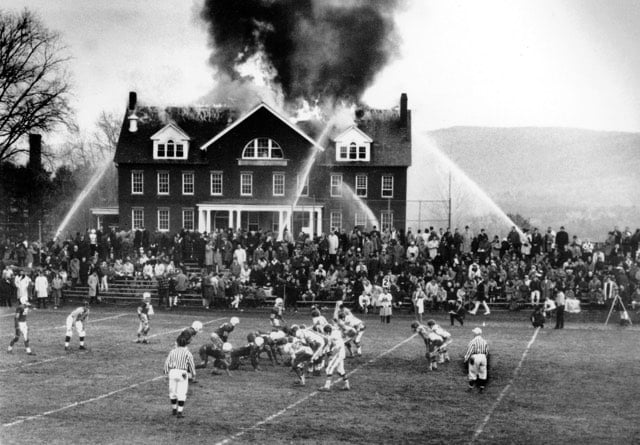
Ok, this is one of the strangest photos I’ve ever seen. In the background, there’s a building on fire and in the foreground, there’s a football game going on like there’s not a building on fire right there. From their photographic recap of 1965, In Focus has the story:
Spectators divide their attention as the Mount Hermon High School football team in Massachusetts hosts Deerfield Academy during a structure fire in the Mount Hermon science building on November 24, 1965. The science building was destroyed, and Mount Hermon lost the football game, ending a two-year-long winning streak.
Update: The photo above reminded some readers of this photo, taken by Joel Sternfeld in 1978.
You’ll notice the fireman buying a pumpkin while the house behind him burns, although there’s a bit more to the story than that.
In 1996, a building burned outside the stadium during the LSU/Auburn game:
Update: Sarah Lyall of the NY Times goes long on the Mount Hermon photo, which was very much real and celebrated when it was initially published.
Even at the time, when the photograph was reprinted around the world, people thought it was too weird to be real. “My colleagues maintain it is a real picture, but I believe it is of the April fool type,” wrote Phil F. Brogan, an editor at The Bulletin newspaper in Bend, Ore. (“I can assure you that the picture was not faked,” replied Arthur H. Kiendl Jr., the headmaster of Mount Hermon, the Massachusetts prep school where the game took place.)
In fact, the photograph, of Mount Hermon’s game against Deerfield Academy on Nov. 20, 1965, was an instant classic. Though the photographer, Robert Van Fleet, never received much in the way of money for it, it was named the Associated Press sports photograph of the year. It was featured on the back page of Life magazine. It was reproduced in dozens of newspapers and magazines across the United States, including The New York Times, often accompanied by supposedly amusing captions about Rome burning, the teams’ “red-hot rivalry” and the like.
Back in September at the beginning of the NFL season, I wrote a post called I’m quitting football.
I’ve been a steadfast fan of NFL football for the past 15 years. Most weekends I’d catch at least two or three games on TV. Professional football lays bare all of the human achievement + battle with self + physical intelligence + teamwork stuff I love thinking about in a particularly compelling way. But for a few years now, the cons have been piling up in my conscience: the response to head injuries, the league’s nonprofit status, the homophobia, and turning a blind eye to the reliance on drugs (PEDs and otherwise). And the final straw: the awful terrible inhuman way the league treats violence against women.
It’s overwhelming. Enough is enough. I dropped my cable subscription a few months ago and was considering getting it again to watch the NFL, but I won’t be doing that. Pro football, I love you, but we can’t see each other anymore. And it’s definitely you, not me. Call me when you grow up.
So how did I do? I ended up watching four games this season: a random Sunday night game in week 15 or 16, the Pats/Ravens playoff, the Pats/Colts playoff, and the Super Bowl. I’ve been watching and rooting for the Patriots for the past, what, 14 or 15 years now. And more to the point, I’ve been following the Brady/Belichick storyline for almost that long and once it became clear the Pats had a great shot at winning it all, not watching the final acts was just not going to happen, NFL bullshit or not. It would be like putting down one of the best 1200-page books you’ve ever read with two chapters to go and just saying, yeah, I’m not going to read the end of that. And that game last night…I felt *incredible* when Butler intercepted that pass. Life is full of many greater, more fulfilling, and more genuine moments, but there’s no feeling quite like the one when you realize your team has won, especially when that victory has been snatched, semi-literally, from the jaws of near-certain defeat.
But that’s ultimately weak sauce. I don’t feel justified about watching just because I really enjoyed it. I made a commitment to myself and didn’t honor it. I believe the NFL is still a terrible organization and isn’t worth supporting with my attention. For whatever it’s worth, I’m going back to not watching next year, and I hope I fare better.
Update: Bill Simmons, in an epic recap of the final 12 minutes of the Super Bowl, echoes what I was getting at above.
When you’ve been rooting for the same people for 15 years, at some point the stakes become greater. You want that last exclamation-point title. (Just ask Spurs fans.) You want to feel like you rooted for a dynasty, or something close to it, instead of just “a team that won a couple of times.” You want to say that you rooted for the best coach ever and the best quarterback ever, and you want to be constantly amazed that they showed up to save your sad-sack franchise at the exact same time.
I know, I know, no football.1 But I could not help seeing this catch last night by NY Giants receiver Odell Beckham. Many are calling it the best catch anyone has ever made in the history of the NFL.
As a player, how do you prepare yourself for making the greatest catch in history? It would be easy to dismiss this catch as a lucky fluke…one-handed, fighting off a defender, just gets it by his fingertips. But here’s the thing: Beckham practices exactly this catch:
Luck is what happens when preparation meets opportunity. Preparation, kids. Preparation.
Aside from the occasional highlight, I still have not watched a single minute of NFL football this year. It’s not been easy, particularly on Sunday nights, where all I want to do most of the time is flip on the game and veg out with a Collinsworth/Michaels soundtrack. ↩
I lay awake at night wondering how many lives were irreparably damaged by my most handy ball boy tool: smelling salts. On game days my pockets were always full of these tiny ammonia stimulants that, when sniffed, can trick a brain into a state of alertness. After almost every crowd-pleasing hit, a player would stagger off the field, steady himself the best he could, sometimes vomit a little, and tilt his head to the sky. Then, with eyes squeezed shut in pain, he’d scream “Eric!” and I’d dash over and say, “It’s O.K., I’m right here, got just what you need.”
Memory loss is just one of the problems that plague Gerald Willhite, 55. Frustration, depression, headaches, body pain, swollen joints, and a disassociative identity disorder are other reminders of his seven-season (1982-88) career with the Denver Broncos, during which he said he sustained at least eight concussions.
“I think we were misled,” Willhite said from Sacramento. “We knew what we signed up for, but we didn’t know the magnitude of what was waiting for us later.”
When Willhite read about the symptoms of some former players who were taking legal action against the NFL, he thought “Crap, I got the same issues.” He decided to join the lawsuit that claimed the league had withheld information about brain injuries and concussions. He feels that the $765 million settlement, announced last summer and earmarked for the more than 4,000 players in the lawsuit, is like a “Band-Aid put on a gash.”
Any other year, Steve Almond would have seen the play. But, after forty years of fandom, he’s quit the N.F.L. In his new book, “Against Football,” Almond is plain about what he considers the various moral hazards of the game: “I happen to believe that our allegiance to football legitimizes and even fosters within us a tolerance for violence, greed, racism, and homophobia.”
This part resonated most with me:
Even a casual N.F.L. fan can recognize that this is a particularly opportune time for a Raiders fan to stop watching football. The team is terrible. I asked Almond about that. “If the Raiders were really good, I might not have written the book,” he said. “How fucked up is that? It’s true, I love them. I see those colors, and it’s me.” For Almond, his struggle to confront his own hypocrisy is exactly the point: proof of football’s insidiousness, of its ominous power.
“Football somehow hits that Doritos bliss point,” he told me. “It’s got the intellectual allure of all these contingencies and all this strategy, but at the same time it is so powerfully connecting us to the intuitive joys of childhood, that elemental stuff: Can you make a miracle? Can you see the stuff that nobody else sees? And most of us can’t, but we love to see it. And I don’t blame people for wanting to see it. I love it, and I’m going to miss it.”
It’s overwhelming. Enough is enough. I dropped my cable subscription a few months ago and was considering getting it again to watch the NFL, but I won’t be doing that. Pro football, I love you, but we can’t see each other anymore. And it’s definitely you, not me. Call me when you grow up.
My (admittedly unoriginal) suspicion is that the reason we keep having this discussion over the ethics of football is almost entirely a product of the sport’s sheer popularity. The issue of concussions in football is debated exhaustively, despite the fact that boxing — where the goal is to hit your opponent in the face as hard as possible — still exists. But people care less about boxing, so they worry less about the ethics of boxing. Football is the most popular game in the United States and generates the most revenue, so we feel obligated to worry about what it means to love it. Well, here’s what it means: We love something that’s dangerous. And I can live with that.
I’m not here to dictate other people’s morality. I’m certainly not here to call for banning of the risky activities of consenting adults. And my moral calculus is my own. Surely it is a man’s right to endanger his body, and just as it is my right to decline to watch. The actions of everyone in between are not my consideration.
Same here. I don’t feel any sense of judgment or righteousness about this. Just the personal loss of a hobby I *really* enjoyed. (via @campbellmiller & @Godzilla07)
Yesterday, I was looking for a GIF of two people missing a high-five (as one does) and the top hits I got back were all of New England Patriots quarterback Tom Brady.
I thought, “the three-time Super Bowl winner and one of his wide receivers trying to high-five and missing each other’s hands? That’s pretty funny!” Oh no. What is funnier still is Brady trying to high-five one or more of his teammates and the other players totally ignoring him. What’s even funnier than that? This has happened over and over again.
Against the Ravens:
Against the Saints:
And against the Steelers. (These are all just from last season, and all Patriots wins, by the way):
If Glenn Burke and the 1977 Dodgers show us the original spirit of the high-five, Tom Brady and the 2013 Patriots show us that the high-five evangelist’s work is never done.
Richard Sherman is a football player for the Seatt…hey, HEY!, you nerds that were about to wander off because I’m talking about sportsball, come on back here. Like I was saying, Sherman plays cornerback for the Seattle Seahawks, who won the Super Bowl last year. The thing is, whatever it is you do, Richard Sherman is way better at his job than you are at yours. And he’s able to explain how he does what he does, which, if you’ve ever been to a technology conference or read more than a thing or two linked from Hacker News, you know is even more rare.
Sherman is, by his own admission, not particularly athletically gifted in comparison to some others in the NFL, but he’s one of the top 5 cornerbacks in the game because he studies and prepares like a mofo. In this video, he explains how he approaches preparing for games and shares some of the techniques he uses to gain an advantage over opposing quarterbacks and receivers.
Sherman is obviously really intelligent, but his experience demonstrates once again the value of preparation, hard work, and the diligent application of deliberate practice.
“Barry Sanders is my new idol,” Bo Jackson said after a Raiders-Lions game in 1990. “I love the way the guy runs. When I grow up, I want to be just like him.”
The Raiders won that game, and the Lions were 4-9 at the time, but it didn’t even matter.
All anyone could talk about afterward was the “little water bug” who “might rewrite history.”
This wasn’t necessarily a metaphor for Barry’s entire Lions career — he was on more playoff teams than people remember — but it definitely covers about half the years he spent in Detroit. Even when the Lions were awful, Barry would still have a few plays every game that would keep people gawking afterward.
Bo Jackson had a similar effect on people, which is part of what makes that old quote so cool. The Bo Jackson combination of speed and power is something we’d never seen before and haven’t seen since. He was a cult hero then, and the legend has only grown over the years.
I’ve always been an atypical sports fan. I grew up in Wisconsin rooting for the Packers & Brewers but switched to being a Vikings & Cubs fan sometime in high school. But despite following the Vikings at the time, my favorite player in the NFL was Barry Sanders. For my money, Sanders was pure symphonic excellence in motion, the best running back (and perhaps player) the NFL had ever seen and maybe will ever see. I wonder if one of the reasons why I like Lionel Messi so much is because he reminds me of Sanders; in stature, in strength, in quickness, in skill. Compare and contrast some of their finest runs:
Every year, a bunch of folks play a game called Last Man, in which the participants attempt to be the last person to find out the result of the Super Bowl. TLDR did an entertaining podcast on this year’s contestants.
Most of the runners, however, found themselves waking up each day in a cold sweat. “I feel like I’m being sequestered for the stupidest jury trial in modern history,” one competitor said. “It’s gotten to the point where three things may end me: recklessness, homesickness, or sheer boredom.”
Jon Bois attempted to create the most lopsided game ever in Madden NFL on his Xbox. He beefed up the players on one team (7’0”, 440 lbs, good at everything) and put a bunch of scrubs on the other team (5’0”, 160 lbs, bad at everything). He started playing and was on pace to score more than 1500 points when…
With just under two minutes left in the first quarter, I was winning 366 to zero. I realized that I was on pace to score 1,500 points in a single game. I had never conceived of such a high score. I’d never even heard anyone talk idly about such a thing. There was absolutely nothing the Broncos could do to slow down my pace. I could score just as surely as someone can point and click. It was great. I wanted to ruin Madden in a way I never had before, and I was doing it.
And then it happened. Before I tell you what happened next, I want to lay out a couple of things: first, I made no actual hacks to this game. I didn’t have some special jailbroken Xbox, nor a special copy of Madden, nor anything like that. I bought my Xbox at Target and bought my copy of Madden off Amazon, and that’s that. Second, I stake whatever journalistic integrity I have upon the statement that I didn’t Photoshop any of this, and that it happened just as I say it did.
This is LOL funny in several places…particularly the GIFs. (via @delfuego)









Stay Connected