Kurzgesagt’s latest video on the paradox of time is a bit more of a brain-bender than their usual videos. From the accompanying sources document:
This video summarizes in a narrative format two well-known theories about time: the so-called “block universe” and the “growing block”.
The block universe is an old theory of time which appears to be an unavoidable consequence of Einstein’s theory of special relativity. In philosophical contexts, basically the same idea is known as “eternalism”. Simplified, this theory posits that, although not apparent to our human perception, both the past and the future exist in the same way as the present does, and are therefore as real as the present is: The past still exists and the future exists already. As a consequence, time doesn’t “flow” (even if it looks so to us) and things in the universe don’t “happen” - the universe just “is”, hence the name “block universe”.
But then: “Quantum stuff is ruining everything again.” And so we have the growing block theory:
The Evolving/Growing Block: A relatively new alternative to the classical block universe theory, which asserts that the past may still exist but the present doesn’t yet, and all that in a way that is still compatible with Einstein’s relativity.
And there are still other theories about how time works:
Some scientists think that the idea of “now” only makes sense near you, but not in the universe as a whole. Others think that time itself doesn’t even exist — that the whole concept is an illusion of our human mind. And others think that time does exist, but that it’s not a fundamental feature of the universe. Rather, time may be something that emerges from a deeper level of reality, just like heat emerges from the motion of individual molecules or life emerges from the interactions of lifeless proteins.
I really enjoyed this piece by Tom Vanderbilt on how time is kept, coordinated, calculated, and forecast. It’s full of interested tidbits throughout, like:
Care to gawk at one of the world’s last surviving original radium standards, a glass ampoule filled with 20.28 milligrams of radium chloride prepared by Marie Curie in 1913? NIST has it in the basement, encased in a steel bathtub, buried under lead bricks.
And:
For GPS to work, it needs ultra-exact timing: accuracy within fifteen meters requires precision on the order of fifty nanoseconds. The 5G networks powering our mobile phones demand ever more precise levels of cell-tower synchronization or calls get dropped.
And:
And as Mumford could have predicted, nowhere has time become so fetishized as in the financial sector, with the emergence over the past decade of algorithmic high-frequency trading. Donald MacKenzie, the author of Trading at the Speed of Light, estimated in 2019 that a trading program could receive market data and trigger an order in eighty-four nanoseconds, or eighty-four billionths of a second.
And:
All this makes F1 staggeringly accurate: it will gain or shed only one second every 100,000,000 years. Since the days when time was defined astronomically, the accuracy of the second is estimated to have increased by a magnitude of eight.
And:
“A clock accurate to a second over the age of the cosmos,” Patrick Gill, a physicist at the U.K.’s National Physical Laboratory, is quoted as saying in New Scientist, “would allow tests of whether physical laws and constants have varied over the universe’s history.”
And:
“If you were to lift this clock up a centimeter of elevation,” Hume told me, “you would be able to discern a difference in the ticking rate.” The reason is Einstein’s theory of relativity: Time differs depending on where you are experiencing it.
And I could go on and on. If any or all of those tidbits is interesting to you, you should go ahead and read the whole thing.
Ok this is kind of incredible: Brick Technology built a solar-powered Lego clock that will keep time for a billion years. It’s got various displays in the style of an astronomical clock so you can keep track of seconds, hours, months, centuries, and even galactical years (the amount of time the Sun takes to orbit the center of the galaxy). The clock is powered by solar energy, and the solar cell is connected to the clock so that it tilts throughout the day to keep facing the sun.
This is a) an extremely accessible explanation of how clocks work, b) the nerdiest thing ever, and c) I love it so much. Even if you’re not a Lego fan, you should watch this. (For more on how clocks work, check out Bartosz Ciechanowski’s excellent explainer on mechanical watches.)
The obvious thing that sprung to mind watching this was The Clock of the Long Now, a 10,000-year clock being constructed inside a mountain in West Texas. But I also thought of Arthur Ganson’s Machine With Concrete, which utilizes extreme gear ratios to turn an input of 200 rpm into a gear that turns only once every 2 trillion years. That’s slow enough that the final gear is actually embedded in concrete and it doesn’t affect the operation of the machine at all.
The length of a human life is around 80 years. You might get 100 if you’re lucky. The universe is about 13.7 billion years old. The vast difference between a human lifespan and the age of the universe can be difficult to grasp — even the words we use in attempting to describe it (like “vast”) are comically insufficient.
To help us visualize what a difference of eight orders of magnitude might look like, Wylie Overstreet and Alex Gorosh have created a scale model of time in the Mojave Desert, from the Big Bang to the present day. This is really worth watching and likely to make you think some big think thoughts about your place in the universe and in your life.
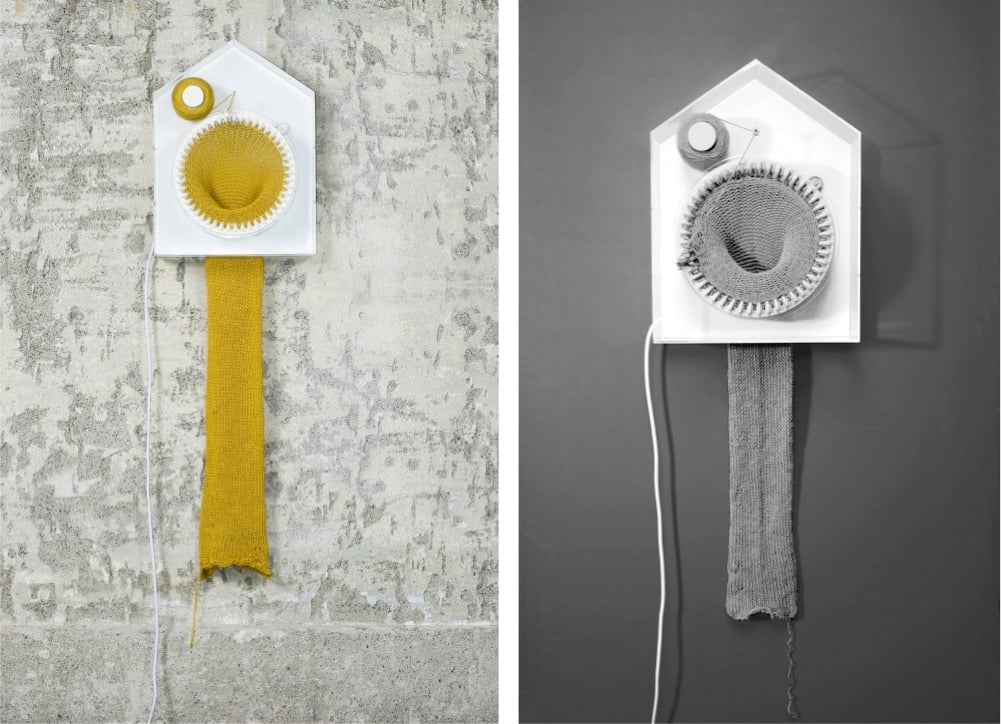
Time is manifested in physical objects; in things that grow, develop or extinguish. Time is an ever forward-moving force and I wanted to make a clock based on times true nature, more than the numbers we have attached to it.
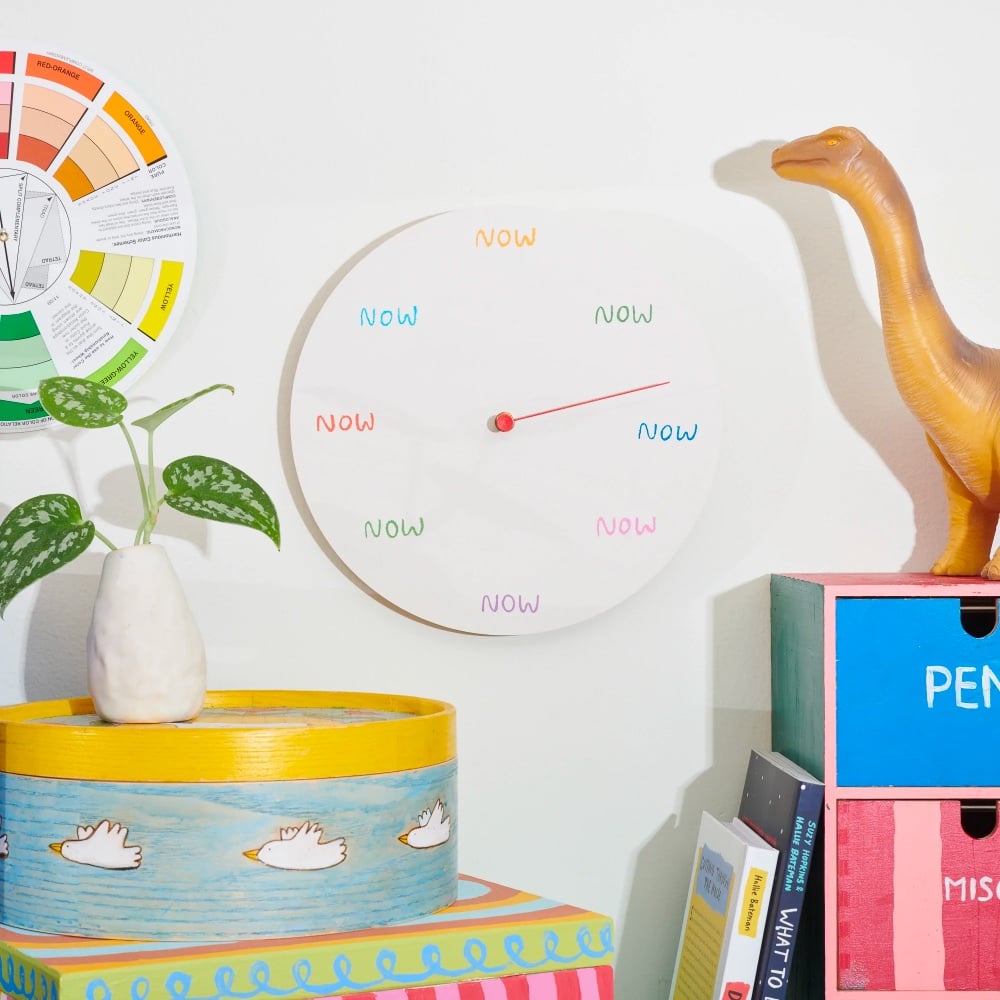
Based on an illustration she did for a tech blog in 2014, Hallie Bateman is selling the NOW clock, a timepiece that reminds you whatever time it happens to be, it’s also always the present moment.
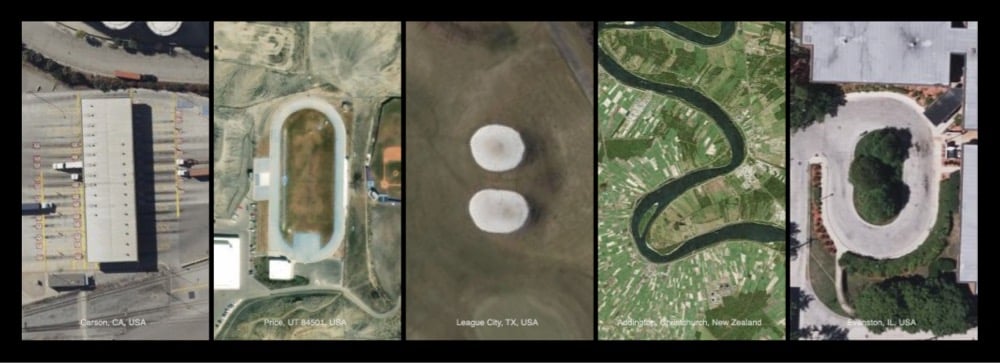
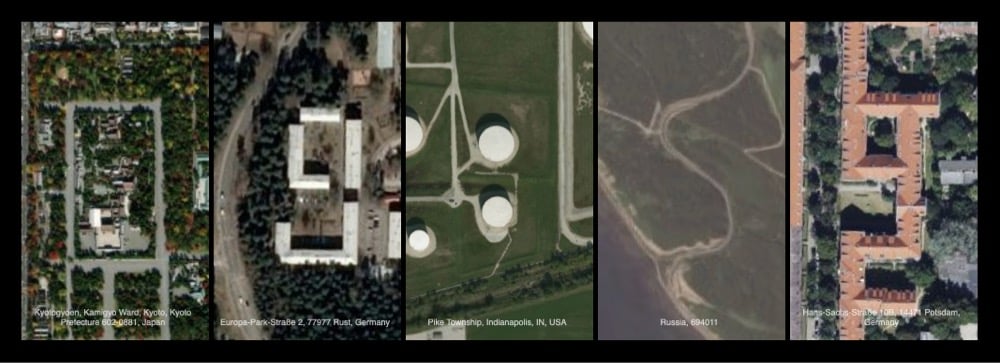
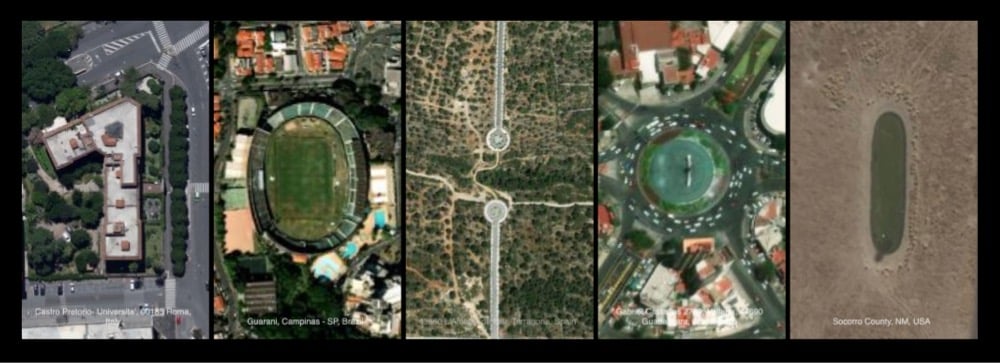
Earth Clock is a digital clock where the digits are satellite photos of geographic and architectural features that look like numbers, complete with a colon in the middle. A few screenshots from this morning…you get the idea:
As part of his Real Time series of new clock designs, Maarten Baas created the Sweeper’s Clock, a timepiece where the time is indicated by hands made of trash that is swept around the face by a pair of cleaners sweeping for 12 hours.
Years, days, seasons, even months correspond to natural divisions of time in most parts of the Earth. We split those into hours, minutes, seconds, pretty cleanly if you’re a post-Sumerian who loves the number 60. But weeks? You can talk about phases of the moon, but for the most part, weeks are our most arbitrary (and mathematically awkward) imposition on the experience of time. (Not everybody observes a seven-day week, even today.)
Although taboos and cosmologies in several different cultures attached significance to seven-day cycles much earlier, there is no clear evidence of any society using such cycles to track time in the form of a common calendar before the end of the 1st century CE. As the scholars Ilaria Bultrighini and Sacha Stern have recently documented, it was in the context of the Roman Empire that a standardised weekly calendar emerged out of a combination and conflation of Jewish Sabbath counts and Roman planetary cycles. The weekly calendar, from the moment of its effective invention, reflected a union of very different ways of counting days. This fact alone ought to discourage us from assuming that weeks have just one obvious technological application.
Along with charting the stars and setting aside time for the sacred, weeks, David Henkin argues, serve as mnemonic devices, divide work from non-work days, allow us to distinguish one cycle of days from the next, and offer a regular opportunity to take stock.
Starting around the nineteenth century, particularly in the United States, the division of time into weeks (which correspondingly creates a repeating order of days) also allowed for a new, industrial-bureaucratic conditioning to take place: we created schedules.
Increasingly and pervasively, Americans were applying the technology of the seven-day count to the project of scheduling. Some of these schedules emerged in work settings, specifically schools and housekeeping. As daily school attendance became a normative activity outside the southern US in the early 19th century, masses of schoolchildren learned early and often to expect certain regular activities (examinations, early recesses, special classes) to take place on the same day of the week. And as new norms of hygiene and respectability took hold in middle-class households, domestic manuals began prescribing weekly schedules for core housekeeping tasks: washing on Mondays, ironing on Tuesdays, baking on Wednesdays.
Offices and workplaces were soon to follow. Eventually, the week provided such a regular structure to our days and activities that when any disruption happens (be it mild and passing like a holiday, or more deeply deranging, like a pandemic), it throws us into disorientation. We made the week, but now we can’t live without it.
Taking a page from The Up Series, director John Sutter is making a series of films that revisit four geographic locations every 5 years until 2050 in order to document the effects in those areas due to climate change. The name of the series is Baseline and it’s a reference to the concept of shifting baselines, which the trailer above defines as “a phenomenon of lowered expectations in which each generation regards a progressively poorer natural world as normal”. The four areas the films will focus on are Alaska, Utah, Puerto Rico, and the Marshall Islands.
Sutter did a TEDx Talk about shifting baselines and climate change — the clip he shows right at the beginning featuring the shifting sizes of fish caught in Key West, Florida is astonishing.
He also wrote a piece about the series and the Alaskan village featured in it.
In this info-packed little Twitter thread, science writer Ferris Jabr reminds us that the four “traditional” seasons of summer, autumn, winter, and spring are not universal and mainly only apply to the mid-latitudes. Other places on Earth observe different patterns. For starters, the polar year is split into light and dark while the tropics typically have a wet and a dry season.
February 9-13 - Bush warblers start singing in the mountains
February 24-28 - Mist starts to linger
March 26-30 - First cherry blossoms
June 11-15 - Rotten grass becomes fireflies
July 29-August 2 - Earth is damp, air is humid
October 18-22 - Crickets chirp around the door
November 22-26 - Rainbows hide
January 30-February 3 - Hens start laying eggs
Indian calendars used in India, Bangladesh, Nepal, and Sri Lanka have six seasons: summer, monsoon, early autumn, late autumn, winter, and spring.
The Cree calendar has six as well, augmenting the usual four seasons with late spring and ice freeze-up.
In some climates, there is a period in the spring called the “hungry gap” between when the winter vegetables run out and the spring veggies aren’t yet ready to harvest.
Indian summer is the term generally used for a warm microseason that sometimes occurs in the autumn after a hard frost, but I prefer the similar Gaelic season “little autumn of the geese”.
Members of the Gulumoerrgin language group in Australia observe seven seasons, including heavy dew time, big wind time, and spear grass & goose egg time.
Velvet season refers to a spring period in the Crimea that is pleasantly warm but not hot, just the right time to wear velvet (instead of fur).
Vermonters know these six seasons all too well, although they give the two extra seasons different names. What’s going on right now and will continue into mid-to-late December is “stick season”. All the beautiful fall foliage has fallen off of the trees and we’re left with not-so-beautiful sticks until the snow flies regularly enough to call it winter. Between winter and spring — what Vonnegut calls “Unlocking” — is called “mud season” here. That’s when the dozens of feet of snow that fell during the winter, rapidly thawing ground, and Vermont’s rainy season collude to wreak havoc on unpaved roads and driveways, turning them into mud pits, some of which are impassable for a month or more.
This year, we’ve mostly skipped stick season and gone right into winter. It snowed the first week of November and we’ve had continual snow cover and below-freezing temperatures ever since.↩
In this short clip from 1983, legendary computer scientist Grace Hopper uses a short length of wire to explain what a nanosecond is.
Now what I wanted when I asked for a nanosecond was: I wanted a piece of wire which would represent the maximum
distance that electricity could travel in a billionth of a second. Now of course it wouldn’t really be through wire — it’d be out in space, the velocity of light. So if we start with a velocity of light and use your friendly computer, you’ll discover that a nanosecond is 11.8 inches long, the maximum limiting distance that electricity can travel in a billionth of a second.
One of my favorite Wikipedia articles is the timeline of the far future, which details the predictions science makes about the possible futures of the Earth, solar system, galaxy, and universe, from Antares exploding in a supernova visible from Earth in broad daylight in 10,000 years to the end of star formation in galaxies 1 trillion years from now…and beyond.
In his new video, Timelapse of the Future, John Boswell takes us on a trip through that timeline, a journey to the end of time.
We start in 2019 and travel exponentially through time, witnessing the future of Earth, the death of the sun, the end of all stars, proton decay, zombie galaxies, possible future civilizations, exploding black holes, the effects of dark energy, alternate universes, the final fate of the cosmos — to name a few.
A regular time lapse of that voyage would take forever, so Boswell cleverly doubles the pace every 5 seconds, so that just after 4 minutes into the video, a trillion years passes in just a second or two.1 You’d think that after the Earth is devoured by the Sun about 3 minutes in, things would get a bit boring and you could stop watching, but then you’d miss zombie white dwarfs roaming the universe in the degenerate era, the black hole mergers era 1000 trillion trillion trillion trillion years from now, the possible creation of baby “life boat” universes, and the point at which “nothing happens and it keeps not happening forever”.
This is similar to Charles and Ray Eames’ Powers of Ten increasing its speed and field of view every 10 seconds.↩
This week’s edition of Noticing, the Kottke.org newsletter, features the return of Doctor Time, the world’s only metaphysical advice columnist. In this case, the good doctor tries to explain the difference between faith and hope, and tries to understand what hope might mean in the absence of God. Here’s the section in full. For more thoughtful goodness, subscribe to the newsletter! I write it just about every week; if you like my posts or Jason’s posts at all, I think you’ll like it.
* * *
What’s the difference between faith and hope?
Okay, to be fair, nobody actually asked this question in this way, but the distinction came in conversation more than once this week, and for lots of reasons, it’s worth talking about right now. For the answer, we’re going to start with an excellent podcast episode from the BBC’s In Our Time, all about the philosophy of hope.
The episode starts its genealogy with Hesiod, who right away poses the problem of Pandora’s Box and/or Jar: Hope is sealed up in the jar of all the evils in the world, but does that make it one of the evils Zeus sent to punish humanity with, or is it a good in our pantry that helps us deal with all the other evils? Even the Greeks seem split on this: Hesiod’s original story is decidedly pessimistic, and Plato and Aristotle didn’t set much store by hope, but one Greek-speaker, St. Paul, thought enough of hope that he put it with faith and love as part of a second Holy Trinity of Christian virtues. (I guess if faith is God the father, and love is Christ, hope is the holy spirit? Probably not worth mapping them onto each other too closely.)
Anyways, the really great thinker on hope is St. Augustine, who is MY MAN for many, many reasons. (I’m not Catholic or Christian any more, but I love the way the great theologians think about the universe and its problems, and Augustine is the very best one.) For Augustine, hope is first and foremost about the second coming, and the ultimate fulfillment of human beings and their potential. So you have faith, a belief that God is real and salvation is possible, which is given to you by God, you can’t manufacture it. You have love — also caritas, or charity — a kind of selfless outpouring of affection and righteous deeds towards God and all His works, especially other human beings. And then you have hope, which is this imaginative representation of being fulfilled and made whole at the end of time.
Time is important for Augustine, and hope becomes a kind of ontological structure for understanding time. Augustine thinks of temporality as a kind of eternal stretching of the now, from the beginning of time in the creation through the end of time in the resurrection, and hope is also imagined as a kind of stretching. This is how he puts it in his tractates on the first letter of John:
The entire life of a good Christian is in fact an exercise of holy desire. You do not yet see what you long for, but the very act of desiring prepares you, so that when he comes you may see and be utterly satisfied.
Suppose you are going to fill some holder or container, and you know you will be given a large amount. Then you set about stretching your sack or wineskin or whatever it is. Why? Because you know the quantity you will have to put in it and your eyes tell you there is not enough room. By stretching it, therefore, you increase the capacity of the sack, and this is how God deals with us. Simply by making us wait he increases our desire, which in turn enlarges the capacity of our soul, making it able to receive what is to be given to us.
So, my brethren, let us continue to desire, for we shall be filled. Take note of Saint Paul stretching as it were his ability to receive what is to come: Not that I have already obtained this, he said, or am made perfect. Brethren, I do not consider that I have already obtained it.
It’s kind of sexy, isn’t it? Holy desire! Stretching ourselves to be filled up! Utter satisfaction! It’s a kind of religious tantra. And every kind of hope or desire, no matter how base, is a prefiguration of (and ideally, subordinate to) that ultimate desire: to be reconciled with the universe in the godhead. We imagine, i.e., represent to ourselves, the satisfaction of our desire by stretching ourselves across time to the endpoint of our fulfillment.
And hope, like faith, is a thing that happens to us. We don’t will it; it’s inflicted on us and we receive it, make it manifest, and figure out what to do with it. This bothered the classical Greeks tremendously, because their virtues were virtues of control and mastery. But for Greek-speaking Jews and the Christians that followed them, the passive nature of hope was itself a virtue. It left room for the Messiah to walk through the door.
It also means that hope has a secular dimension that faith just doesn’t. Any object can be an object of hope. Hoping for ordinary fulfillment trains us to hope for spiritual fulfillment. It stretches us out. It makes our hearts bigger. It makes time intelligible for human beings. For all these reasons, hope, more so than faith and even love, is my favorite theological virtue. It’s the most powerful. It’s the easiest one to lose. And we are at our best and most human when we find room to hold holy our deepest hopes.
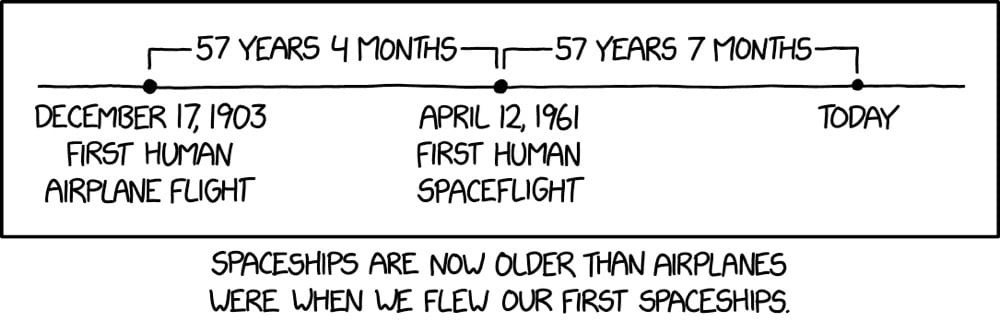
From XKCD, a reminder that human spaceflight is older than we might think and human flight is more recent.
I am a sucker for these sorts of things. Perhaps my favorite is that Cleopatra lived closer to the Moon landing than she did to the construction of the Great Pyramid of Giza. Or maybe it’s that Ralph Macchio is five years older now than Pat Morita was when he played Mr. Miyagi opposite Macchio in The Karate Kid.
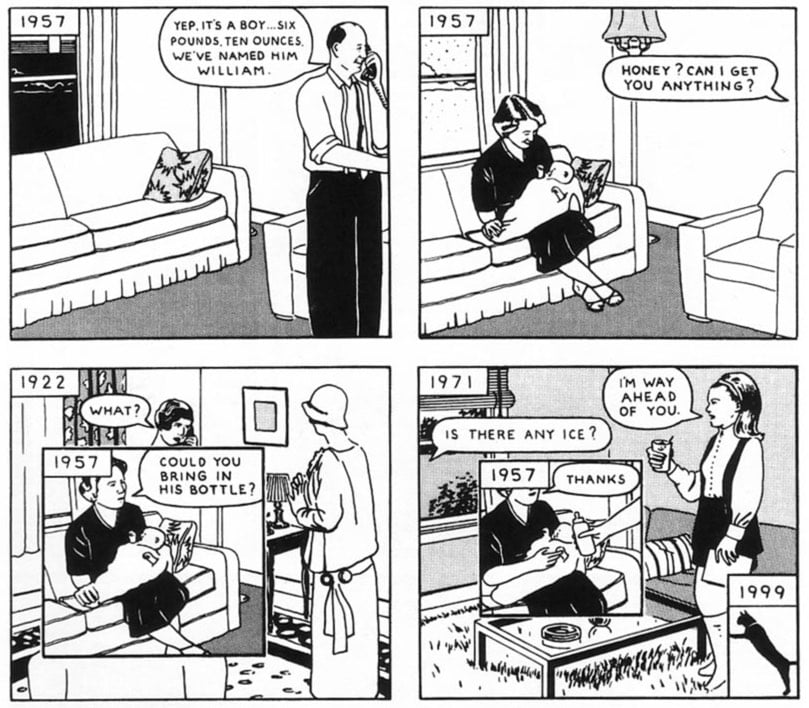
The book originated as a 36-panel story published in 1989 in Raw, the comics journal edited by Art Spiegelman and Francoise Mouly. No one who saw that story ever forgot it: a chronicle of a life, running from 1957 to 2027, as situated in one room, with kaleidoscopic intrusions from various pasts and a wisp of a future — the house burns in 2029 and is torn down in 2030; a time capsule is interred on the site in 2033. The time capsule, perhaps too neat a detail, has not survived the translation to the book, and the story no longer follows a single human life but fully widens its scope to the life of the place. You might say that the book is “Fantasia” to the story’s “Steamboat Willie,” for example, considering the latter’s black-and-white panels that draw their style from generically jocular 1950s illustration.
Drawing from David Wittenberg’s book, Time Travel: The Popular Philosophy of Narrative, as a guide, Evan Puschak goes in search of the origins of time travel in fiction. Along the way, he connects Charles Darwin’s work on evolution to the largely forgotten genre of utopian romance novels to the depiction of time travel in modern sci-fi.
P.S. While I was in France, I met up with Evan for lunch (we happened to be in Paris at the same time). We’d never met before, and it was really strange hearing the voice of one of my favorite YouTube channels coming out of an actual person.
Using a number of hand-drawn diagrams, minutephysics goes over the various types of time travel featured in books and movies like Primer, Harry Potter, Back to the Future, and Looper. The video covers free will, do-overs, alternate timelines, multiple selves, time machines within time machines, and many other things.
In 2012, physicist Frank Wilczek speculated that it would be possible to make a crystal whose lattice repeats in four dimensions, not just three.
Wilczek thought it might be possible to create a similar crystal-like structure in time, which is treated as a fourth dimension under relativity. Instead of regularly repeating rows of atoms, a time crystal would exhibit regularly repeating motion.
Many physicists were sceptical, arguing that a time crystal whose atoms could loop forever, with no need for extra energy, would be tantamount to a perpetual motion machine — forbidden by the laws of physics.
Now, a team at Berkeley have succeeded in making time crystals, publishing a method that two other teams have already successfully followed.
For Yao’s time crystal, an external force — like the pulse of a laser — flips the magnetic spin of one ion in a crystal, which then flips the spin of the next, and so forth, setting the system into a repeating pattern of periodic motion.
There are two critical factors. First, after the initial driver, it must be a closed system, unable to interact with and lose energy to the environment. Second, interactions between quantum particles are the driving force behind the time crystal’s stability. “It’s an emergent phenomenon,” says Yao. “It requires many particles and many spins to talk to each other and collectively synchronise.”
Melody Kramer is one of the smartest, most thoughtful people I know in journalism. She has a new post up at Poynter talking about ways to design the news that take into account that news can be overwhelming.
People take breaks, go on vacations, have stretches where they can’t keep up, work weird hours, have different levels of interest and background knowledge, and so forth — but they still want to be informed, connected, and engaged.
How can we deal with that? Here’s one good idea:
We should allow people to check out or pause and return. I envision a website where someone can say how long they’d like to be away from the news and what kinds of news they’d like when they return. This could most easily be accomplished through newsletters. For example, a landing page might allow a user to say: “I am taking [XX] [days / weeks / months] off. When I come back, I’d like to be updated on [topics] on [this frequency.]”
Years ago, some of us called this “my time” or “TiVo time”: a personalized, time-shifted attention economy. (Actually, I don’t think anybody called it “TiVo time” but me. And maybe a few guys who worked for TiVo.)
And for a little while, say around 2000-2010, media consumption in the form of DVRs, IM chats, blogging (and commenting), RSS feeds, Netflix DVDs (by mail!), was sort of unconsciously driven by this principle. It was available in close-to-real-time, but you could dip in and out of the stream much more easily.
Then a lot of factors — including short-form social media, livestream video, Netflix bingeing, a resurgence of TV events, and maybe especially always-available mobile devices — pushed us back to a much more immediate and real-time immersion in media. This hasn’t always been to everyone’s benefit. Not all consumers’, and not all producers’ either.
Choosing between plunging in or checking out has become a much more all-or-nothing proposition. It doesn’t have to be that way. We know this. We already built a lot of the tech that lets us manage this. Now we just have to figure out the best ways to deploy it.
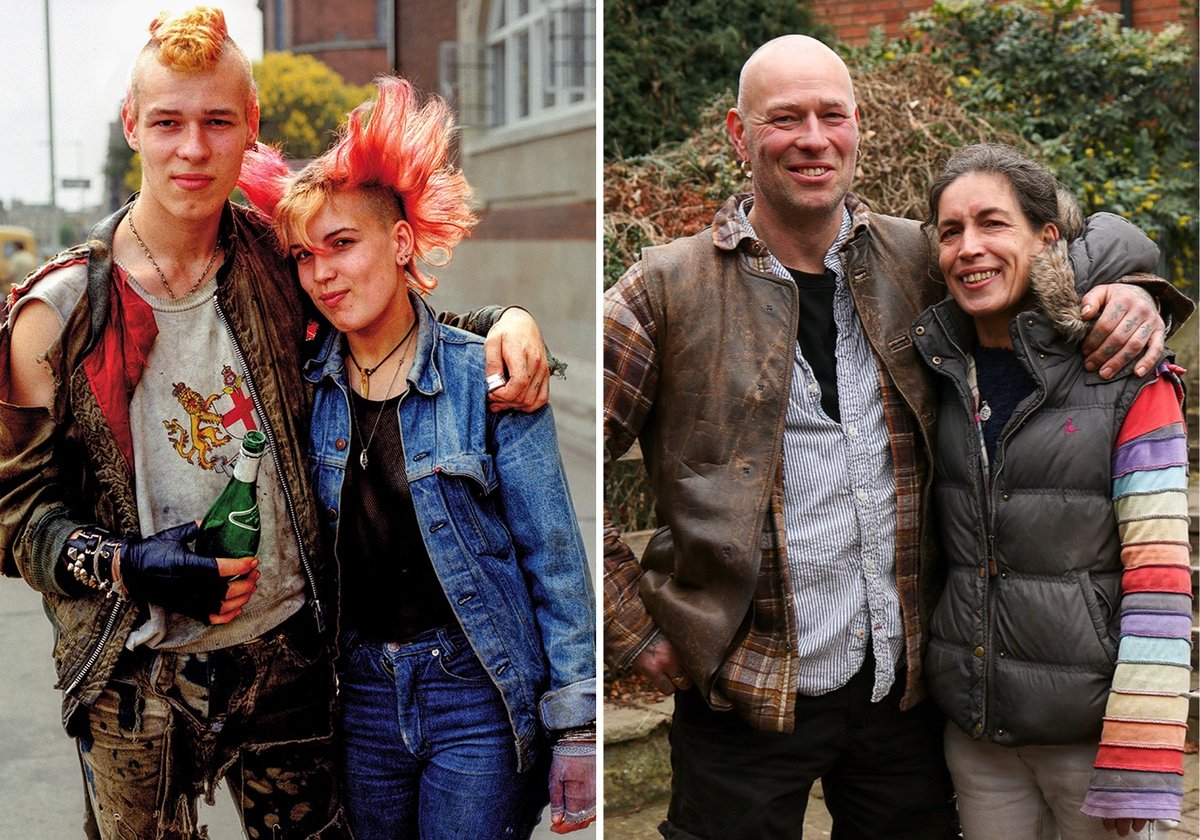
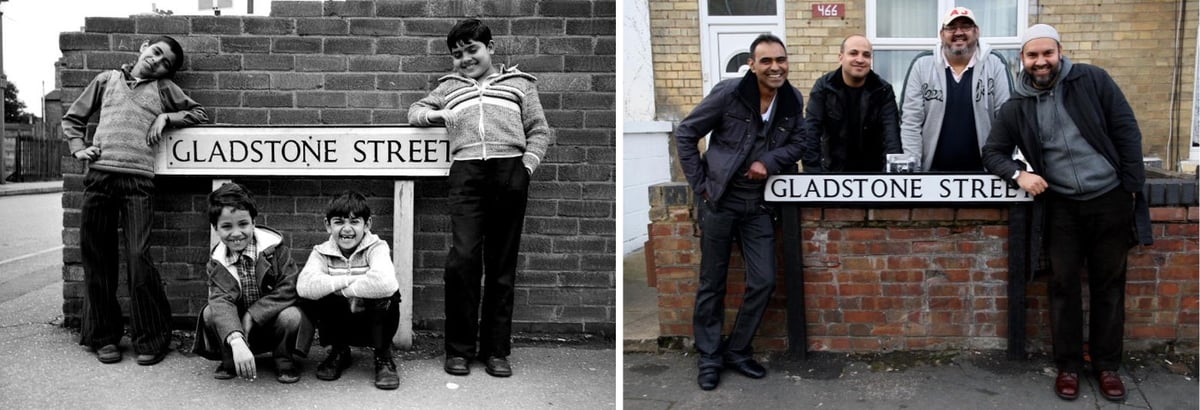
Photographer Chris Porsz has been taking candid photos of people on the streets of the English city of Peterborough since the 1970s. Recently, he tracked down a bunch of his subjects — many of them strangers — to recreate photos taken decades before, often in the same location. See also The Up Series, I should think.
Phil Edwards talks to James Gleick about his new book, Time Travel: A History, and of course the subject of killing Baby Hitler comes up. Turns out, the idea of using time travel to kill Adolf Hitler was first used by writer Ralph Milne Farley in 1941, before the US ever entered World War II or before the world learned the horrifying scope of the Holocaust.
I’m currently reading Gleick’s book and the most surprising thing so far is how recently time travel was invented…it’s only about 120 years old. The idea of progress was not really evident to people before the pace of technology and the importance of history became apparent in the 19th century. Progress made time travel relevant…without it, people couldn’t imagine going back in time to see how far they’d come or forward in time to see how much they’d progress.
[Spoilers!] This season, Game of Thrones is experimenting with time travel. A few years ago, Harrison Densmore created a chart showing the three kinds of time travel that happens in movies: fixed timeline (as in 12 Monkeys), dynamic timeline (as in Back to the Future), and multiverse (as in Terminator 2). So which kind of time travel is happening in Game of Thrones?
P.S. In addition to the extensive spoilers about what’s already happened on the show, the latter moments of the video also offers some fan theories about what might happen on the show in the future. If that sort of thing bothers you, maybe stop watching around the 4:05 mark.
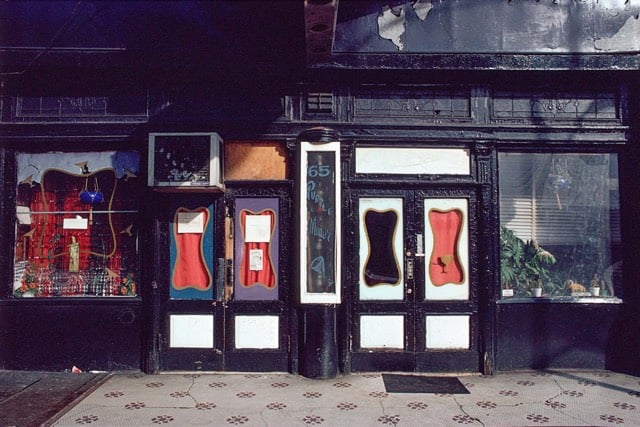
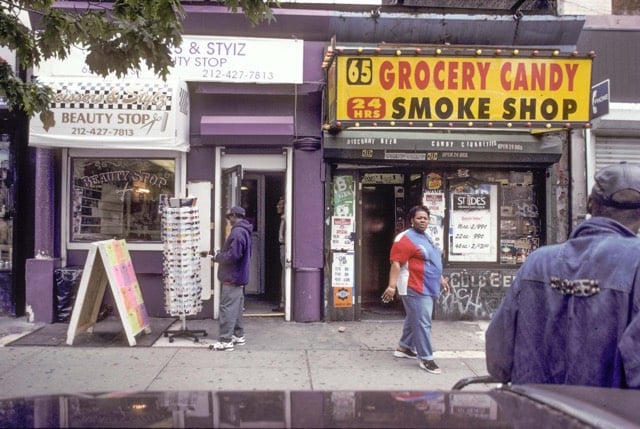
Camilo Jose Vergara’s Tracking Time project is a collection of photos of locations around the US (LA, Harlem, Detroit, South Bronx) photographed repeatedly over the years, from the 70s to the present day. For instance, here’s how 65 East 125th St in Harlem looked in 1978:
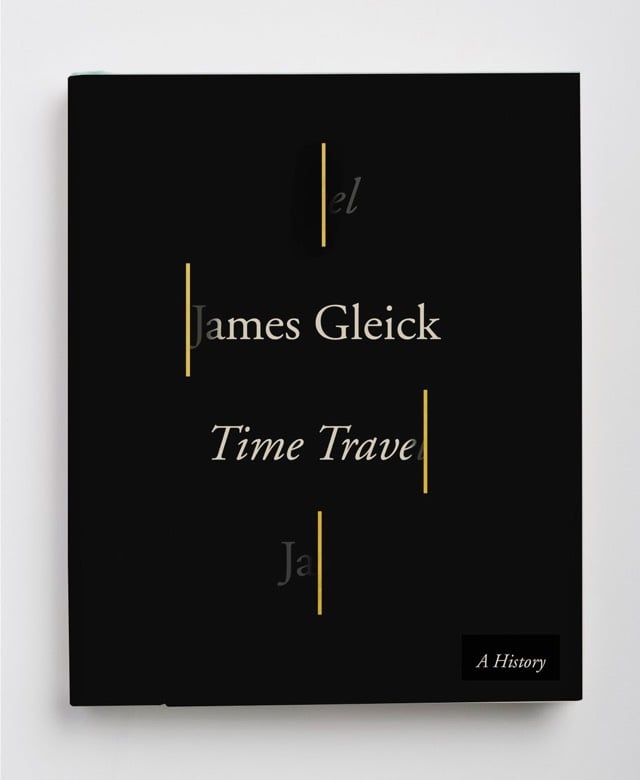
James Gleick, author of The Information, Chaos, and Genius, is coming out with a new book this fall called Time Travel. William Gibson has given it his thumbs up. Really excited for this one (it comes out on my birthday!) and curious to see how liberally he treats his subject…for instance, cameras are time machines.
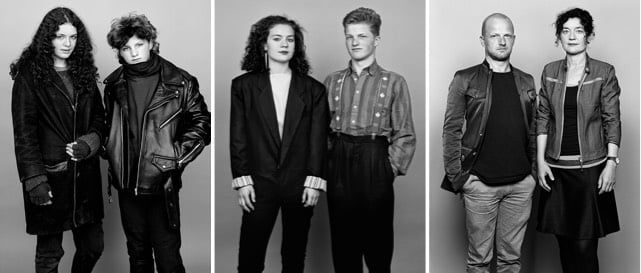
In 1982, photographer Barbara Davatz took photographs of 12 pairs of people. In 1988, she photographed them again. Same thing in 1997. And in 2014. A new book, As Time Goes By, collects all those photos in one place.
Their ranks have swelled over the years, with the addition of 14 children and even some grandchildren in the meantime, so the project now covers three generations. Other themes have long since been added to the original one of self-presentation. Without revealing any specific personal information, the series narrate a wide array of changes — physical, biographical and sartorial — over time. They tell of separations, of aging and loss, of the growth of families and the inheritance of family traits. But also of current urban society in each period.
This short student film follows a stone through many millions of years, from a large mountain to a grindstone to a cannonball and beyond. See also Al Jarnow’s Cosmic Clock. (via @mikesheffernj)
I cannot imagine the future, but I care about it. I know I am a part of a story that starts long before I can remember and continues long beyond when anyone will remember me. I sense that I am alive at a time of important change, and I feel a responsibility to make sure that the change comes out well. I plant my acorns knowing that I will never live to harvest the oaks.
I want to build a clock that ticks once a year. The century hand advances once every 100 years, and the cuckoo comes out on the millennium. I want the cuckoo to come out every millennium for the next 10,000 years.
The Clock of the Long Now is a short video portrait of Hillis and his collaborators as they build this clock in a mountain in western Texas. I like what Hillis had to say about our future:
I’m very optimistic about the future. I’m not optimistic because I think our problems are small. I’m optimistic because I think our capacity to deal with problems is great.
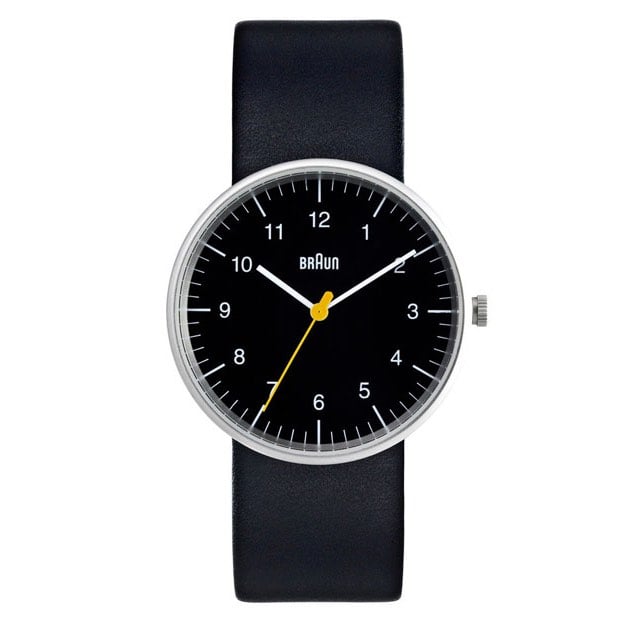
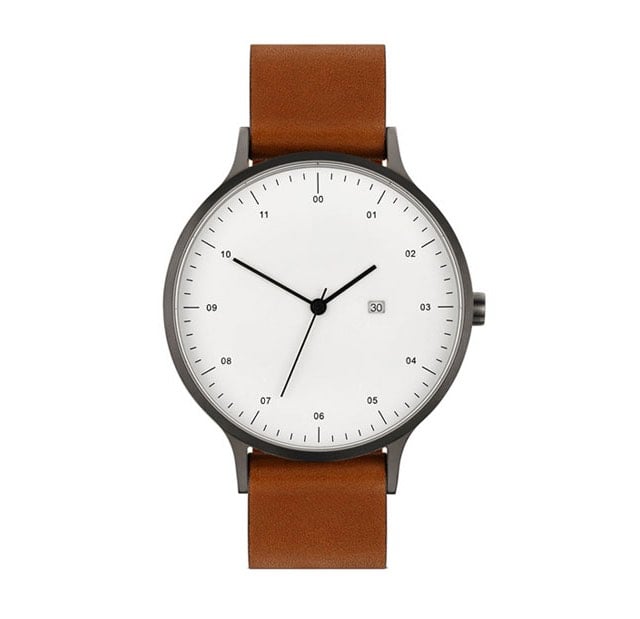
I am not a watch person. Haven’t worn one since high school, no interest in getting an Apple Watch, etc. But this post on We Made This about watches that appeal to graphic designers lists a few watches I would consider wearing. The Braun is a classic, of course:
But this one from Instrmnt is also quite nice, although I would prefer slightly larger numbers:









Stay Connected