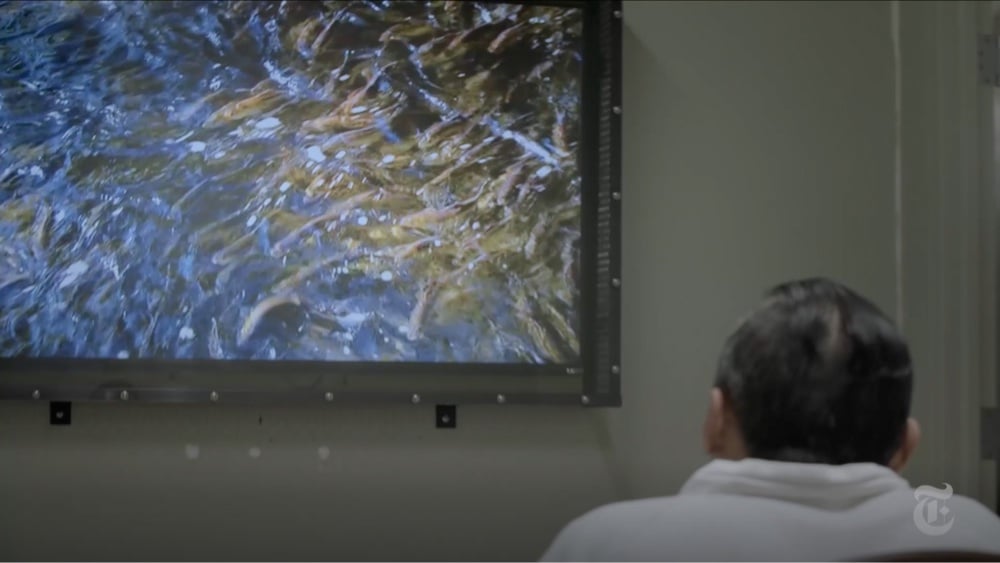
Merete Mueller’s short film Blue Room is about as meditative and peaceful a look at life in prison as you’ll ever see. It’s also quietly disturbing. In the US, our prison system is designed to punish incarcerated people by separating them from the outside world. Perhaps most significantly for their mental health, they are kept separate from nature: trees, rivers, lakes, oceans, the night sky; things that can keep people happy, healthy, and well-balanced. After learning about a program that shows nature videos in prisons, Mueller went to film and observe:
Years ago, I read about an exploratory program that showed nature imagery to people in prison to improve their mental health. During allotted downtime and in high-stress situations, individuals could request to visit the “blue room” to watch nature videos. Prison administrators hoped that these sessions would offer alternatives for people who were struggling emotionally, many of whom often ended up in solitary confinement.
We believe in the power of relaxing and meditative videos around here and I’m glad people in these prisons are able to find some peace in the blue room, but videos are not the real world. If Blue Planet II is necessary for incarcerated people to maintain their sanity and tenuous connection to nature and the outside world, as a society we really need to rethink what this system is doing to people. A friend said it reminded her of the incredibly dystopian use of VR goggles on cows in order to produce more milk. In his 2009 New Yorker article, Atul Gawande said that long-term solitary confinement is torture — but maybe all imprisonment is torture in our deeply punitive system? (thx, caroline)
By making public health central to their health care system, Costa Rica has achieved a higher life expectancy than the US for a fraction of the cost. How did they do it? The New Yorker’s Atul Gawande investigates.
Life expectancy tends to track national income closely. Costa Rica has emerged as an exception. Searching a newer section of the cemetery that afternoon, I found only one grave for a child. Across all age cohorts, the country’s increase in health has far outpaced its increase in wealth. Although Costa Rica’s per-capita income is a sixth that of the United States — and its per-capita health-care costs are a fraction of ours — life expectancy there is approaching eighty-one years. In the United States, life expectancy peaked at just under seventy-nine years, in 2014, and has declined since.
People who have studied Costa Rica, including colleagues of mine at the research and innovation center Ariadne Labs, have identified what seems to be a key factor in its success: the country has made public health — measures to improve the health of the population as a whole — central to the delivery of medical care. Even in countries with robust universal health care, public health is usually an add-on; the vast majority of spending goes to treat the ailments of individuals. In Costa Rica, though, public health has been a priority for decades.
The Covid-19 pandemic has revealed the impoverished state of public health even in affluent countries — and the cost of our neglect. Costa Rica shows what an alternative looks like. I travelled with Álvaro Salas to his home town because he had witnessed the results of his country’s expanding commitment to public health, and also because he had helped build the systems that delivered on that commitment. He understood what the country has achieved and how it was done.
In the US, the pandemic has revealed a public health system that is underfunded, underutilized, undervalued, and disconnected from the largely private health care system. As with many other aspects of American life, private individuals who can afford it get access to better lives, at the expense of everyone else.
The concern with the U.S. health system has never been about what it is capable of achieving at its best. It is about the large disparities we tolerate. Higher income, in particular, is associated with much longer life. In a 2016 study, the Harvard economist Raj Chetty and his research team found that the difference in life expectancy between forty-year-olds in the top one per cent of American income distribution and in the bottom one per cent is fifteen years for men and ten years for women.
This video interview with two former inmates (Five Mualimm-Ak and Terrence Slater) about their experiences in solitary confinement is, well, I was going to says “sobering” but it’s not sobering. It’s fucking infuriating and upsetting. Just to pick one moment, here’s Mualimm-Ak’s answer to “How do you maintain a sense of who you are?”:
You don’t. You live off of your memories because you have nothing else to accumulate to move forward. And then you end up having this short-term memory disorder which is a part of you the consequences of being in solitary where you can’t keep one train of thought for too long. And then you’re dropped off in 42nd Street-Times Square, the biggest tourist spot in the world, with 20 million commuters. It’s a sensory overload.
Being confined in a 6x9-foot cell for almost 30 years, with very limited contact with other humans or physical exercise, surely has consequences on one’s overall health, including the brain. King knew that solitary confinement was changing the way his brain worked. When he finally left his cell, he realized he had trouble recognizing faces and had to retrain his eyes to learn what a face was like. His sense of direction was also messed up, and he was unable to follow a simple route in the city by himself. It is as if his brain had erased all those capabilities that were no longer necessary for survival in a cell no bigger than the back of a pick-up truck.
A couple of things from the video that merit your attention. The first is Hell Is a Very Small Place, a book of stories by people who are now or have been in solitary confinement. And second, Mualimm-Ak started an organization called Incarcerated Nation Network “an abolition alliance network dedicated to transforming the prison industrial complex & ending torture” — join me in sending a donation to them? (via open culture)
I posted earlier about Atul Gawande’s piece in the New Yorker on the importance of incremental care in medicine. One of the things that the Affordable Care Act1 did was to make it illegal for insurance companies to deny coverage to people with “preexisting conditions”, which makes it difficult for those people to receive the type of incremental care Gawande touts. And who has these preexisting conditions? An estimated 27% of US adults under 65, including Gawande’s own son:
In the next few months, the worry is whether Walker and others like him will be able to have health-care coverage of any kind. His heart condition makes him, essentially, uninsurable. Until he’s twenty-six, he can stay on our family policy. But after that? In the work he’s done in his field, he’s had the status of a freelancer. Without the Affordable Care Act’s protections requiring all insurers to provide coverage to people regardless of their health history and at the same price as others their age, he’d be unable to find health insurance. Republican replacement plans threaten to weaken or drop these requirements, and leave no meaningful solution for people like him. And data indicate that twenty-seven per cent of adults under sixty-five are like him, with past health conditions that make them uninsurable without the protections.
That’s 52 million people, potentially ineligible for health insurance. And that’s not counting children. Spurred on by Gawande, people have been sharing their preexisting conditions stories on Twitter with the hashtag #the27Percent.
A new Kaiser Family Foundation analysis finds that 52 million adults under 65 — or 27 percent of that population — have pre-existing health conditions that would likely make them uninsurable if they applied for health coverage under medical underwriting practices that existed in most states before insurance regulation changes made by the Affordable Care Act.
In eleven states, at least three in ten non-elderly adults would have a declinable condition, according to the analysis: West Virginia (36%), Mississippi (34%), Kentucky (33%), Alabama (33%), Arkansas (32%), Tennessee (32%), Oklahoma (31%), Louisiana (30%), Missouri (30%), Indiana (30%) and Kansas (30%).
36% uninsurable in West Virginia! You’ll note that all 11 of those states voted for Trump in the recent election and in West Virginia, Trump carried the day with 68.7% of the vote, the highest percentage of any state. The states whose people need the ACA’s protection the most voted most heavily against their own interest.
Update: An earlier version of this post unfairly pinned the entire blame for the lack of coverage of those with preexisting conditions on the insurance companies.2 I removed the last paragraph because it was more or less completely wrong. Except for the part where I said we should be pissed at the Republican dickheads in Congress who want to repeal the ACA without replacing it with something better.3 And the part where we should be outraged. And the part where we regulated cars and cigarettes and food to make them safer, forced companies to build products in ways they didn’t want, and saved millions of lives. We can’t make everyone healthier and raise taxes to do it? Pathetic for what is supposedly the world’s most powerful and wealthy nation. (thx @JPVMan + many others)
I hope, for the love of Pete, that everyone reading this site is aware that the Affordable Care Act (the ACA) is Obamacare. Obamacare is the derogatory name the Republicans gave to the ACA that everyone, including Obama himself, ended up using. Which is unfortunate. President Obama and his administration deserve neither all of the credit nor should shoulder all of the blame for the ACA.
I would also like to add that I, as a (very) small business owner, rely on the protections afforded by the ACA to get insurance coverage for me and my family. Something to keep in mind if you otherwise don’t know anyone who would be affected by the ACA’s repeal. (Of course, the cushy insurance policy you get through work might be affected as well, you never know.)↩
At the heart of the ACA is a compromise between the US government and the insurance companies. The insurance companies don’t want to sell people insurance only when people are sick…that would be prohibitively expensive. That’s where the preexisting conditions thing comes in. So, the ACA says, ok, you have to sell insurance to people with preexisting conditions and we’ll make sure that everyone has to buy insurance, whether they’re sick or not. That bargain makes sure more people are covered and gives the insurance companies a larger pool of people to draw premiums from.
You can see why Republicans don’t like it: it forces people to buy something even if they don’t want to and it forces companies to sell things to people they would rather not sell. And as a bonus, people the Republicans don’t give a shit about — women, the poor, people of color — are disproportionately helped by the ACA. So they’ll repeal it and replace it with magic! And the only cost will be an increase in dead Americans.↩
I am all for this, BTW. If Paul Ryan and Donald Trump come up with a plan to give better and cheaper healthcare coverage to everyone in America, let’s do it.↩
In a piece called The Heroism of Incremental Care for the New Yorker, surgeon Atul Gawande argues that our healthcare system is built for and celebrates heroic intensive care over the slower but more effective efforts of long-term primary care givers.
We have a certain heroic expectation of how medicine works. Following the Second World War, penicillin and then a raft of other antibiotics cured the scourge of bacterial diseases that it had been thought only God could touch. New vaccines routed polio, diphtheria, rubella, and measles. Surgeons opened the heart, transplanted organs, and removed once inoperable tumors. Heart attacks could be stopped; cancers could be cured. A single generation experienced a transformation in the treatment of human illness as no generation had before. It was like discovering that water could put out fire. We built our health-care system, accordingly, to deploy firefighters. Doctors became saviors.
But the model wasn’t quite right. If an illness is a fire, many of them require months or years to extinguish, or can be reduced only to a low-level smolder. The treatments may have side effects and complications that require yet more attention. Chronic illness has become commonplace, and we have been poorly prepared to deal with it. Much of what ails us requires a more patient kind of skill.
How can we subject prisoners to unnecessary solitary confinement, knowing its effects, and then expect them to return to our communities as whole people? It doesn’t make us safer. It’s an affront to our common humanity.
“It crushes your spirit and weakens your resistance more effectively than any other form of mistreatment.” That’s a quote on solitary from John McCain from an old New Yorker piece from Atul Gawande: Hellhole. (via nextdraft)
Atul Gawande’s new book about medicine and death, Being Mortal, is out today. Two excerpts of the book are available online, The Best Possible Day:
I spoke with more than 200 people about their experiences with aging or serious illness, or dealing with a family member’s — many of them my own patients, some in my own family. I interviewed and shadowed front-line staff members in old age homes, palliative-care specialists, hospice workers, geriatricians, nursing home reformers, pioneers, and contrarians. And among the many things I learned, here are the two most fundamental.
First, in medicine and society, we have failed to recognize that people have priorities that they need us to serve besides just living longer. Second, the best way to learn those priorities is to ask about them. Hence the wide expert agreement that payment systems should enable health professionals to take sufficient time to have such discussions and tune care accordingly.
You don’t have to spend much time with the elderly or those with terminal illness to see how often medicine fails the people it is supposed to help. The waning days of our lives are given over to treatments that addle our brains and sap our bodies for a sliver’s chance of benefit. These days are spent in institutions — nursing homes and intensive-care units — where regimented, anonymous routines cut us off from all the things that matter to us in life.
Too many books to read! Gotta make time for this one though.
Surgeon and New Yorker writer Atul Gawande has a new book about death coming out in October called Being Mortal.
Medicine has triumphed in modern times, transforming birth, injury, and infectious disease from harrowing to manageable. But in the inevitable condition of aging and death, the goals of medicine seem too frequently to run counter to the interest of the human spirit. Nursing homes, preoccupied with safety, pin patients into railed beds and wheelchairs. Hospitals isolate the dying, checking for vital signs long after the goals of cure have become moot. Doctors, committed to extending life, continue to carry out devastating procedures that in the end extend suffering.
Gawande, a practicing surgeon, addresses his profession’s ultimate limitation, arguing that quality of life is the desired goal for patients and families. Gawande offers examples of freer, more socially fulfilling models for assisting the infirm and dependent elderly, and he explores the varieties of hospice care to demonstrate that a person’s last weeks or months may be rich and dignified.
This piece Gawande wrote for the New Yorker in 2010 was probably the genesis of the book. I maintain a very short list of topics I’d like to write books about and death is one of them. Not from a macabre Vincent Price / Tim Burton perspective…more like this stuff. Dying is something that everyone has to deal with many times during the course of their life and few seem to have a handle on how to deal with it. That’s fascinating. Can’t wait to read Gawande’s book.
This has been the pattern of many important but stalled ideas. They attack problems that are big but, to most people, invisible; and making them work can be tedious, if not outright painful. The global destruction wrought by a warming climate, the health damage from our over-sugared modern diet, the economic and social disaster of our trillion dollars in unpaid student debt-these things worsen imperceptibly every day. Meanwhile, the carbolic-acid remedies to them, all requiring individual sacrifice of one kind or another, struggle to get anywhere.
The global problem of death in childbirth is a pressing example. Every year, three hundred thousand mothers and more than six million children die around the time of birth, largely in poorer countries. Most of these deaths are due to events that occur during or shortly after delivery. A mother may hemorrhage. She or her baby may suffer an infection. Many babies can’t take their first breath without assistance, and newborns, especially those born small, have trouble regulating their body temperature after birth. Simple, lifesaving solutions have been known for decades. They just haven’t spread.
If you’re interested, Gawande wrote extensively on anesthesia and antiseptics in The New England Journal of Medicine.
From back in August, Atul Gawande visits a Cheesecake Factory and wonders if the combination of “quality control, cost control, and innovation” achieved by chain restaurants can offer lessons to hospitals and other health care organizations.
The company’s target last year was at least 97.5-per-cent efficiency: the managers aimed at throwing away no more than 2.5 per cent of the groceries they bought, without running out. This seemed to me an absurd target. Achieving it would require knowing in advance almost exactly how many customers would be coming in and what they were going to want, then insuring that the cooks didn’t spill or toss or waste anything. Yet this is precisely what the organization has learned to do. The chain-restaurant industry has produced a field of computer analytics known as “guest forecasting.”
“We have forecasting models based on historical data-the trend of the past six weeks and also the trend of the previous year,” Gordon told me. “The predictability of the business has become astounding.” The company has even learned how to make adjustments for the weather or for scheduled events like playoff games that keep people at home.
A computer program known as Net Chef showed Luz that for this one restaurant food costs accounted for 28.73 per cent of expenses the previous week. It also showed exactly how many chicken breasts were ordered that week ($1,614 worth), the volume sold, the volume on hand, and how much of last week’s order had been wasted (three dollars’ worth). Chain production requires control, and they’d figured out how to achieve it on a mass scale.
As a doctor, I found such control alien-possibly from a hostile planet. We don’t have patient forecasting in my office, push-button waste monitoring, or such stringent, hour-by-hour oversight of the work we do, and we don’t want to. I asked Luz if he had ever thought about the contrast when he went to see a doctor. We were standing amid the bustle of the kitchen, and the look on his face shifted before he answered.
“I have,” he said. His mother was seventy-eight. She had early Alzheimer’s disease, and required a caretaker at home. Getting her adequate medical care was, he said, a constant battle.
This piece was on several best-of-the-year longreads lists and deservedly so. But the Factory’s 3000-calorie plate of pasta will probably not help the state of American health care.
Writing for The New England Journal of Medicine, Atul Gawande reviews the history of surgery. The utility and efficacy of surgical procedures increased sharply with the use of anesthesia and antiseptic practices.
Before anesthesia, the sounds of patients thrashing and screaming filled operating rooms. So, from the first use of surgical anesthesia, observers were struck by the stillness and silence. In London, Liston called ether anesthesia a “Yankee dodge” - having seen fads such as hypnotism come and go - but he tried it nonetheless, performing the first amputation with the use of anesthesia, in a 36-year-old butler with a septic knee, 2 months after the publication of Bigelow’s report. As the historian Richard Hollingham recounts, from the case records, a rubber tube was connected to a flask of ether gas, and the patient was told to breathe through it for 2 or 3 minutes. He became motionless and quiet. Throughout the procedure, he did not make a sound or even grimace. “When are you going to begin?” asked the patient a few moments later. He had felt nothing. “This Yankee dodge beats mesmerism hollow,” Liston exclaimed.
It would take a little while for surgeons to discover that the use of anesthesia allowed them time to be meticulous. Despite the advantages of anesthesia, Liston, like many other surgeons, proceeded in his usual lightning-quick and bloody way. Spectators in the operating-theater gallery would still get out their pocket watches to time him. The butler’s operation, for instance, took an astonishing 25 seconds from incision to wound closure. (Liston operated so fast that he once accidentally amputated an assistant’s fingers along with a patient’s leg, according to Hollingham. The patient and the assistant both died of sepsis, and a spectator reportedly died of shock, resulting in the only known procedure with a 300% mortality.)
Athletes and singers have coaches. Teachers and surgeons don’t. Maybe they should? Atul Gawande investigates.
The concept of a coach is slippery. Coaches are not teachers, but they teach. They’re not your boss — in professional tennis, golf, and skating, the athlete hires and fires the coach — but they can be bossy. They don’t even have to be good at the sport. The famous Olympic gymnastics coach Bela Karolyi couldn’t do a split if his life depended on it. Mainly, they observe, they judge, and they guide.
Coaches are like editors, another slippery invention. Consider Maxwell Perkins, the great Scribner’s editor, who found, nurtured, and published such writers as F. Scott Fitzgerald, Ernest Hemingway, and Thomas Wolfe. “Perkins has the intangible faculty of giving you confidence in yourself and the book you are writing,” one of his writers said in a New Yorker Profile from 1944. “He never tells you what to do,” another writer said. “Instead, he suggests to you, in an extraordinarily inarticulate fashion, what you want to do yourself.”
The coaching model is different from the traditional conception of pedagogy, where there’s a presumption that, after a certain point, the student no longer needs instruction. You graduate. You’re done. You can go the rest of the way yourself. This is how elite musicians are taught. Barbara Lourie Sand’s book “Teaching Genius” describes the methods of the legendary Juilliard violin instructor Dorothy DeLay. DeLay was a Perkins-like figure who trained an amazing roster of late-twentieth-century virtuosos, including Itzhak Perlman, Nigel Kennedy, Midori, and Sarah Chang. They came to the Juilliard School at a young age — usually after they’d demonstrated talent but reached the limits of what local teachers could offer. They studied with DeLay for a number of years, and then they graduated, launched like ships leaving drydock. She saw her role as preparing them to make their way without her.
Two million patients pick up infections in American hospitals, most because someone didn’t follow basic antiseptic precautions. Forty per cent of coronary-disease patients and sixty per cent of asthma patients receive incomplete or inappropriate care. And half of major surgical complications are avoidable with existing knowledge. It’s like no one’s in charge-because no one is. The public’s experience is that we have amazing clinicians and technologies but little consistent sense that they come together to provide an actual system of care, from start to finish, for people. We train, hire, and pay doctors to be cowboys. But it’s pit crews people need.
In the past 4 months, I’ve changed my life for the better in three significant ways.
Why?
My relationships changed, and thus my everyday changed. I began eating with someone who ate differently than me. I adopted her eating habits, which spurred me to change how I ate. I also spent more time with Grant, who introduced me to the world of urban cycling. I adopted his lifestyle and his interests. And then I changed myself and started pushing my heart in the gym.
I’m playing Health Month this month, mostly just for the hell of it. The game is built to be social…there are teams, players offer each other support, etc. Just two days in, I can see why this might work for me: it turns private goals into public rules.
You may have seen a reference to this last week, but the New Yorker just posted the full text of Atul Gawande’s latest article on their site. The article is about efforts to lower healthcare costs by focusing on the patients who use (and often misuse) healthcare the most. Like many of Gawande’s other articles, this is a must-read.
“Let’s do the E.R.-visit game,” he went on. “This is a fun one.” He sorted the patients by number of visits, much as Jeff Brenner had done for Camden. In this employed population, the No. 1 patient was a twenty-five-year-old woman. In the past ten months, she’d had twenty-nine E.R. visits, fifty-one doctor’s office visits, and a hospital admission.
“I can actually drill into these claims,” he said, squinting at the screen. “All these claims here are migraine, migraine, migraine, migraine, headache, headache, headache.” For a twenty-five-year-old with her profile, he said, medical payments for the previous ten months would be expected to total twenty-eight hundred dollars. Her actual payments came to more than fifty-two thousand dollars — for “headaches.”
Was she a drug seeker? He pulled up her prescription profile, looking for narcotic prescriptions. Instead, he found prescriptions for insulin (she was apparently diabetic) and imipramine, an anti-migraine treatment. Gunn was struck by how faithfully she filled her prescriptions. She hadn’t missed a single renewal — “which is actually interesting,” he said. That’s not what you usually find at the extreme of the cost curve.
The story now became clear to him. She suffered from terrible migraines. She took her medicine, but it wasn’t working. When the headaches got bad, she’d go to the emergency room or to urgent care. The doctors would do CT and MRI scans, satisfy themselves that she didn’t have a brain tumor or an aneurysm, give her a narcotic injection to stop the headache temporarily, maybe renew her imipramine prescription, and send her home, only to have her return a couple of weeks later and see whoever the next doctor on duty was. She wasn’t getting what she needed for adequate migraine care — a primary physician taking her in hand, trying different medications in a systematic way, and figuring out how to better keep her headaches at bay.
It was a dimly lit box, 9ft by 6ft, with bars at the front facing on to the bare cement walls of a long corridor. Inside was a narrow bed, a toilet, a fixed table and chair, and an air vent set into the back wall.
Some days I would pace up and down and from left to right for hours, counting to myself. I learned to know every inch of the cell. Maybe I looked crazy walking back and forth like some trapped animal, but I had no choice — I needed to feel in control of my space.
He was in the hands of medicine. He was hopeful but realistic. He will come to feel increasingly like a member of the audience in the theater of his own illness. I’ve been there. There were times when I seemed to have nothing to do with it. One night, unable to speak, I caught the eye of a nurse through my open door and pointed to the blood leaking from my hospital gown. She pushed a panic button and my bed was surrounded by an emergency team, the duty physician pushing his fingers with great force against my carotid artery to halt the bleeding. I was hoisted on my sheet over to a gurney, and raced to the OR. “Move it, people,” he shouted. “We’re going to lose this man.”
Anderson Cooper asked Hitchens whether he’d been moved by the prayer groups supporting him to pray himself:
“No, that’s all meaningless to me. I don’t think souls or bodies can be changed by incantation.” There was a catch in his voice, and the slightest hint of tears. That was the moment — not the cancer or the dying — that got to me. Prayer groups also prayed for me, and I was grateful and moved. It isn’t the sad people in movies who make me cry, it’s the good ones.
Hitchens added that if there should be reports of his deathbed conversion, they would be reports of a man “irrational and babbling with pain.” As long as he retains his thinking ability, he said, there will be no conversion to belief in God. This is what I expected him to say. Deathbed conversions have always seemed to me like a Hail Mary Pass, proving nothing about religion and much about desperation.
I wrote this at Snarkmarket at the beginning of the week:
Recent efforts by Tony Judt, Christopher Hitchens, Atul Gawande, following on slightly older ones by Joan Didion and Phillip Roth, make me wonder whether we’ve achieved a new breakthrough in our ability to write about death — perhaps especially protracted death, death within the context of medical treatment, in a secular context, which as Gawande reminds us, is comparatively new and certainly much more common.
Here’s the section of Gawande’s recent New Yorker essay I was thinking of:
For all but our most recent history, dying was typically a brief process. Whether the cause was childhood infection, difficult childbirth, heart attack, or pneumonia, the interval between recognizing that you had a life-threatening ailment and death was often just a matter of days or weeks… [A]s the end-of-life researcher Joanne Lynn has observed, people usually experienced life-threatening illness the way they experienced bad weather—as something that struck with little warning—and you either got through it or you didn’t.
An unexpected cost of the secularization/medicalization of death is that we lose the language we need to talk our way through it:
Dying used to be accompanied by a prescribed set of customs. Guides to ars moriendi, the art of dying, were extraordinarily popular; a 1415 medieval Latin text was reprinted in more than a hundred editions across Europe. Reaffirming one’s faith, repenting one’s sins, and letting go of one’s worldly possessions and desires were crucial, and the guides provided families with prayers and questions for the dying in order to put them in the right frame of mind during their final hours. Last words came to hold a particular place of reverence.
These days, swift catastrophic illness is the exception; for most people, death comes only after long medical struggle with an incurable condition—advanced cancer, progressive organ failure (usually the heart, kidney, or liver), or the multiple debilities of very old age. In all such cases, death is certain, but the timing isn’t. So everyone struggles with this uncertainty—with how, and when, to accept that the battle is lost.
That’s one of the stunning things about Gawande’s essay — how much of what it describes is a failure of language. No one can speak, at least directly; we can only watch.
Almost all these patients had known, for some time, that they had a terminal condition. Yet they-along with their families and doctors-were unprepared for the final stage. “We are having more conversation now about what patients want for the end of their life, by far, than they have had in all their lives to this point,” my friend said. “The problem is that’s way too late.” In 2008, the national Coping with Cancer project published a study showing that terminally ill cancer patients who were put on a mechanical ventilator, given electrical defibrillation or chest compressions, or admitted, near death, to intensive care had a substantially worse quality of life in their last week than those who received no such interventions. And, six months after their death, their caregivers were three times as likely to suffer major depression. Spending one’s final days in an I.C.U. because of terminal illness is for most people a kind of failure. You lie on a ventilator, your every organ shutting down, your mind teetering on delirium and permanently beyond realizing that you will never leave this borrowed, fluorescent place. The end comes with no chance for you to have said goodbye or “It’s O.K.” or “I’m sorry” or “I love you.”
Warning: it’s good, but you’ll probably be crying by the end of this article.
My father didn’t die nearly so well. At 74, after a 50-year career as a professor of mechanical engineering, he lost his mind. At first he’d cover his mistakes with jokes-a forced punch line after slipping up on calculating the tip at dinner. Have you noticed how forgetful he’s getting? His second wife whispered to me in the kitchen after a family meal. I hadn’t. But it wasn’t long before his colleagues politely suggested that it was time for him to retire. He’d been spotted in the elevator, the doors opening and closing repeatedly, as he stood there incapable of deciding which button to push. He could no longer locate his car in the lot. The faculty feared he was a danger to himself. Not long after, my father left his office; it’s piles of professional journals and papers, and the poster hung on the back door, “I’M GOING TO BE AN ENGINEER LIKE MY MOM,” expecting to be back.
Half the words you now routinely use you did not know existed when you started: words like arterial-blood gas, nasogastric tube, microarray, logistic regression, NMDA receptor, velluvial matrix.
O.K., I made that last one up. But the velluvial matrix sounds like something you should know about, doesn’t it? And that’s the problem. I will let you in on a little secret. You never stop wondering if there is a velluvial matrix you should know about.
Since I graduated from medical school, my family and friends have had their share of medical issues, just as you and your family will. And, inevitably, they turn to the medical graduate in the house for advice and explanation.
I remember one time when a friend came with a question. “You’re a doctor now,” he said. “So tell me: where exactly is the solar plexus?”
I was stumped. The information was not anywhere in the textbooks.
Gawande had seen that part of the man’s colon was ischemic — dead and gangrenous — and had ceased to move waste out of the body. He wasn’t sure about the cause, but suspected a blood clot. One thing was clear: without immediate surgery, the colon would rupture.
After examining the patient, Gawande conferred with the resident in the corridor outside the man’s room. He went through a familiar and well-practiced set of actions that he seemed to do without thinking: slipping his ring finger into his mouth to moisten it, working his wedding band off, unbuckling his watchband, threading it through the ring, and refastening it, all the while carrying on a conversation about stopping the patient’s anti-clotting medication and getting a vascular surgeon to assist.
Atul Gawande and some colleagues searched the US for healthcare successes — hospitals and clinics where costs are relatively low and quality of care is high — and came up with a few lessons.
If the rest of America could achieve the performances of regions like these, our health care cost crisis would be over. Their quality scores are well above average. Yet they spend more than $1,500 (16 percent) less per Medicare patient than the national average and have a slower real annual growth rate (3 percent versus 3.5 percent nationwide).
I wanted this article to be much longer than it was with breakouts of each of the ten lessons with lengthy explanations.
I recently came on a phrase in an article in the journal “Annals of Internal Medicine” about an axiom of medical economics: a dollar spent on medical care is a dollar of income for someone. I have been reciting this as a mantra ever since. It may be the single most important fact about health care in America that you or I need to know. It means that all of us — doctors, hospitals, pharmacists, drug companies, nurses, home health agencies, and so many others — are drinking at the same trough which happens to hold $2.1 trillion, or 16% of our GDP. Every group who feeds at this trough has its lobbyists and has made contributions to Congressional campaigns to try to keep their spot and their share of the grub. Why not? — it’s hog heaven. But reform cannot happen without cutting costs, without turning people away from the trough and having them eat less. If you do that, you have to be prepared for the buzz saw of protest that dissuaded Roosevelt, defeated Truman’s plan and scuttled Hillary Clinton’s proposal.
In Gawande’s example, what Verghese is saying is that you can’t just make McAllen’s healthcare system adopt an El Paso type of system without a whole lot of pain.
Gawande addressed some of the criticisms of his article on the New Yorker site. One of the major criticisms was that McAllen’s higher costs were associated with higher levels of poverty and unhealthiness:
As I noted in the piece, McAllen is indeed in the poorest county in the country, with a relatively unhealthy population and the problems of being a border city. They have a very low physician supply. The struggles the people and medical community face there are huge. But they are just as huge in El Paso — its residents are barely less poor or unhealthy or under-supplied with physicians than McAllen, and certainly not enough so to account for the enormous cost differences. The population in McAllen also has more hospital beds than four out of five American cities.
On Friday, Atul Gawande gave the commencement address at the University of Chicago Pritzker School of Medicine. The address touched on some of the same themes as his recent piece on the differing costs of healthcare across the US. He began with an anecdote about how observation of well-nourished children in poor Vietnamese villages led to village-wide improvments in curbing malnutrition.
The villagers discovered that there were well-nourished children among them, despite the poverty, and that those children’s mothers were breaking with the locally accepted wisdom in all sorts of ways — feeding their children even when they had diarrhea; giving them several small feedings each day rather than one or two big ones; adding sweet-potato greens to the children’s rice despite its being considered a low-class food. The ideas spread and took hold. The program measured the results and posted them in the villages for all to see. In two years, malnutrition dropped sixty-five to eighty-five per cent in every village the Sternins had been to.
And I don’t know why, but I’ve always thought of surgery as primarily a cerebral pursuit; a great surgeon is so because he’s clever and smart. A short passage from Gawande’s address reveals that perhaps that’s not the case:
In surgery, for instance, I know that I have more I can learn in mastering the operations I do. So what does a surgeon like me do? We look to those who are unusually successful — the positive deviants. We watch them operate and learn their tricks, the moves they make that we can take home.
So surgeons learn surgery in the same way that kids learn Kobe Bryant’s post moves from SportsCenter highlights?
As part of the larger effort to overhaul health care, lawmakers are trying to address the problem that intrigues Mr. Obama so much — the huge geographic variations in Medicare spending per beneficiary. Two decades of research suggests that the higher spending does not produce better results for patients but may be evidence of inefficiency.
Atul Gawande discovered that McAllen, Texas spends more per person on healthcare than El Paso (which is demographically similar to McAllen) and set out to find out why. Along the way, he encounters a curious relationship between the amount spent on healthcare and the quality of that care: higher spending does not correlate with better care.
When you look across the spectrum from Grand Junction to McAllen — and the almost threefold difference in the costs of care — you come to realize that we are witnessing a battle for the soul of American medicine. Somewhere in the United States at this moment, a patient with chest pain, or a tumor, or a cough is seeing a doctor. And the damning question we have to ask is whether the doctor is set up to meet the needs of the patient, first and foremost, or to maximize revenue.
There is no insurance system that will make the two aims match perfectly. But having a system that does so much to misalign them has proved disastrous. As economists have often pointed out, we pay doctors for quantity, not quality. As they point out less often, we also pay them as individuals, rather than as members of a team working together for their patients. Both practices have made for serious problems.
Obama, you’re reading this guy’s stuff, yes? Get him on the team.
I changed the bit in the first paragraph about El Paso and McAllen being “nearby”. Funny, I thought 800 miles in Texas *was* nearby. (thx, stephen)
I also changed “lower spending correlates with better care” to “higher spending does not correlate with better care”…those two statements are not the same. I misread the results of one of the studies that Gawande mentions. (thx, patrick)
Atul Gawande branches out from his usual excellent writing on medicine and turns his attention to solitary confinement in America’s prison system. Gawande likens extended solitary time to torture.
This is the dark side of American exceptionalism. With little concern or demurral, we have consigned tens of thousands of our own citizens to conditions that horrified our highest court a century ago. Our willingness to discard these standards for American prisoners made it easy to discard the Geneva Conventions prohibiting similar treatment of foreign prisoners of war, to the detriment of America’s moral stature in the world. In much the same way that a previous generation of Americans countenanced legalized segregation, ours has countenanced legalized torture. And there is no clearer manifestation of this than our routine use of solitary confinement-on our own people, in our own communities, in a supermax prison, for example, that is a thirty-minute drive from my door.
This likely will not change until Americans start to believe that rehabilitation and not punishment is the primary goal of prisons. So, probably never.
Every industrialized nation in the world except the United States has a national system that guarantees affordable health care for all its citizens. Nearly all have been popular and successful. But each has taken a drastically different form, and the reason has rarely been ideology. Rather, each country has built on its own history, however imperfect, unusual, and untidy.
As usual, Gawande makes a lot of sense. Whatever the solution, we should be doing all we can to avoid something like this from ever happening again:
“When I heard that I was losing my insurance, I was scared,” Darling told the Times. Her husband had been laid off from his job, too. “I remember that the bill for my son’s delivery in 2005 was about $9,000, and I knew I would never be able to pay that by myself.” So she prevailed on her midwife to induce labor while she still had insurance coverage. During labor, Darling began bleeding profusely, and needed a Cesarean section. Mother and baby pulled through. But the insurer denied Darling’s claim for coverage. The couple ended up owing more than seventeen thousand dollars.
I try not to miss any of Atul Gawande’s New Yorker articles, but his piece on itching from this week’s issue is possibly the most interesting thing I’ve read in the magazine in a long time. He begins by focusing on a specific patient for whom compulsive itching has become a very serious problem. (Warning, this quote is pretty disturbing…but don’t let it deter you from reading the article.)
…the itching was so torturous, and the area so numb, that her scratching began to go through the skin. At a later office visit, her doctor found a silver-dollar-size patch of scalp where skin had been replaced by scab. M. tried bandaging her head, wearing caps to bed. But her fingernails would always find a way to her flesh, especially while she slept.
One morning, after she was awakened by her bedside alarm, she sat up and, she recalled, “this fluid came down my face, this greenish liquid.” She pressed a square of gauze to her head and went to see her doctor again. M. showed the doctor the fluid on the dressing. The doctor looked closely at the wound. She shined a light on it and in M.’s eyes. Then she walked out of the room and called an ambulance. Only in the Emergency Department at Massachusetts General Hospital, after the doctors started swarming, and one told her she needed surgery now, did M. learn what had happened. She had scratched through her skull during the night — and all the way into her brain.
From there, Gawande pulls out to tell us about itching/scratching (the two are inseparable), then about a recent theory of how our brains perceive the world (“visual perception is more than ninety per cent memory and less than ten per cent sensory nerve signals”), and finally about a fascinating therapy initially developed for those who experience phantom limb pain called mirror treatment.
Among them is an experiment that Ramachandran performed with volunteers who had phantom pain in an amputated arm. They put their surviving arm through a hole in the side of a box with a mirror inside, so that, peering through the open top, they would see their arm and its mirror image, as if they had two arms. Ramachandran then asked them to move both their intact arm and, in their mind, their phantom arm-to pretend that they were conducting an orchestra, say. The patients had the sense that they had two arms again. Even though they knew it was an illusion, it provided immediate relief. People who for years had been unable to unclench their phantom fist suddenly felt their hand open; phantom arms in painfully contorted positions could relax. With daily use of the mirror box over weeks, patients sensed their phantom limbs actually shrink into their stumps and, in several instances, completely vanish. Researchers at Walter Reed Army Medical Center recently published the results of a randomized trial of mirror therapy for soldiers with phantom-limb pain, showing dramatic success.
Crazy! Gawande documents and speculates about other applications of this treatment, including using virtual reality representations instead of mirrors and utilizing multiple mirrors for treatment of M.’s itchy scalp. Anyway, read the whole thing…highly recommended.





Stay Connected