This is a nice thing to end the week on: Yo-Yo Ma playing “Bach’s Prélude from Suite No. 2, amidst the melting permafrost on Lower Tanana Dene lands in Fairbanks, Alaska.” He was brought to this birch forest by Princess Daazhraii Johnson, a member of the Neets’aii Gwich’in people, who wrote:
Our relationship to our birch relatives, our salmon relatives, and all the beings of Alaska are sacred. Our traditional stories tell us that at one point we all spoke the same language … we still do. If we find the time to truly listen, we might recognize ourselves in the melting permafrost or the fallen birch, but we might also recognize ourselves in the songs of the birds or the freshness of the Arctic breeze. There is still hope when we experience life. We should all fall in love with the places we live and let this love drive our determination to protect the waters, the salmon, the caribou, and all our plant relatives so that future generations may also experience such joy and sustenance.
In order to leave comments on posts, you need to be a current kottke.org member. If you'd like to sign up for a membership to support the site and join the conversation, you can explore your options here.
The Man Who Killed Google Search, i.e. how “growth-hungry managerial types” from Google’s ad business chased out the old search team “to make Google worse to make the company more money”.
This is great: a 25-minute interview with legendary animator Chuck Jones as he sits and draws some of his iconic characters (Bugs Bunny, Porky Pig, Daffy Duck). He told this anecdote about how Steven Spielberg and George Lucas were both influenced by a particular space-themed cartoon of his:
Porky was just a kind of a little third-string Boy Scout and was not very interesting to me. And then when I put him in a picture called Duck Dodgers in the 24th and a Half Century. Spielberg used that picture in Close Encounters the Third Kind - when his kids were watching television in the picture, they were watching Duck Dodgers in the 24th and a Half Century. And Lucas told me that he saw that picture when he was 12 years old and when when he opened Star Wars in San Francisco he told them they couldn’t have Star Wars in San Francisco unless they ran Duck Dodgers in the 24th and a Half Century.
Sounds like The Onion has been rescued from an agonizing death by private equity by an acquisition by people who actually care about it. “The Onion is just an institution. It should be preserved and it should be great.”
The other day, the novelist Robin Sloan mentioned in his newsletter that he really liked the Financial Times. It seems everyone’s talking up the Financial Times lately, so I went and followed them on Instagram.
The surprise of middle age, and the terror of it, is how much of a person’s fate can boil down to one misjudgement.
Such as? What in particular should the young know? If you marry badly — or marry at all, when it isn’t for you — don’t assume the damage is recoverable. If you make the wrong career choice, and realise it as early as age 30, don’t count on a way back. … A big [mistake], or just an early one, can foreclose all hope of the life you wanted.
At first I found it oddly cheering (if I can’t fix my mistakes, I might as well relax and accept my circumstances), but then I found it sad. (Does my husband feel like he made a life-destroying mistake by marrying me? LMAO.) Now I’m more like ¯\_(ツ)_/¯ because things can only ever go the way they go. Anyway, I’m not yet a FT subscriber, but it was a nudge.
Here is a pleasantly painful trailer for a new movie from the filmmaker Joanna Arnow. It opens this Friday, April 26, at IFC and Lincoln Center in NYC. I don’t know if I’m going to watch it, but I couldn’t really look away.
Arnow also stars as…
an emotionally detached young Brooklynite drifting through unremarkable days and nights. Neither her on-again-off-again BDSM relationship with a mildly disinterested older dom, nor her nondescript corporate job, appear to bring her any satisfaction.
And yet “she finds a core of poignant truth about the ways people search for … emotional happiness and sexual gratification” (per the Lincoln Center summary). It’s currently at a 100% on Rotten Tomatoes, FWIW. (This bit also made me laugh out loud.)
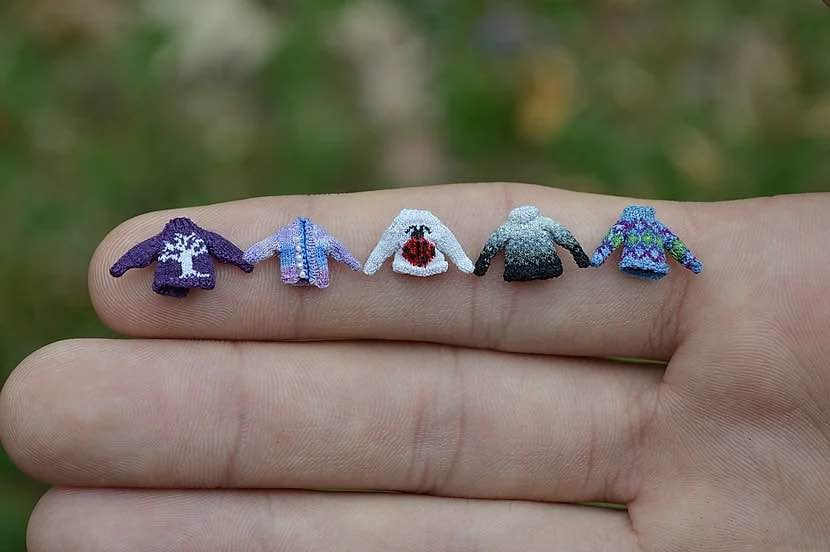
Oh my gosh — this video about making the teeny-tiny sweaters seen in the movie Coraline! Says artist Althea Crome:
I think knitters are often fascinated by the fact that I use such tiny needles. Some of the needles are almost the dimension of a human hair.
Sublimely absurd, perfection. More info in Reactor. [Thanks, Tobias!]
And here’s another pic, grabbed from Crome’s website:
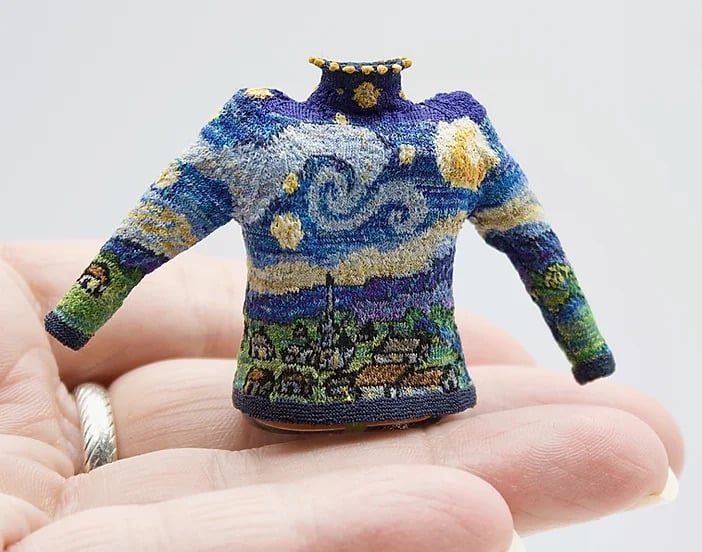
I don’t know about you, but this makes me want to drop everything and disappear into the process of knitting a microscopic sweater for the next six months. Like her Starry Night one.
Actually, the Starry Night sweater should just be its whole own post:
“I love the paradox of creating an object that takes the form of something you can wear,” Crome writes, “yet is impossible to wear.”
“I have no training for this work. I got the job by bringing in my posters to be framed … and asking the frame shop guy—my boss—if he needed an assistant.” I loved this essay about working in a frame shop (and beyond). “My life has gone off the map, it seems.”
I love this: The Pudding ran an online experiment where they started with a shape (like a straight line or circle) and asked people to trace, as best they could, the tracing of the person before them. This resulted in a series of “flipbook” animation of how the shapes evolved over time — invariably, a squiggle.
One thing I noticed right away was how all the squiggles ended up squished over on the right side of the screen. The Pudding team had a theory on why that happened (the 3:20 mark in this video):
I found this study from like 35 years ago - they were trying to figure out why people kept missing their targets on touch screens. They found people tended to touch below their target and people tended to touch closer to the edges of the screen. And so I figure if it’s like right-handers who are missing, you’re going to be missing to the right. We probably had about half the users on mobile and 90% of the those half are probably going to be right-handed so it would make sense that it would gradually go to the right.
Go read the rest of the post — they also did an experiment about people’s inclination to draw penises on “any free-form drawing project on the internet”. (via waxy)
As someone who is interested in birds but doesn’t know a whole lot about them, this new animated video series from Will Rose is right up my alley. What Bird Is That? is a beginners guide to birding. The second episode, embedded above, is all about how to identify birds from their calls.
What’s that bird that sounds like Star Wars singing on my roof? What bird sings it’s own name? What’s that laughing sound you heard in the woods?
Right now, I “cheat” by using Cornell Lab of Ornithology’s eBird app, which allows you to record a bit of birdsong and it’ll ID the bird for you. (via the kid should see this)
A Message from the Chancellor on the Recent Student Protest. “But this recent protest is different. These students will never inspire change. Fifty years from now, we will definitely not pretend that we agreed with them the whole time.”
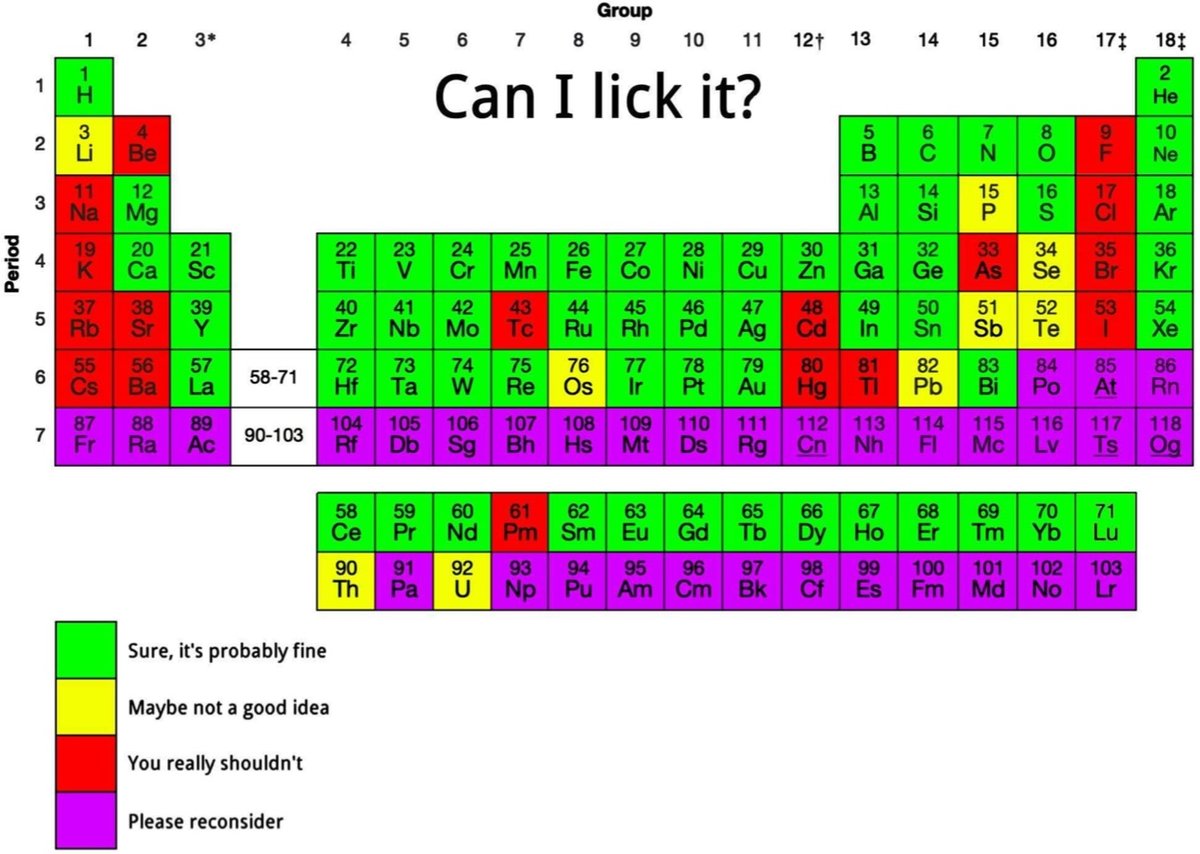
Is the periodic table yummy? Well, it depends on the element. But if you’ve ever wondered if a little taste of xenon or iridium would do you any harm, this periodic table is for you.
The novelist R.O. Kwon: The Parents Who Regret Having Children. “It’s possible to have strong, lasting regrets about a life choice while ferociously loving — and caring for — the fruit of that decision.”
Steve Mould’s videos are always entertaining and informative but this one is also a little bit mind-blowing. If you build a circular trough with just the right dimensions and fill it with lighter fluid, a flame will travel around it. And other shapes will do other things — the effect created by the star/octopus shape is especially cool. The effect is an example of an excitable medium:
An excitable medium is a nonlinear dynamical system which has the capacity to propagate a wave of some description, and which cannot support the passing of another wave until a certain amount of time has passed (known as the refractory time).
A forest is an example of an excitable medium: if a wildfire burns through the forest, no fire can return to a burnt spot until the vegetation has gone through its refractory period and regrown.
Other examples:
Normal and pathological activities in the heart and brain can be modelled as excitable media. A group of spectators at a sporting event are an excitable medium, as can be observed in a Mexican wave (so-called from its initial appearance in the 1986 World Cup in Mexico).
Designer/creative Connell McCarthy: “I got married and over-engineered everything.” He obviously designed everything — invites, website (using AWS!), signage — but also made custom candles and an iPad jukebox app using the Spotify API.
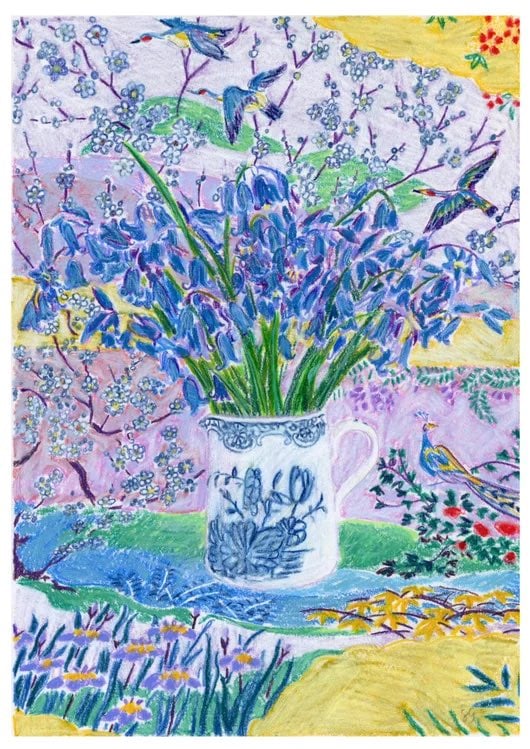
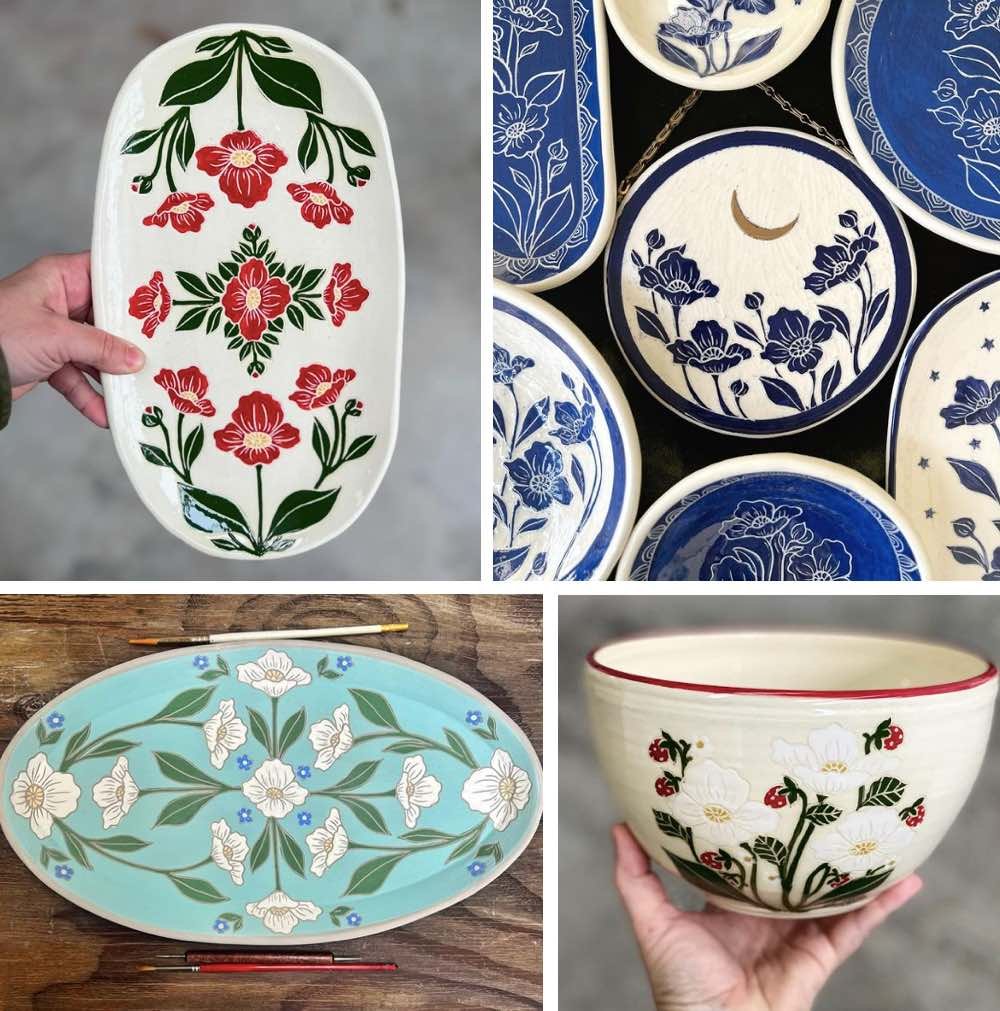
In the spirit of recommending things I truly love, I wanted to highlight the pottery of Northern California artist Naja Tepe. I’ve ordered from her twice now, and her work is fabulous. I love her strawberry-themed items, but the crescent moon on the plate in her most recent Instagram post (upper right in the composite above) made me want to have everything it appears on, too. Great for gifts. I don’t think my mom reads this site, so I will therefore reveal that I got her a Naja Tepe item for her birthday this year.
Okay, here’s a toy car for actually cleaning floors. You load it up with paper towels and set the kids loose. It’s probably not something I need, but the reviews are strangely compelling.
Fascinated by this “WTF Notebook” post because 1) it’s a really good listening/note-taking idea for new team members 2) applied for weirdly Machiavellian ends, e.g. wanting ppl to think they’re helpful rather than wanting to be helpful.
Ok mountain bike nerds, I need your advice. Here’s my situation: I’ve been riding for 3.5 years now on a Kona Honzo hardtail (which I really love) and am pondering a full-suspension bike purchase. They are $$$, but I want to do more riding this summer & fall — including some downhilling on some local lift-serviced trails here in VT (Bolton, Killington, Sugarbush, Burke) — and it feels like it’s the right time to invest in an upgrade.
I would say I’m an intermediate rider (but more towards the beginner end of the spectrum than the expert end). I love flowy trails and can do small jumps and such, but I’m not super fast and am still learning how to turn properly in the berms. I’m never going to be a super aggressive rider but I’d like to progress. A lot of the stuff I ride is up and down, so I need something that climbs well (not looking for a downhill bike). I’m 6’ and 155# if that matters. My Honzo is a large and has 29” wheels, which I like. I’ve ridden a Kona Process 153 29 and that felt good, although maybe a little squishy (but maybe everything feels squishy after a hardtail).
There are good bike shops around here and I’m definitely going to talk to them about what I’m looking for, but I’m wondering if anyone out there has thoughts about brands (particularly those that are known for quality (and ones that aren’t)), what to look for, what to stay away from, etc. Should I buy used? If so, good places to buy used? (I know about Pinkbike.) Any help or advice is appreciated, either in the comments below or via email. Thanks!
I’m getting ready to start filming a feature I wrote about a group of professional female shoplifters who find a device called a situational accelerator that heightens the conflict of anything they shoot it at. I also have a sci-fi adventure: a janky, lo-fi epic space funk opera. My dream is to use the same crew and shoot the two movies back to back in Oakland, Calif. [where I live]. That’s one thing about being 53 — I want to be able to spend more time with my kids.
Writer Alice McDermott:
There are three kinds of novels I’ve never taken to heart: science fiction, murder mysteries and novels about novelists. So I’ve decided to try my hand at each. If I fail, they’re probably not books I’d want to read anyway.
Cartoonist Daniel Clowes:
I’ve always had the desire to do fakes of artworks I admire — to figure out how they were done, and so I could have otherwise unaffordable artwork hanging in my living room. Painting [with oil] is as frustrating and exhilarating as I remember it being when I was in art school 43 years ago, and my paintings look alarmingly not unlike the ones I did at 19.
Artist and writer Nell Irvin Painter:
I’m way too old to be a beginner. I’m 81 and have already written and published a million (OK, 10) books. But a very different kind of project’s been tugging at me: something like an autobiographical Photoshop document with layers from different phases of my life in the 1960s and ’70s — spent in France, Ghana, the American South. I’d have to be myself at different ages.
Artist Christine Sun Kim:
I have a bit of an adverse reaction to people doing American Sign Language interpretations of popular songs on social media - they’re usually based entirely on the lyrics in English, when rhyming works differently in ASL. So I’ve been wanting to make a fully native ASL “music” video. One day.
Artist Eric Mack:
I’m starting to recharge in order to begin my next body of work. I journal, read, explore the Criterion Channel and get deep-tissue massages. I keep wishing I’d organize the fabrics in my studio.
I love that: Mack shared not what he’s working on next but that he’s using the time to recharge the batteries, a step that’s often neglected, either out of sheer economic necessity, obsession, or fear (I was *terrified* to take time off from the site for years). And I want to see both of those films by Boots Riley — “a situational accelerator”?!
So. What are you starting right now or hope to very soon?
Letterboxd asked Dune director Denis Villeneuve what his four favorite films were and he cheated and listed five (including 2001 and Blade Runner).
First of all, who knows how long Blade Runner has been on his top 5 (or even 10 or 20 list) but getting to do a sequel of one of your favorite films has to be unbelievably rewarding as a director.1
And I’m going to cheat as well here and list a number of other films that Villeneuve has publicly praised, courtesy of this piece from IndieWire: Vertigo, Children of Men, Downsizing (?), There Will Be Blood, Seven Samurai, The Beguiled, Jaws, and three Nolan films (Dunkirk, Inception, Tenet).
I was trying to think of what might be the equivalent to this for me and all I could come up with is getting hired to reboot Suck or something.↩
They fixed it: NASA is able to talk to Voyager I again. “For the first time since November, NASA’s Voyager 1 spacecraft is returning usable data about the health and status of its onboard engineering systems.”
Hey there everyone. As I quickly touched on over the weekend, I launched a few new tweaks/features for the comments here on kottke.org:
1. Ability to edit comments. After you post a new comment, you’ve got 10 minutes to edit it — to fix any typos, formatting slip-ups, or quick extra thoughts. After 10 minutes, the comment is locked. Edited comments are denoted by some text (“Edited”) next to the timestamp of the comment and you can click on it to see the comment’s original text.
2. A (hopefully) less confusing posting interface. I still haven’t totally dialed this in, but the inline reply box wasn’t working, particularly when you tried replying to the last comment in a thread and then you had Dueling Comment Textareas but only one was the One True Textarea — chaos. Now everything (posting, replying, editing) is in a popup modal. We’ll see how that works.
3. There’s been a list of recently active comment threads on the front of the site for a couple of months now. One of the biggest feature requests I’ve gotten is a way for people to follow threads that they’ve participated in, to see if others have replied to them, etc. There are lots of potential ways to tackle this problem, but for right now, I’ve added a tab to the front page comment widget that lists threads that you’ve commented in that have new comments. It’s not perfect, but neither is turning the whole site into Reddit or a social media site. Navigating that middle path is going to be tricky — I don’t want to end up in a place where several things about the site half-work — but hey it’s fun to be out here experimenting.
Given this refresh, this seems like a good moment to check in on how comments are going overall. Here’s what I wrote when they launched back in October:
“Always good, often great, and occasionally sublime” describes a lot of the feedback I get via email and social media — kottke.org readers are a super-interesting bunch and very often share things that are more interesting than whatever thing I posted that prompted them to write in. Reader comments become more valuable to everyone who reads the site when they’re relocated from my inbox and from disparate threads on various social sites to the site itself. Some days, my inbox is the best thing on the internet and I want to bring that vibe to the site.
The timing feels right. Twitter has imploded and social sites/services like Threads, Bluesky, and Mastodon are jockeying to replace it (for various definitions of “replace”). People are re-thinking what they want out of social media on the internet and I believe there’s an opportunity for sites like kottke.org to provide a different and perhaps even better experience for sharing and discussing information. Shit, maybe I’m wrong but it’s definitely worth a try.
I have been very happy with how the comments have gone over the past 6 months. Borrowing Michael Pollan’s formulation, I feel like we’ve largely stuck to the unstated maxim of “Post comments. Not too much. Mostly interesting.” Every day on the site, there’s are 2-3 active threads going and I learn something new from or am moved (to feel, to action) by a comment or a discussion, but it’s not so much that you can’t keep up with it all. There are a lot of posts without comments and that’s great too. Thank you to everyone for taking the time to participate and adding to the vibe here.
Moderation has been extremely easy — having commenting open only to active members has resulted in aligned incentives for everyone and we’ve all committed to the bit, i.e. tried to follow the guidelines to help create something meaningful together.
How about some stats? Around 850 unique commenters have left more than 4300 comments on ~650 posts (mean: 6.5 comments/post, median: 3 comments/post). The most popular post is Who Are the People in the Neighborhood? (350 comments) and more than two dozen threads have 30 comments or more. Only 4 comments have started with the word “actually”. 🙃
Comments are open on almost every post now, and that’s been going well. The very few comments I’ve had to hide have either been off-topic, out of place in a community setting, or of the “fighting about opinions” variety. Nothing that I can recall has been mean-spirited or in bad faith. All of the hidden comments would not be out of place on social media at all, but we’re trying something slightly different here.
The last time we checked in on the comments, I shared a few threads that I thought were particularly good for whatever reason and I’d like to do that again here:
The job board comments thread is an obvious place to start — in the months since I’ve heard of a couple of people who found work bc of it. I’ll try doing this again in a few weeks.
Why Weather Forecasts Have Gotten So Good. Not a huge thread but almost every comment is substantive. And Jeffrey Shrader, whose paper was cited in the link I posted, made a comment and took the time to answer questions from other readers. The thread made the whole post so much better.
Knitting Anything? A perfect Friday post about something that a lot of people are into. This was one of the most active threads and the most enthusiastic. I don’t knit and am not super interested in it, but I checked back on this one through the weekend because everyone was so excited to share and learn. And now I want to learn how to knit a little?
Where Do You Call Home? Maybe my favorite thread on the site…just so many people sharing personal stories and thoughts about what and where they think of as home and why.
And finally, a short thread about something goofy with folks in the comments sharing related goofy things. One commenter even came back more than a month later to follow up on a recommendation made by another reader (“Recommend! And thanks Elsa!”)
What threads and/or comments have you particularly liked? Maybe I’ll collect some of them under a tag of some sort so we can all keep track of them. Also, please let me know if you’ve got feedback or other thoughts about the comments — I’ve got a list of future improvements I’d like to do, but would love to hear of any features you’d like to see or pain points you’re having a hard time with.
A database of useful biological numbers, including the duration of an eye blink, the surface area of human skin, the diameter of a water molecule, and the mass of a male fruit fly.
Hold the Line is a “piece of sound art generated by data from Canada’s 2023 wildfire season”, an data sonification if you will. Clicks represent fires (Zippo “tings” for human-started fires) and rumbles for forest area burned.
This weekend I was doing some programming work (comments, another small project) and listening to some old-school electronica (DJ-Kicks by Kruder & Dorfmeister anyone?). When I write, I tend to listen to chill stuff so I can concentrate — classical, vaporwave, soundtracks, Jon Hopkins, Sigur Rós, Tycho, Boards of Canada, things like that — but when designing or programming, I need something faster with a beat to spur me onwards.
So anyway, I was about to switch from electronica to something by kottke.org favorites The Hood Internet when I thought to check their website to see if they’d released any new mixtapes. And lo — they had (sorta). The Lost Mixtape is a 45-minute mix of music from circa 2005-2009, discovered on some dusty old hard drive and recently finished up & released for our listening pleasure.
The bit at around 16:00 where they mix Milkshake and So Electric is just superb. You can find streaming options and a downloadable MP3 on their website.
This had me cackling in laughter this morning: Kevin Del Aguila hamming it up in the wings off-stage while the show, Some Like It Hot, goes on. How on Earth did the actors not completely break during all of that?
A bot that pairs the clichéd “I hope this email finds you” with snippets from books beginning with “finds you…” E.g.: “I hope this email finds you wherever you go, and lands right in the center of your brain.”
























Stay Connected