This is fascinating: an instructional video from 1988 for British Royal Military Police personnel to watch before travelling the 103 miles of autobahn across East Germany to West Berlin. (A Cold War refresher: West Berlin was completely surrounded by East Germany — the city was not on the border.) Those in transit had to follow many rules:
Approach the Soviet sentry who will be standing close to the small hut on the left of the road. He will salute you. You must, irrespective of your sex, status, or form of dress, return his salute.
They also couldn’t stop anywhere but a few designated areas, could only deal with Soviet personnel (and not East German personnel), were forbidden from speaking Russian, and obviously couldn’t take photos. What a time capsule!
I was 16 years old on the day the Berlin Wall fell. I remember coming home from school that day and watching the events unfold on television, completely shocked at how quickly it had all happened. Politics & protests had been pushing the Eastern Bloc countries toward more openness for years, but before watching this video, I’d never heard that the catalyst for that world-changing event was a short mistaken statement at the end of an otherwise boring press conference. From the BBC:
East German leaders had tried to calm mounting protests by loosening the borders, making travel easier for East Germans. They had not intended to open the border up completely.
The changes were meant to be fairly minor — but the way they were delivered had major consequences.
Notes about the new rules were handed to a spokesman, Günter Schabowski — who had no time to read them before his regular press conference. When he read the note aloud for the first time, reporters were stunned.
“Private travel outside the country can now be applied for without prerequisites,” he said. Surprised journalists clamoured for more details.
Shuffling through his notes, Mr Schabowski said that as far as he was aware, it was effective immediately.
In fact it had been planned to start the next day, with details on applying for a visa.
But the news was all over television — and East Germans flocked to the border in huge numbers.
The “nuclear sponge” is a colorfully named Cold War-era concept whereby stationing a massive collection of ICBMs in sparsely populated areas of the United States would serve to “soak up” a nuclear attack from the Soviet Union, drawing fire away from populated targets like NYC, Chicago, and Seattle.
Before the development of nuclear-armed submarines that can hide their locations at sea, ICBMs were the crux of American nuclear strategy. Today, however, their only purpose is to draw fire away from other targets (like New York and San Francisco) in the (suicidal and thus highly unlikely) event of a first strike by Russia. The Air Force does not plan to launch the missiles in a war, but to have them draw a nuclear attack to the Upper Midwest.
We’re not making this up — that’s what former Defense Secretary Jim Mattis told Congress.
Here’s what the nuclear sponge looks like, courtesy of the National Park Service (areas in black have been decommissioned):
The amazing/crazy thing is that the sponge is not only still an active strategy, but the Pentagon is planning on replacing the sponge arsenal with new missiles at a cost of $95.8 billion.
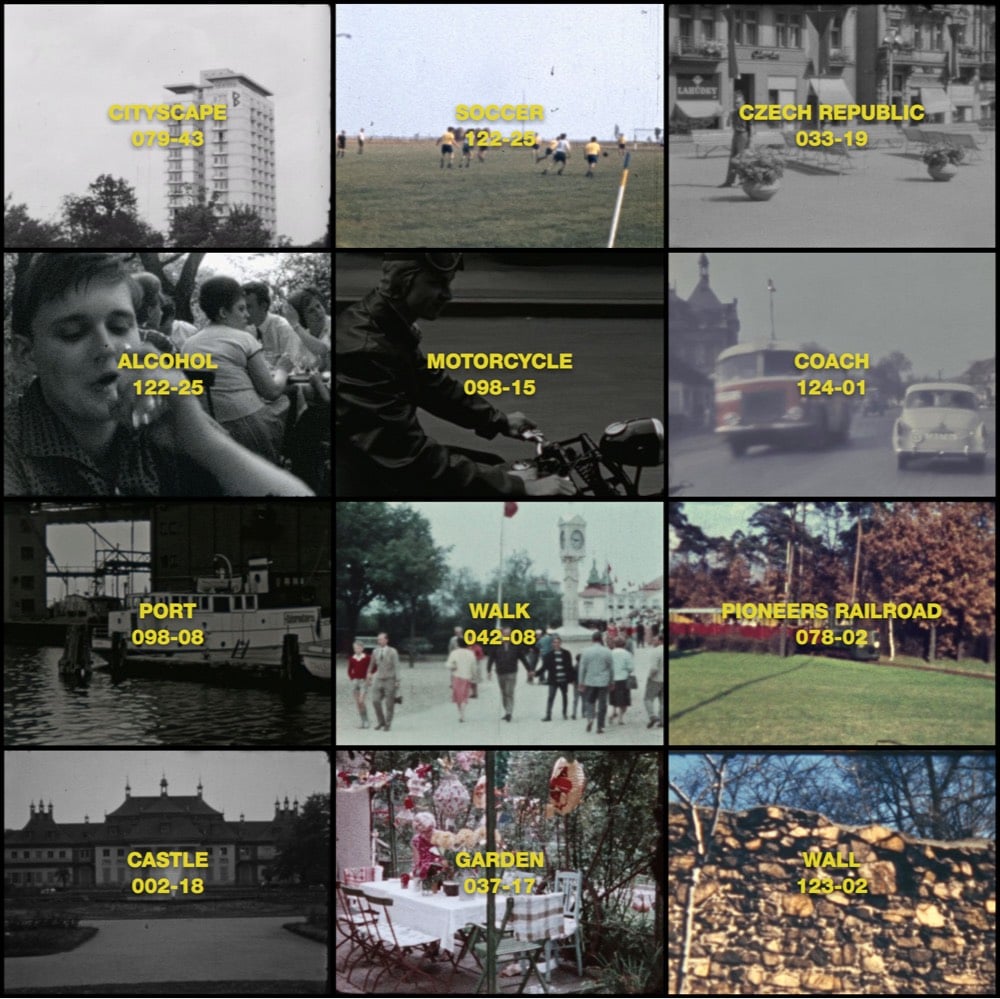
Open Memory Box houses what they say is the largest digitized collection of home movies from East Germany. The 415 hours of footage was filmed between 1947 and 1990 by 149 different families, who captured scenes of what it was like behind the Iron Curtain. Here’s one of the few videos they’ve posted to YouTube (the rest are presented on the site with a custom video player):
Some interesting searches are Trabant, sports, Berlin, China, and Brandenburg Gate. Light NSFW warning…East Germans went about in the nude more often than one might have guessed. Also, a lot of the footage has a huge watermark over it, which can make it difficult to focus on the actual subject matter.
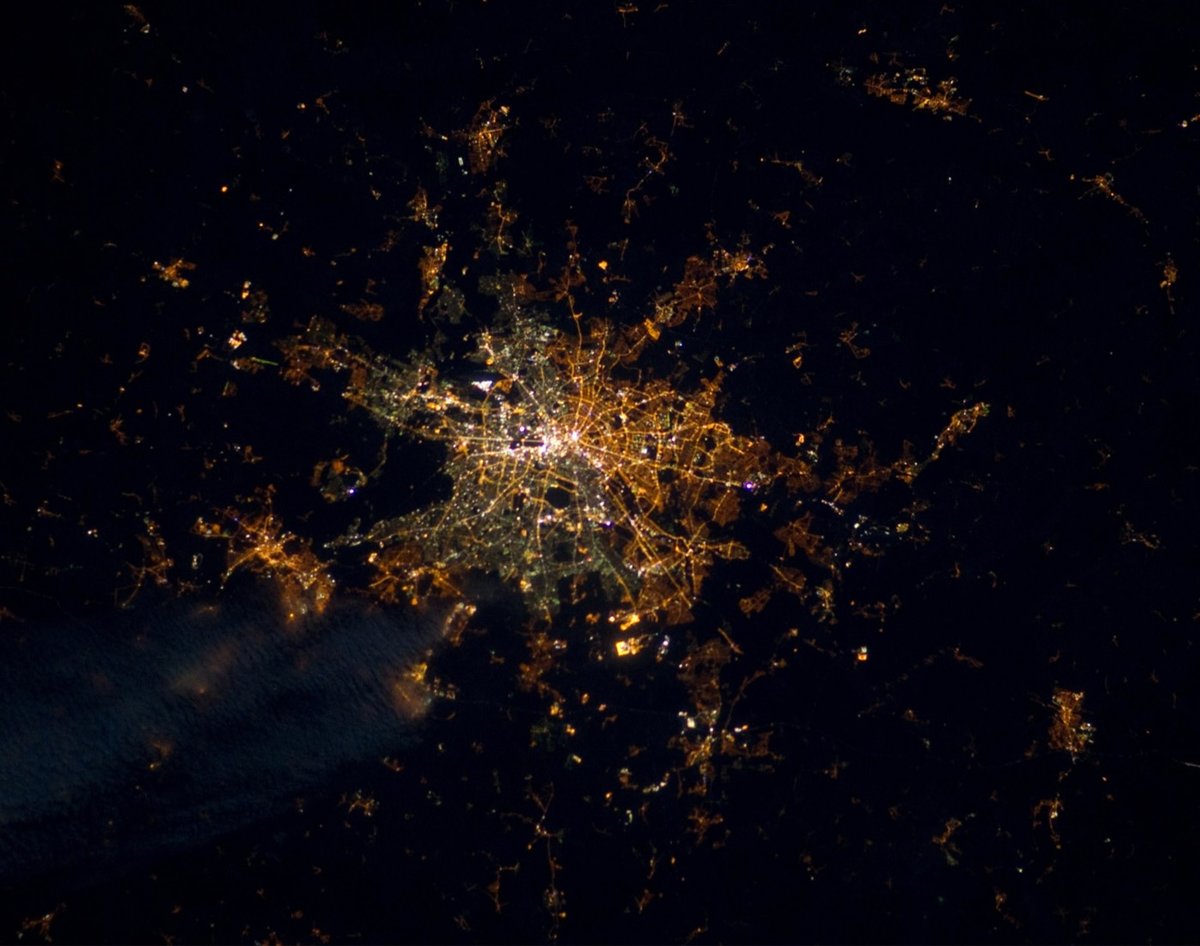
Daniela Augenstine, of the city’s street furniture department, says: “In the eastern part there are sodium-vapour lamps with a yellower colour. And in the western parts there are fluorescent lamps — mercury arc lamps and gas lamps — which all produce a whiter colour.” The western Federal Republic of Germany long favoured non-sodium lamps on the grounds of cost, maintenance and carbon emissions, she says.
The new LEDs may be environmentally sensitive, but they are also optically harsh.
“The old lights made everybody look bad,” said Christopher Stoddard, an architect, who lives at the corner of Fuller Place. “But these are so cold and blue, it’s like ‘Night of the Living Dead’ out there.”
“We’re all for saving energy,” his wife, Aida Stoddard, also an architect, said, “but the city can do so much better.”
A few blocks away, Rose Gallitelli taped up black garbage bags on her bedroom windows so that she could sleep. “They’re the heavy-duty kind,” she said.
Werner Herzog’s latest film is called Meeting Gorbachev, in which he sits down with former Soviet leader Mikhail Gorbachev for a series of interviews about his life, political career, and his role in ending the Cold War. From a review in the NY Times:
The two men appear to like each other immensely — in narration, Herzog calls Gorbachev “one of the greatest leaders of the 20th century” — but Gorbachev can be a cool customer. He sometimes seems guarded in his assessment of what he might have done differently. He says he believes the Soviet Union should have given its republics more rights instead of dissolving entirely. As for Boris Yeltsin, who became the first president of a post-Soviet Russia, he says, “I should have sent him off somewhere.”
It’s not easy to speak of what I tried to accomplish. I think as a natural concomitant you get the feeling that there should be better times between the West and Russia. The demonization of Russia is a great mistake of the Western media and Western politics, and we should try and seek a climate that was created by Ronald Reagan and Mikhail Gorbachev, the most improbable characters you could ever put together in one room.
Meeting Gorbachev is out in US theaters now, but just barely. Probably best to catch this streaming in a month or two.
I love the in situ audio clips in this piece. I’ve only seen this technique used a few times…more sites should do this.↩
In 1985, Ballard’s mission was to dive to depths of 9,800 feet using a towed camera system called Argo to find and document the imploded remains of the Scorpion. The objective of the mission was to locate the submarine’s nuclear reactor and nuclear weapons and to gain evidence to help determine what led to her loss. After concluding his successful investigations of the Scorpion, Ballard used the final 12 days of his expedition to discover the RMS Titanic at a depth of 12,540 feet.
The work of Molony in his documentary is compelling and seems to make logical sense. The hidden fire caused damage to a bulkhead in the ship. The increased speed of the ship was due to the excess burning of coal to fight the fire. Also the failure of the bulkhead was due to the incredible heat generated by the coal fire, which was right against the bulkhead. In Molony’s opinion if the bulkheads held, the passengers on the ship may have been rescued. There was a ship hailed and on the way. If the Titanic could have stayed afloat for a few hours longer, a historic tragedy may have been averted.
Update: The coal fire thing has been a theory for years. After Molony’s documentary aired last year, a group of maritime historians who have studied Titanic extensively, wrote a thorough article debunking the idea that the coal fire contributed to the disaster in any way.
When hard evidence is factored in, there is only one viable conclusion: the coal bunker fire aboard Titanic was not a primary factor in her contact with the iceberg, or in causing her to sink after the she struck the ice. It played no part in the significant loss of life.
(thx, andrew)
Update: A group of enthusiasts used a video game engine called Unreal Engine 4 to build a fantastically detailed model of the Titanic that you can (virtually) walk though:
From Orbital Mechanics, a visualization of the 2153 nuclear weapons exploded on Earth since 1945.
2153! I had no idea there had been that much testing. According to Wikipedia, the number is 2119 tests, with most of those coming from the US (1032) and the USSR (727). The largest device ever detonated was Tsar Bomba, a 50-megaton hydrogen bomb set off in the atmosphere above an island in the Barents Sea in 1961. Tsar Bomba had more than three times the yield of the largest bomb tested by the US. The result was spectacular.
The fireball reached nearly as high as the altitude of the release plane and was visible at almost 1,000 kilometres (620 mi) away from where it ascended. The subsequent mushroom cloud was about 64 kilometres (40 mi) high (over seven times the height of Mount Everest), which meant that the cloud was above the stratosphere and well inside the mesosphere when it peaked. The cap of the mushroom cloud had a peak width of 95 kilometres (59 mi) and its base was 40 kilometres (25 mi) wide.
All buildings in the village of Severny (both wooden and brick), located 55 kilometres (34 mi) from ground zero within the Sukhoy Nos test range, were destroyed. In districts hundreds of kilometers from ground zero wooden houses were destroyed, stone ones lost their roofs, windows and doors; and radio communications were interrupted for almost one hour. One participant in the test saw a bright flash through dark goggles and felt the effects of a thermal pulse even at a distance of 270 kilometres (170 mi). The heat from the explosion could have caused third-degree burns 100 km (62 mi) away from ground zero. A shock wave was observed in the air at Dikson settlement 700 kilometres (430 mi) away; windowpanes were partially broken to distances of 900 kilometres (560 mi). Atmospheric focusing caused blast damage at even greater distances, breaking windows in Norway and Finland. The seismic shock created by the detonation was measurable even on its third passage around the Earth.
The Soviets did not give a fuck, man…what are a few thousand destroyed homes compared to scaring the shit out of the capitalist Amerikanskis with a comically large explosion? Speaking of bonkers Communist dictatorships, the last nuclear test conducted on Earth was in 2013, by North Korea.
Steven Spielberg is directing Tom Hanks in Bridge of Spies, a movie about the negotiation to release U-2 pilot Francis Gary Powers from Soviet custody. Here’s the trailer:
The script was punched up by none other than the Coen brothers.
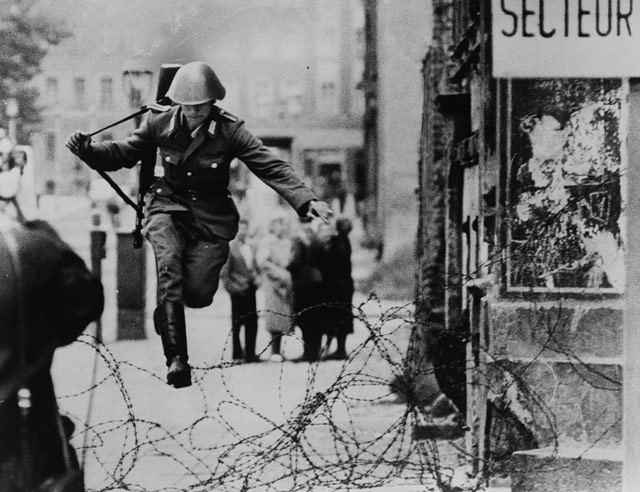
In Focus has a photo retrospective of the Berlin Wall, 25 years after it fell. This is one of the most iconic photos, depicting East German border guard Conrad Schumann leaping over the Wall during the early days of construction, when it was only barbed wire.
Schumann made a clean getaway, settled in Bavaria, and lived to see the fall of the Wall in 1989. But Schumann struggled with the separation from his family, birthplace, and old life and, suffering from depression, died of suicide in 1998. Walls may fall, but that’s not the same as never having built them in the first place.
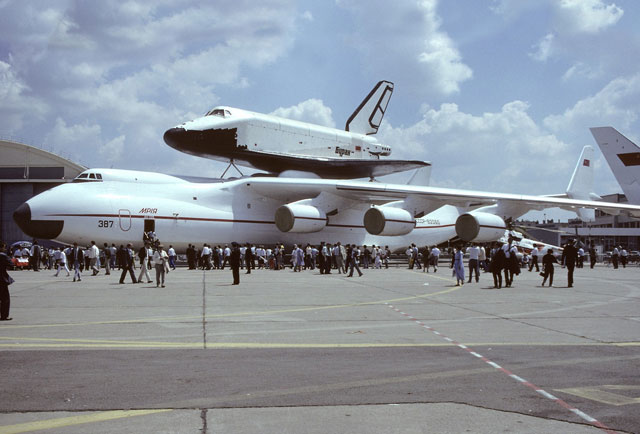
Called Buran (Russian for blizzard or snowstorm), the program was launched by the Kremlin as a reaction to NASA’s space shuttle and an attempt to gain an edge in space against the backdrop of Ronald Reagan’s “Star Wars” Strategic Defense Initiative. It was also an attempt to fulfill the Soviet Union’s dream of reusable spacecraft and payloads, ideas that predated the American space program.
A massive effort began. Over a million and a half people worked on the multi-billion dollar project, while researchers developed new, elaborate schemes for Russian space exploration. Among other tasks, Russian scientists hoped that the Buran would be able to carry the space station back to Earth, and — the reported reason for its inception — to allow the USSR to carry out military attacks from space.
The Soviet Shuttle, the Buran (snowstorm) was an aerodynamic clone of the American orbiter, but incorporated many original features that had been considered and rejected for the American program, such as all-liquid rocket boosters, jet engines, ejection seats and an unmanned flight capability. You know you’re in trouble when the Russians are adding safety features to your design.
The decision to include culture and art in the US Cold War arsenal was taken as soon as the CIA was founded in 1947. Dismayed at the appeal communism still had for many intellectuals and artists in the West, the new agency set up a division, the Propaganda Assets Inventory, which at its peak could influence more than 800 newspapers, magazines and public information organisations. They joked that it was like a Wurlitzer jukebox: when the CIA pushed a button it could hear whatever tune it wanted playing across the world.
The next key step came in 1950, when the International Organisations Division (IOD) was set up under Tom Braden. It was this office which subsidised the animated version of George Orwell’s Animal Farm, which sponsored American jazz artists, opera recitals, the Boston Symphony Orchestra’s international touring programme. Its agents were placed in the film industry, in publishing houses, even as travel writers for the celebrated Fodor guides. And, we now know, it promoted America’s anarchic avant-garde movement, Abstract Expressionism.
In the event of an invasion, the entire country of Switzerland is rigged to destroy all of its road, bridges, railroads, and other infrastructure. Or at least it was during the Cold War. Geoff Manaugh reports on a John McPhee book about the country’s defenses.
In any case, the book’s vision of the Alps as a massively constructed-or, at least, geotechnically augmented and militarily amplified-terrain is quite heady, including the very idea that, in seeking to protect itself from outside invaders, Switzerland is prepared to dynamite, shell, bulldoze, and seal itself into a kind of self-protective oblivion, hiding out in artificially expanded rocky passes and concrete super-basements as all roads and bridges into and out of the country are instantly transformed into landslides and dust.
The first reader comment is more than a little eye-popping:
I have seen this with my own eyes as a foreign student in Switzerland in 1981, when a MOUNTAIN “opened” up and four jets flew out of it, near the quiet town, Martigny.
Update: About a minute into this clip from Rick Steves’ Europe, Steves takes a tour of some of the hidden defenses of Switzerland.
Richard Rhodes recently gave a Long Now talk called The Twilight of the Bombs about the future obsolescence of nuclear weaponry. From Stewart Brand’s summary of the talk:
How much did the Cold War cost everyone from 1948 to 1991, and how much of that was for nuclear weapons? The total cost has been estimated at $18.5 trillion, with $7.8 trillion for nuclear. At the peak the Soviet Union had 95,000 weapons and the US had 20 to 40,000. America’s current seriously degraded infrastructure would cost about $2.2 trillion to fix — all the gas lines and water lines and schools and bridges. We spent that money on bombs we never intended to use — all of the Cold War players, major and minor, told Rhodes that everyone knew that the bombs must not and could not be used. Much of the nuclear expansion was for domestic consumption: one must appear “ahead,” even though numbers past a couple dozen warheads were functionally meaningless.
Jeffrey Goldberg visited with Fidel Castro recently and has two posts on his Atlantic blog about his meetings with the former Cuban head of state: part one and part two.
After this first meeting, I asked Julia to explain the meaning of Castro’s invitation to me, and of his message to Ahmadinejad. “Fidel is at an early stage of reinventing himself as a senior statesman, not as head of state, on the domestic stage, but primarily on the international stage, which has always been a priority for him,” she said. “Matters of war, peace and international security are a central focus: Nuclear proliferation climate change, these are the major issues for him, and he’s really just getting started, using any potential media platform to communicate his views. He has time on his hands now that he didn’t expect to have. And he’s revisiting history, and revisiting his own history.”
This is substantial reporting but I’ll admit my favorite line was:
I’ve never seen someone enjoy a dolphin show as much as Fidel Castro enjoyed the dolphin show.
Because of Goldberg’s reportage on Castro’s remarks regarding anti-Semitism, Venezuelan President Hugo Chavez (and strong critic of Israel) announced yesterday that he would meet with Venezuela’s Jewish leaders. Someone get Errol Morris down to Cuba to make a sequel to his film about Robert McNamara. The Fog of Cold War perhaps? (via @kbanderson)
Earlier this year I realized we would celebrate the 20th anniversary of the fall of the Berlin Wall. I went back into my archive and discovered that I had boxes full of negatives that I had never seen before, taken in East Germany over the past 50 years. It was a treasure which had to be unearthed.
Berliners! Artist Martin Butler is trying to find 33,000 people to recreate the Berlin Wall for the 20th anniversary of the Wall’s fall.
The idea is to form on the 9th of november 2009 — the night the Wall fell 20 years ago — a line of people that will recreate the Berlin Wall with their physical presence, marking the path where the wall once stood. Thousands of people will form a human chain that will make its way on the 9th of november around 8.15pm. This action will last for approximately 15 minutes.
Update: A U2 concert at the Brandenburg Gate has run into some trouble after — and I swear I am not making this up — a huge wall has been constructed to keep non-ticket holders out of the concert. (thx, john)
Gorbachev tried to switch the subject. Perhaps the United States and the Soviet Union might open the way for greater cooperation in space, he told the president. But the president wasn’t to be diverted. According to the transcript, Reagan told Gorbachev that space was in the direction of heaven, but not as close to heaven as some other things that they had been discussing.
As the meeting ended, Reagan became even more direct and personal. He noted that his own son Ron did not believe in God either. “The President concluded that there was one thing he had long yearned to do for his atheist son. He wanted to serve his son the perfect gourmet dinner, to have him enjoy the meal, and then to ask him if he believed there was a cook.”
In Arsenals of Folly, Richard Rhodes details the making of the nuclear arms race between the United States and the Soviet Union, with a particular focus on the roles of Ronald Reagan and Mikhail Gorbachev. The book is fantastic and a full review is forthcoming, but I wanted to share a couple of passages that would be worthy of cinematic adaptation.
A pivotal event in the book is the 1986 summit meeting between the two leaders in Reykjavik, Iceland. For two full days, Gorbachev and Reagan discussed drastically reducing the number of nuclear weapons in the two countries’ arsenals with the eventual goal of eliminating nuclear weapons altogether. Gorbachev proposed meeting in Iceland because it was halfway between the US and the Soviet Union, but the tiny country was unprepared in some ways for the number of people participating in the negotiations.
Back at the American Embassy, Shultz assembled Donald Regan, John Poindexter, Paul Nitze, Richard Perle, Max Kampelman, Kenneth Adelman, and Poindexter’s military assistant, Robert Linhard, inside what Adelman calls “the smallest bubble ever built” — the Plexiglas security chamber, specially coated to repel electromagnetic radiation and mounted on blocks to limit acoustic transmissions, that is a feature of every U.S. Embassy in the world. Since the State Department had seen no need for extensive security arrangements for negotiating U.S. relations with little Iceland, the Reykjavik Embassy bubble was designed to hold only eight people. When Reagan arrived, the air-lock-like door swooshed and everyone stood up, bumping into each other and knocking over chairs in the confusion. Reagan put people at ease with a joke. “We could fill this thing up with water,” he said, gesturing, “and use it as a fish tank.” Adelman gave up his chair to the president and sat on the floor leaning against the tailored presidential legs, a compass rose of shoes touching his at the center of the circle.
And later, the US team deliberated in an even tinier space:
Gorbachev and Reagan returned. The leaders retreated upstairs with their teams. Reagan’s advisors briefed him in the only place where they could meet in private, Rowny recalled, “a little ten by twelve bathroom where about ten of us crowded in. Several stood in the bathtub, Reagan was on the throne. I was agitated, I was worried about the idea of giving up all nuclear weapons.”
The metaphorical possibilities of these two scenes are endless. I hope someone working with a good cinematographer makes a movie out of the book.
In a narrative that reads like a thriller, Rhodes reveals how the Reagan administration’s unprecedented arms buildup in the early 1980s led ailing Soviet leader Yuri Andropov to conclude that Reagan must be preparing for a nuclear war. In the fall of 1983, when NATO staged a larger than usual series of field exercises that included, uniquely, a practice run-up to a nuclear attack, the Soviet military came very close to launching a defensive first strike on Europe and North America. With Soviet aircraft loaded with nuclear bombs warming up on East German runways, U.S. intelligence organizations finally realized the danger.
Random House has posted a portion of the first chapter from which I won’t quote because Rhodes’ storytelling style is nigh impossible to excerpt; he starts the story on page one and doesn’t relent until the final paragraphs. Like the above quote says, his nonfiction reads like a novel…reminds me of Tom Clancy’s books but meticulously researched and true.
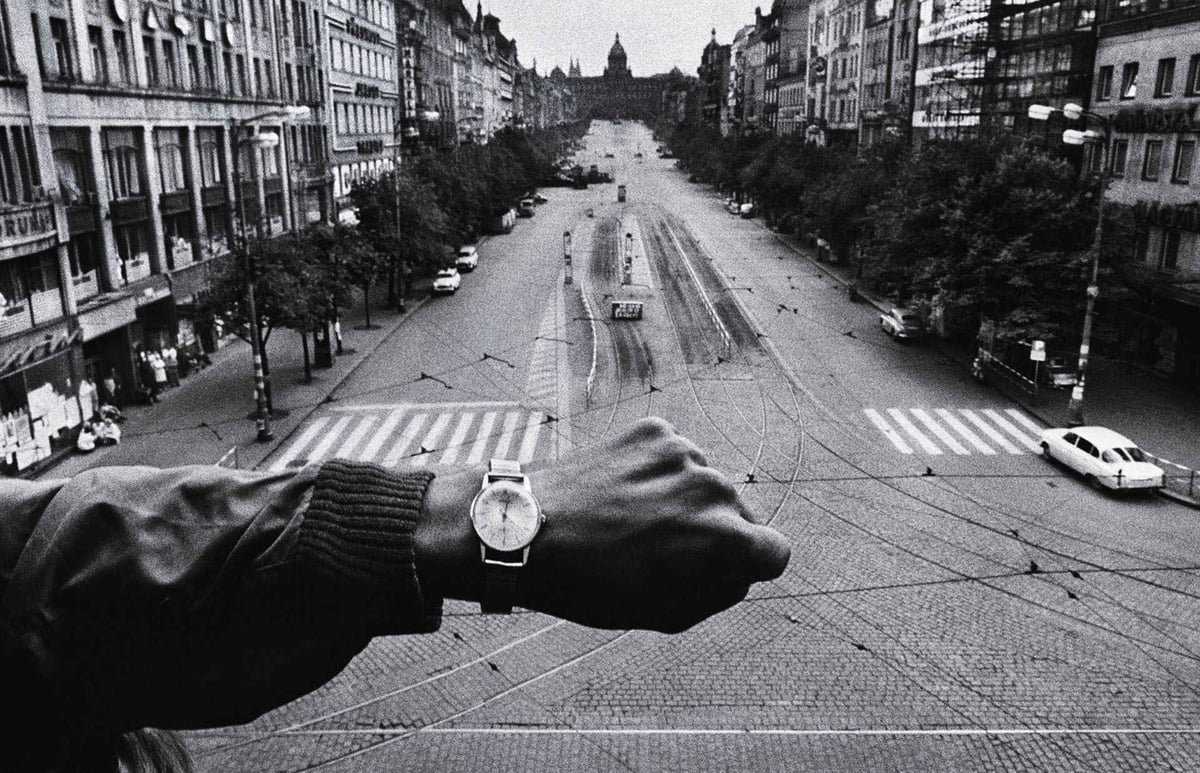
This is one of my favorite photos. It was taken by Josef Koudelka in Prague in 1968, just before the Soviet Union invaded and put a stop to The Prague Spring. To demonstrate the emptiness of the streets at noon, Koudelka stuck his wristwatch into the scene before shooting it. A simple, brilliant gesture that adds not only a temporal dimension to the photo but also a sense of solitary humanity in contrast to the empty streets.
Rhodes’ followup to The Making of the Atomic Bomb (for which he won a Pulitzer), while not as tight a narrative as its predecessor, was more interesting to me because I was less familiar with the story. In particular, the Soviet espionage effort during WWII was fascinating.




Stay Connected