kottke.org

...is a weblog about the liberal arts 2.0 edited by Jason Kottke since March 1998 (archives). You can read about me and kottke.org here. If you've got questions, concerns, or interesting links, send them along.

354 kottke.org posts about weblogs


Summing up the 2000s

The blog You Aught To Remember is counting down all the of the memorable people, ideas, and trends of the 2000s. Some recent entries include the demotion of Pluto, World of Warcraft, the Red Sox winning the World Series, and Queer Eye for the Straight Guy.

By Jason Kottke    Nov 2, 2009    The 2000s   weblogs

How to write badly well

Writer Joel Stickley keeps a blog about how best to write badly. Here's a snippet from a recent entry titled "Describe every character in minute detail, taking no account of narrative pacing":

Terrence Handley shifted his weight, the weight that had been steadily increasing for the last ten years and showed no sign of diminishing, at least while his wife Marie continued to excel as she did at the design and production of delectable gourmet meat pies, and shuffled his feet restively as he waited.

Iconic photos

The Iconic Photos blog reminds me a bit of Letters of Note (and Footnotes of Mad Men). It's one notable photo per post plus some context.

Alex Ross on the move

Alex Ross has moved his blog from The Rest is Noise to the New Yorker site. It's now called Unquiet Thoughts.

By Jason Kottke    Oct 15, 2009    Alex Ross   music   weblogs

From the desk of Mr. Jagger

You are still reading Letters of Note, yes? A couple of recent letters include Bill Gates' infamous An Open Letter to Hobbyists -- "most of you steal your software" -- and a letter from Mick Jagger to Andy Warhol about the design of an album cover in which Jagger gives the impression of being the perfect client...do whatever you want and let me know how much to pay you.

Jagger letter to Warhol

Update: Jagger's letter to MC Escher didn't work out quite as well.

By the way, please tell Mr. Jagger I am not Maurits to him, but
Very sincerely,
M. C. Escher.

(thx, @pjdoland)

Vivian Maier, recently discovered street photographer

Vivian Maier was a street photographer from the 1950s-70s in Chicago whose extensive body of work (40,000 negatives) was recently discovered at an auction. This blog is presenting that work to the public for (I think) the first time.

Vivian Maier

(thx, frank)

Update: Blake Andrews discusses some other photographers who came late to the public eye.

The other X factor in recognition is a curatorial champion. Bellocq had Friedlander. Atget had Abbot. Disfarmer had Miller. Without their discoverers, these photographers might still be anonymous. For Maier it's been John Maloof. An interesting mental experiment is to wonder what would've happened had Maier posted her own photos on a blog while still alive. Would they have the same impact? Or would they just be another series of old images from some self-promoting has-been?

Letters of Note

Letters of Note is a blog that publishes important, unusual, and memorable letters.

Letters of Note is an attempt to gather and sort fascinating letters, postcards, telegrams, faxes, and even emails. Scans/photos where possible. Fakes will be sneered at. Updated weekdays.

Here's a letter from Winston Churchill to his wife to be delivered in the event of his death in WWI and the Lindbergh baby kidnapping ransom note. Fantastic idea for a blog and well done too. Subscribed. (thx, felicia)

By Jason Kottke    Sep 14, 2009    weblogs

Blogger as accidental puppeteer

Heather Armstrong purchased a new washing machine which promptly broke. After several attempts to get it fixed failed, she registered her displeasure on Twitter to her 1,000,000+ followers. The rest of the story is amusing but I enjoyed it for more inside-baseball reasons, i.e. this is how you fucking blog. Take notes.

This is where some of you are all, WTF? You spent how much on a washing machine? Don't you know that some of us don't even have washing machines? Don't you know that some of us have to drag our five loads of laundry AND our three kids down to the laundromat every week? HOW DARE YOU EVEN WRITE AND/OR COMPLAIN ABOUT YOUR PRECIOUS LITTLE WASHING MACHINE.

And you can give me a goddamn break. It's not like we said, you know what? Let's just go spend fourteen hundred dollars today! It'll be fun! Where can we go? An appliance store! Hurry, let me change into my diamond-studded panties and climb into our golden chariot! Have the local police shut down traffic so that we don't have to maneuver around the little people! Also, where is Clive Owen and that blow job I paid for?

Life advice from old people

Seth Menachem takes his video camera out on the streets and collects Life Advice From Old People. Menachem is in the movie biz so he even got advice from Jon Voight and Errol Morris.

The best of Wikipedia

The Best of Wikipedia blog collects interesting entries from Wikipedia. Some recent entries include Lawsuits Against God, Missing White Woman Syndrome, and Dead Cat Bounce.

The footnotes of Mad Men

This may be my favorite new blog of the year: The Footnotes of Mad Men. Sample footnote: The Dream of the Fisherman's Wife, the tentacle porn hanging in Bert Cooper's office. (via sandwich)

By Jason Kottke    Aug 18, 2009    Mad Men   TV   weblogs

Bloggers and press passes in NYC

Gothamist's Jake Dobkin attended a public discussion of "Rules for City Issued Press Credentials" in NYC today and took some good notes. The proposed new rules address some inconsistencies in the city's issuing process...in particularly the denial of press passes to bloggers and other online publications.

Restrictions limiting press passes to certain mediums will be removed -- in the future, online, offline, on-air, etc. will all be treated equally. To qualify for a press pass, the journalist or journalism organization will need to provide six clips from the last 24 months showing news-gathering activity that would merit a press card -- that would include live reportage from police and fire scenes, public assemblies, government press conferences, or similar events.

Hurley has a blog

Sweet Marvin Candle! How come no one told me that Hurley from Lost has a blog?

By Jason Kottke    May 22, 2009    Jorge Garcia   Lost   TV   weblogs

Birth year cultural scrapbook

Sveinn Birkir has been collecting images from 1976 and putting them on his blog in order to create a visual anthology from the year he was born. Neat idea.

In defense of Twitter

Living in a big city, you get to hear other people's conversations all the time. These are private conversations meant for the benefit of the participants but it's no big deal if they're overheard on the subway. And you know what people talk about most of the time? In no particular order:

1. What they had or are going to have for breakfast/lunch/dinner.
2. Last night's TV or sports.
3. How things are going at work.
4. The weather.
5. Personal gossip.
6. Celebrity gossip.

Of course you'd like to think that most of your daily conversation is weighty and witty but instead everyone chats about pedestrian nonsense with their pals. In fact, that ephemeral chit-chat is the stuff that holds human social groups together.

Ever since the web hit the mainstream sometime in the 90s, people have asked of each new conversational publishing technology -- newsgroups, message boards, online journals, weblogs, social networking sites, and now Twitter -- the same question: "but why would anyone want to hear about what some random person is eating for breakfast?" The answer applies equally well for both offline conversation and online "social media": almost no one...except for their family and friends.

So when you run across a Twitter message like "we had chicken sandwitches & pepsi for breakfast" from someone who has around 30 followers, what's really so odd about it? It's just someone telling a few friends on Twitter what she might normally tell them on the phone, via email, in person, or in a telegram. If you aren't one of the 30 followers, you never see the message...and if you do, you're like the guy standing next to a conversing couple on the subway platform.

P.S. And anyway, the whole breakfast question is a huge straw man periodically pushed across the tracks in front of speeding internet technology. There is much that happens on Twitter or on blogs or on Facebook that has nothing to do with small groups of people communicating about seemingly nothing. Can we just retire this stupid line of questioning once and for all?

(Would you like to post this link to Twitter?)

Update: From Twitter, two pithier reformulations of the above:

@phoutz: If Twitter is banal it is because you and I are banal (It's called social norming)

@thepalephantom: The "no one cares what you're doing" proclamation is a solipsists way of saying "i don't care"

Update: Three related articles. How the Other Half Writes: In Defense of Twitter by Geoff Manaugh of BLDGBLOG (thx, @secretsquirrel):

Again, I fail to see any clear distinction between someone's boring Twitter feed - considered only semi-literate and very much bad -- and someone else's equally boring, paper-based diary -- considered both pro-humanist and unquestionably good. Kafka would have had a Twitter feed! And so would have Hemingway, and so would have Virgil, and so would have Sappho. It's a tool for writing. Heraclitus would have had a f***ing Twitter feed.

Twitter: Industries of Banality by Struan McRae Spencer of Vitamin Briefcase:

Living with friends and colleagues would be a cheap alternative to living alone. People generally don't do it because it's not a good thing for humans to do. We are genetically predisposed to need time in solitude occasionally. So instead of living with your friends and colleagues, try living with their disembodied thoughts floating around on your computer and popping up on your desktop every fifteen, thirty, sixty, (manual refresh), minutes. Fellowship exists to provide us with relief from solitude and our individual pursuits. Living in a state of constant fellowship with hundreds, if not thousands of people who have known you (or not) across various stages of your life becomes an insurmountable problem the longer you try to do it.

To Tweet or Not To Tweet by Maureen Dowd of the NY Times, the essay that finally set me off in the first place:

Do you ever think "I don't care that my friend is having a hamburger?"

By Jason Kottke    Apr 23, 2009    Twitter   weblogs   www

Stinky blogging stats

Mark Penn, a former Clinton pollster, writes in the Wall Street Journal that:

In America today, there are almost as many people making their living as bloggers as there are lawyers.

Understandably, Penn's catching a bit of flack for that and statements and the numbers he uses to back them up. From Waldo Jaquith at VQR:

Penn's thesis is that average American citizens are becoming professional bloggers, offsetting the loss in journalists, with millions enjoying a revenue stream from blogging and nearly half a million making a living at it. That's wrong on its face. There's simply no way there there's more than, say, 10,000 Americans are paying for their basic life expenses purely through blogging.

Scott Rosenberg, who has done all sorts of research about blogging for his forthcoming book, reacted similarly:

Technorati's are the longest-running and most valuable, and consistent, series of blogging studies over time, but like any study's numbers, they can be easily misrepresented: here, Penn relies on them for the datum that bloggers who reach 100,000 uniques a month can earn $75K a year. But if you read the source, you find this:

"The average income was $75,000 for those who had 100,000 or more unique visitors per month (some of whom had more than one million visitors each month). The median annual income for this group is significantly lower - $22,000."

In other words, the $75K average is skewed by a handful of outlier successes, but the great majority of bloggers who get 100,000 uniques/month earn more like $22,000. Here, the median is far more relevant than the average. Penn, of all people, knows this.

From my perspective as someone who does make a living blogging, Penn's numbers, especially this 100,000 uniques --> $75K business, are misleading at best and a complete fucking lie at worst.

College English class on the postprint era

Schools are finally taking the end of print media seriously. Professor Robert Lanham is offering a class called Writing for Nonreaders in the Postprint Era that will be graded on the "Raised by Boomers, Everyone's a Winner" system.

Throughout the course, a further paring down of the Hemingway/Stein school of minimalism will be emphasized, limiting the superfluous use of nouns, verbs, adverbs, adjectives, conjunctions, gerunds, and other literary pitfalls.

OMG, this class is totes HFACTDEWARIUCSMNUWKIASLAMB.

Keith Starky explains Twitter

Keith Starky's blog examines tweets as "part of his ongoing research in humor propagation and fluid reputation dynamics".

The central conceit of the "tweet" in this case is the idea that Ninjas, which are black-clad martial artists who employ tactics of stealth to both defeat their opponents and avoid waking people up at night when they go to the bathroom, could partake in some of the worldy pleasures of the non-Ninja world (e.g., crunchy snacks) if that non-Ninja world consisted entirely of people wearing noise-canceling headphones. Henceforth we refer to this world as Headphone-World.

Sorry for the two "explains Twitter" posts in a row. I'll make the next two extra special (i.e. "explains Facebook"). (via jim ray)

By Jason Kottke    Apr 15, 2009    Twitter   weblogs

Goodbye, Speak Up

Long-running design blog Speak Up will cease publication later this week.

Earlier this year, Bryony and I made the decision to close Speak Up. Seeing weeks and weeks go by where we have only two or three posts (and one of them being the Quipsologies round-up) has become too painful for us. It's also like watching Ozzy Ozbourne today, still holding on to that rock glory but he can't really rock no more, not like he used to.

By Jason Kottke    Apr 13, 2009    design   weblogs

Extreme borrowing in the blogosphere

In the past week, both Joshua Schachter and Matt Haughey published articles that were excerpted in the Voices section of All Things Digital, a web site owned by Dow Jones and run by Kara Swisher and Walt Mossberg of the WSJ. Each excerpt was accompanied by a link to the original articles. Schachter and Haughey both reacted negatively to All Things Digital's posting of their work. Andy Baio has collected responses from Schachter, Haughey, All Things Digital's Kara Swisher, other writers whose stuff has been excerpted in the Voices section, and a couple other long-time online writers. Merlin Mann's comment on Twitter sums up what the independent writers seem to be irritated with:

Republishing online work without consent and wrapping it in ads is often called "feed scraping." At AllThingsD, it's called "a compliment."

It does suck that ATD's linking technique makes it appear as though Schachter and Haughey are in the employ of Dow Jones and that DJ has the copyright on what they wrote. ATD should make the lack of affiliation more clear. Other than that, is the ATD post really that bad? In many ways, All Things Digital's linking technique is more respectful of the author of the original piece than that of a typical contemporary blog. For comparison purposes, here are screenshots of Schachter's original article as linked to from a typical blog (in this case, Boing Boing) and by All Things Digital.

Attribution on Boing Boing vs All Things Digital

Go read both posts (ATD, BB) and then come back. With its short excerpt and explicit authorship (i.e. there's no doubt that Joshua Schachter wrote those words), the ATD post is clearly just an enticement for the reader to go read the original post. On the other hand, BB's post summarizes most of Schachter's argument and includes an extensive excerpt of the juiciest part of the original piece. The post is clearly marked as being "posted by Cory Doctorow" so a less-than-careful reader might assume that those are Doctorow's thoughts about URL shorteners.

[Metaphorically speaking, the ATD post is like showing the first 3 minutes of a movie and then prodding the viewer to go see the rest of it in a theater while BB's post is like the movie trailer that gives so much of the story away (including the ending) that you don't really need to watch the actual movie.]

What ends up happening is that blogs like Boing Boing -- and I'm very much not picking on BB here...this is a very common and accepted practice in the blogosphere -- provide so much of the gist and actual text of the thing they're pointing to that readers often don't end up clicking through to the original. To make matters worse, some readers will pass along BB's post instead of Schachter's post...it becomes, "hey, did you see what Boing Boing said about URL shortening services?" And occassionally (but more often than you might think) someone will write a post about something interesting, it'll get linked by a big blog that summarizes and excerpts extensively, and then the big blog's post will appear on the front page of Digg and generally get linked around a lot while the original post and its author get screwed.

So I guess my question is: why is All Things Digital getting put through the wringer receiving scrutiny here for something that seems a lot more innocuous than what thousands of blogs are doing every day? Shouldn't we be just as or more critical of sites like Huffington Post, Gawker, Apartment Therapy, Engadget, Boing Boing, Buzzfeed, Lifehacker, etc. etc. etc. that extensively excerpt and summarize?

Update: I'm pulling a couple of quotes up from the comments so that the opinions of the people involved aren't misrepresented.

Joshua Schachter:

I really just objected to the byline on the ATD thing. It made it appear that there was a relationship when there wasn't. If there is curation, the curator should be the one noted as making the choices.

Andy Baio:

All the complaints stem from the affiliation issue. Running ads and having comments on an excerpt are only an issue if it's presented as original content, instead of curation. Put an editor's name on there, remove the author photos, throw it in a blockquote, and all these complaints go away.

Number eighty

80. Wear a sportcoat when traveling by plane. It has easily accessible pockets.

1001 Rules For My Unborn Son is a poignant idea that's well-executed.

By Ainsley Drew    Mar 30, 2009    lists   rules   weblogs

Old school web design

The Vintage Web blog consists of screenshots of sites whose current design appears to have not been updated since the 1990s.

By Jason Kottke    Mar 13, 2009    nostalgia   weblogs   www

Nerd Boyfriend

Nerd Boyfriend breaks down the wardrobes of the fashionably nerdy male, including those of Peter Sellers, Alistair Hennessey (from The Life Aquatic), Buster Bluth, and Sir Edmund Hillary. (via lonelysandwich)

By Jason Kottke    Mar 9, 2009    fashion   weblogs

The Lone Gunman is one

The Lone Gunman is one of my favorite new sites. Proprietor Lloyd Morgan doesn't update super often but each post is solidly within the 40- and 50-point zones of my interests (this is likely the first and last skee ball metaphor you'll read today). Morgan celebrated the site's first anniversary with an entry reviewing the last year of posts...lots of good liberal arts 2.0 stuff in there.

The business blogging bust

Dan Lyons, who wrote and tried to monetize the now-defunct Fake Steve Jobs blog, on the business of blogging:

Blogs can do many wonderful things [but] generating huge amounts of money isn't one of them.

As businesses go, blogging is a lot like shining shoes. There are going to be very few folks who own chains of shoe shining places which make a lot of money and a bunch of other people who can (maybe) make a living at it if they bust their ass 24/7/365. But for many, shining shoes is something that will be done at home for themselves because it feels good to walk around with a shiny pair of shoes. Everyone else will switch to sandals (i.e. Twitter) or sneakers (i.e. Facebook) and not worry about shining at all. (via fimoculous)

Eye On Springfield

Eye On Springfield celebrates Simpsons moments from seasons 1-9, when the show was "still funny". If you're around me for more than a few minutes, it's likely you'll hear "freshen ya drink, govenah?" at some point.

By Jason Kottke    Jan 27, 2009    The Simpsons   TV   weblogs

New White House site

Several readers have noted that The White House Site has already been refreshed to the now-familiar Obama look-and-feel. It's even got a blog on the front page. Will there be a Twitter account? The Wikipedians have been busy too: Obama is listed as the current President on the President of the United States page.

Update: Oh, and all of the third-party content on the WH site is licensed under Creative Commons. Wow.

Update: Oh, there's a Twitter account. Pair with THE_REAL_SHAQ for maximum fun! (thx, brian)

Update: This appears to be the official WH Twitter account, former updated by the Bush administration but now helmed by the Obama folks.

By Jason Kottke    Jan 20, 2009    Barack Obama   politics   weblogs   www

Useless superpowers

Fun new blog on Superuseless Superpowers. So far, they've got 13th Bullet Bulletproof (aka Eventual Kevlar Skin), Achieving 99% Opacity (aka The Slightly Invisible Man), and Ultra Short-Range Teleportation:

This unamazing power lets you teleport up to one inch away. When done in rapid succession, it gives that old-timey stop action feel. It can also really push your "popping & locking" routine to the next level.

Update: David O'Doherty possesses Very Mild Superpowers. (thx, tom)

By Jason Kottke    Jan 15, 2009    weblogs

People Who Deserve It

People Who Deserve It is a blog listing people who have earned a punch in the face, including Office Food Thief, Traveler With Giant Backpack On Subway, Loser Who Pisses on Toilet Seat, and Sexual Innuendo T-Shirt Guy. My NYC pedestrian-related submissions: Cab Driver Who Honks Excessively From Three Cars Back Just As the Light Turns Green and Bike Messenger with Whistle. (thx, casey)

By Jason Kottke    Jan 7, 2009    weblogs

Ze Frank blogs about participation

Ze Frank has started a blog of notes and advice about fostering online participation. Lots of good stuff so far.

Usually there will be a few contributions that are outliers in technical merit and scale. There is a temptation to reward these contributions by drawing specific attention to them while the project is running. This can sometimes have the effect of damping the project as a whole, since potential contributors will measure their work against an artificially high standard. Alternatively, only displaying the most recent contribution allows the tonality of the project to be at the whim of the last contributor.

Instead of only focusing on technical ability, draw attention to qualities that can be expressed by anyone: simplicity, individuality, and humanity. Allow there to be a feeling of "Hey, I could do that too".

(via snarkmarket)

By Jason Kottke    Jan 7, 2009    weblogs   Ze Frank

outside.in's StoryMaps

I made a slight addition to the kottke.org archives page the other day: a StoryMap from outside.in's GeoToolkit.

[I removed the map temporarily because it wasn't loading.]

To construct the map, outside.in scrapes kottke.org's RSS feed, looks for names of specific places, and plots the related blog entries on a map. There's not a lot of local content on kottke.org but the results are still pretty good; it works a lot better on a local site like Gothamist. [Disclosure: I am an advisor to outside.in.]

By Jason Kottke    Dec 26, 2008    maps   outside.in   weblogs

Daily routines

The Daily Routines blog collects stories about interesting people organize their days. For instance, Thomas Friedman "can't wait to get [his] pants on in the morning". Neither can we! Reminds me of rodcorp's How we work. (via snarkmarket)

By Jason Kottke    Dec 9, 2008    weblogs   working

The Best of LIFE

The Best of LIFE blog is mining Google's Life Magazine archive and Flickr's Commons for the best photos.

By Jason Kottke    Dec 8, 2008    life   photography   weblogs

Does the broken windows theory hold online?

The Economist reports that experimental tests of the controversial "broken windows theory" of social behavior indicate that the theory is correct.

The most dramatic result, though, was the one that showed a doubling in the number of people who were prepared to steal in a condition of disorder. In this case an envelope with a EUR5 ($6) note inside (and the note clearly visible through the address window) was left sticking out of a post box. In a condition of order, 13% of those passing took the envelope (instead of leaving it or pushing it into the box). But if the post box was covered in graffiti, 27% did. Even if the post box had no graffiti on it, but the area around it was littered with paper, orange peel, cigarette butts and empty cans, 25% still took the envelope.

Here's the 1982 Atlantic article in which the theory was first discussed in a popular forum. (Great article, BTW.)

At the community level, disorder and crime are usually inextricably linked, in a kind of developmental sequence. Social psychologists and police officers tend to agree that if a window in a building is broken and is left unrepaired, all the rest of the windows will soon be broken. This is as true in nice neighborhoods as in rundown ones. Window-breaking does not necessarily occur on a large scale because some areas are inhabited by determined window-breakers whereas others are populated by window-lovers; rather, one unrepaired broken window is a signal that no one cares, and so breaking more windows costs nothing.

Reading these articles, I wondered: how does the broken windows theory apply to online spaces? Perhaps like so:

Much of the tone of discourse online is governed by the level of moderation and to what extent people are encouraged to "own" their words. When forums, message boards, and blog comment threads with more than a handful of participants are unmoderated, bad behavior follows. The appearance of one troll encourages others. Undeleted hateful or ad hominem comments are an indication that that sort of thing is allowable behavior and encourages more of the same. Those commenters who are normally respectable participants are emboldened by the uptick in bad behavior and misbehave themselves. More likely, they're discouraged from helping with the community moderation process of keeping their peers in line with social pressure. Or they stop visiting the site altogether.

Unchecked comment spam signals that the owner/moderator of the forum or blog isn't paying attention, stimulating further improper conduct. Anonymity provides commenters with immunity from being associated with their speech and actions, making the whole situation worse...how does the community punish or police someone they don't know? Very quickly, the situation is out of control and your message board is the online equivalent of South Central Los Angeles in the 1980s, inhabited by roving gangs armed with hate speech, fueled by the need for attention, making things difficult for those who wish to carry on useful conversations.

But what about a site's physical appearance? Does the aesthetic appearance of a blog affect what's written by the site's commenters? My sense is that the establishment of social norms through moderation, both by site owners and by the community itself, has much more of an impact on the behavior of commenters than the visual design of a site but aesthetics does factor in somewhat. Perhaps the poor application of a default MT or Wordpress template signals a lack of care or attention on the part of the blog's owner, leading readers to think they can get away with something. Poorly designed advertising or too many ads littered about a site could result in readers feeling disrespected and less likely to participate civilly or respond to moderation. Messageboard software is routinely ugly; does that contribute to the often uncivil tone found on web forums?

By Jason Kottke    Dec 1, 2008    crime   weblogs   www

Pictures of Numbers blog

Pictures of Numbers is infrequently updated, but the subject matter is timeless and the archives are worth a look.

Pictures of Numbers is a book-project-in-progress, consisting of practical tips and techniques for busy researchers on improving their data presentation.

By Jason Kottke    Nov 12, 2008    design   infoviz   weblogs

The Blogging Scholarship

The College Scholarships Foundation is offering a $10,000 blogging scholarship.

Do you maintain a weblog and attend college? Would you like $10,000 to help pay for books, tuition, or other living costs? If so, read on. We're giving away $10,000 this year to a college student who blogs.

Here's the 2007 winner's blog (and the two runners up). The application deadline is October 30. Get blogging!

New blog by James Surowiecki

James Surowiecki, who writes the biweekly financial column for the New Yorker, has started a finance blog on the NYer site called The Balance Sheet.

Finding good stuff on the web

Learn how designer Michael Surtees finds good stuff on the web without having to use an RSS reader.

The blogging houseplant

When houseplants start blogging, you know the trend is on its way out.

The plant interface system, which is built around technology developed by Satoshi Kuribayashi at the Keio University Hiroya Tanaka Laboratory, uses surface potential sensors to read the weak bioelectric current flowing across the surface of the leaves. This natural current fluctuates in response to changes in the immediate environment, such as temperature, humidity, vibration, electromagnetic waves and nearby human activity. A specially developed algorithm translates this data into Japanese sentences, which are used as fodder for the plant's daily blog posts.

(via waxy)

By Jason Kottke    Oct 15, 2008    weblogs

Sergey Brin's blog

Google founder Sergey Brin has started a blog. (via waxy)

Outside.in's StoryMaps

Outside.in has launched a new feature called StoryMaps. When you sign up, they crawl your blog looking for mentions of places and then make a map of your posts. It doesn't work so well for my site (mostly because -- giggedy -- kottke.org is all over the map, har har), but for sites that post about a lot of local stuff, it works pretty well. See Gothamist's implementation, for instance. More on the outside.in blog. (Disclosure: I am an advisor to outside.in.)

By Jason Kottke    Sep 18, 2008    maps   outside.in   weblogs

Some recent Merlin Mann goodness

Merlin Mann has been on a tear lately. He's been rethinking what he wants to do with 43 Folders -- a site he started four years ago to think in public about Getting Things Done (and other stuff) -- which rethinking has resulted in a bunch of good writing on weblogs, creative work, and online media. Some links and excerpts follow.

How to blog, the best and most succinct blogging advice I've ever read:

Find your obsession. Every day, explain it to one person you respect. Edit everything, skip shortcuts, and try not to be a dick. Get better.

Going through my newsreader today, most of the sites I follow are written with those things in mind. Those that don't, out they go.

Better is a short account of Merlin's quest to remove the unpleasant and unproductive from his life. Worth quoting at length:

What makes you feel less bored soon makes you into an addict. What makes you feel less vulnerable can easily turn you into a dick. And the things that are meant to make you feel more connected today often turn out to be insubstantial time sinks - empty, programmatic encouragements to groom and refine your personality while sitting alone at a screen.

Don't get me wrong. Gumming the edges of popular culture and occasionally rolling the results into a wicked spitball has a noble tradition that includes the best work of of Voltaire, Dorothy Parker, Oscar Wilde, and a handful of people I count as good friends and brilliant editors. There's nothing wrong with fucking shit up every single day. But you have to bring some art to it. Not just typing.

What worries me are the consequences of a diet comprised mostly of fake-connectedness, makebelieve insight, and unedited first drafts of everything. I think it's making us small. I know that whenever I become aware of it, I realize how small it can make me. So, I've come to despise it.

I've pointed to this one before...What Makes for a Good Blog?

Good blog posts are made of paragraphs. Blog posts are written, not defecated. They show some level of craft, thinking, and continuity beyond the word count mandated by the Owner of Your Plantation. If a blog has fixed limits on post minimums and maximums? It's not a blog: it's a website that hires writers. Which is fine. But, it's not really a blog.

And then a pair of posts that serve as Merlin's public declaration for 43 Folders' new direction and as a blistering takedown of the productivity blogs industry, reminiscent of Joel Johnson's classic takedown of Gizmodo and other gadget blogs published *on* Gizmodo. The first is Four Years:

At this juncture, I wish to apologize and formally atone for any role 43 Folders or I have had in popularizing "hack" as the preferred nomenclature for unmedicated knowledge workers dicking around with their "productivity system" all day. 43 Folders regrets the error.

And then Time, Attention and Creative Work:

If the work that really matters to you involves understanding a relationship between a handful of seemingly unrelated things and then figuring out the best way to portray, magnify, or resolve those relationships, then you're already doing creative work. Any time you make a connection between two or more axes that hadn't occurred to you 10 minutes ago, yes, you've done something creative. Seriously. This does not require your wearing a beret.

But, then -- and this is really important -- if you want to actually make something out of all that insight, and if you have the will and desire to polish and improve the execution of all the things you produce, then we'll have a lot to talk about.

Good luck with your new direction, Merlin. I never really read 43F too much before this summer -- spending a lot of time reading about all those little productivity tricks and whatnot seemed oxymoronic -- but I'm paying attention now.

How a Wired article comes to be

Wired is keeping a blog that details the process of writing an upcoming story on, appropriately, writer/director Charlie Kaufman.

An almost-real-time, behind-the-scenes look at the assigning, writing, editing, and designing of a Wired feature. You can see more about the design process on Wired creative director Scott Dadich's SPD blog, The Process. This is a one-time experiment, tied solely to the Charlie Kaufman profile scheduled to run in our November 08 issue.

We will post internal e-mails, audio, video, drafts, memos, and layouts. We reserve the right to edit our posts, out of sympathy for the reader or to protect our relationships with our sources. We will not post emails with sources or reproduce communications that take place outside of Wired.

Reading through, I'm not sure I want to know how the sausage is made. With the well-established processes and tropes that magazines follow in publishing each and ever month, stuff like this has a tendency to come off as cynical and overly mechanical (e.g. the piece is already mostly written...they just need Kaufman to fill in the details). I also keep thinking...what if Kaufman reads this before his interviews take place? Is it better or worse for the finished piece that he knows their whole angle going in? (via snarkmarket)

Update: Clarification from Jason Tanz (the author of the Kaufman piece) at Wired...most of the interviews with Kaufman have already been conducted and a rough draft of the story has been completed. They wanted to be at least this far along before they posted any of these materials so as to avoid complications with the interview process. Tanz says that they hope to be "pretty close to real time [on the storyboard blog] by the end of next week".

Digital Journalist photo blog

The Digital Journalist has launched a photo blog modeled after The Big Picture. Well done. I've followed this site on and off for years but always found it too difficult to navigate through to find the photography, which is shot by top-notch photojournalists and is amazing. Nice to see the photography put front and center. Case in point: this wonderful selection of sports photos by Walter Iooss Jr., punctuated by stories of the athletes he was photographing (Tiger Woods, Muhammad Ali, Michael Jordan, etc.). Here's Iooss' account of photographing Jordan at the 1988 dunk contest:

The problem with shooting the NBA slam-dunk contest was that you never knew how the players were going to dunk, especially Jordan. In 1997 [sic, it was actually 1987] he had twirled and dunked with his back to me. But by this time I knew him a little better. As he sat in the stands three hours before the contest, I said, "Michael, can you tell me which way you're going to go, so I can move and get your face in the picture?" He looked at me as if I were crazy but then said, "Sure. Before I go out to dunk I'll put my index finger on my knee and point which way I'm going." I said, "You're going to remember that?" And he said, "Sure." So later, when they announced his name, I looked over to him on the bench and there was his finger pointing left. I got up and moved to the right side of the basket so I could see his face. He went left every time he dunked. On his last two dunks he ran the length of the court, took off from the foul line and slammed the ball through. On the next-to-last one he landed in my lap. On the last one I set up in the same spot. He looked at me as if to say, "Go left a little, give me some room this time." And that was it, the picture was made: 1000th of a second frozen in time.

BTW, I've heard that The Big Picture has spawned a number of copycats around the web, including this one from the WSJ.

DFL

I always forget about the awesome DFL blog until right before the Olympics are over. The site keeps track of all the last place finishers during the Games. Here's the site's tagline:

Celebrating last-place finishes at the Olympics. Because they're there, and you're not.

China is leading with 8 last place finishes. (via matt's a.whole)

What makes for a good blog?

Merlin Mann lists some attributes of good blogs.

Good blogs try. I've come to believe that creative life in the first-world comes down to those who try just a little bit harder. Then, there's the other 98%. They're still eating the free continental breakfast over at FriendFeed. A good blog is written by a blogger who thinks longer, works harder, and obsesses more. Ultimately, a good blogger tries. That's why "good" is getting rare.

Like Merlin, I'm discovering fewer and fewer good blogs these days. Part of it is that blogging as I would define it is passe. These days people are writing for online magazines like Gawker or Tumblring or Twittering or Facebooking or doing a million other things on the web. But people are also listening to a bunch of bad advice -- CALL NOW TO FIND OUT HOW TO MAKE MONEY WITH BLOGS AND WE'LL THROW IN THIS JUICER ABSOLUTELY FREE -- instead of Merlin's level-headedness.

Buzzfeed contributions and Fire Eagle

Buzzfeed unveiled a little something new this week: contributions. The site has always had a feedback mechanism where people could suggest links to add to trends, but now anyone can sign up for an account and contribute links, text, videos, and images to Buzzfeed posts. The vast majority of comments on blogs are text-only but Buzzfeed makes it easy to post video, link, and images responses as well. Call it the Tumblrization of blog comments. Innovation in blog comments has been hard to come by for the past few years...this is a nice step. (Disclosure: I'm an advisor to Buzzfeed.)

Fire Eagle, Yahoo's personal location service, has been in beta for awhile but is now live for anyone to use. The service allows you to update your location through the site, your phone, or through 3rd party apps and services. You can broadcast that location to your friends or keep it to yourself for use with other Fire Eagle-enabled apps (e.g. show me coffee shops near where I am right now). Think of the site as an online wallet where you keep your location for use all around the web. The .net TLD is a nice touch, emphasizing the hub-like character of the site/service.

[And why paste these two sites together? Ze Frank. He's been helping Buzzfeed with their contributions launch and Fire Eagle took its name from Frank's The Show (Fire Eagle Danger Day).]

Ampersand blog

A weblog about ampersands, "often the most attractive punctuation mark of them all". (via le gruber)

Charlie Parker gunslinger

Nice blog with a really long name: If Charlie Parker Was a Gunslinger, There'd Be a Whole Lot of Dead Copycats. Posts belong to a number of ongoing series...check out Annals of Crime, The Cool Hall of Fame, and When Legends Gather, Great Madmen of the 20th Century, and Before and After for a nice taste of what the blog's about.

By Jason Kottke    Aug 4, 2008    weblogs

What Would Don Draper Do?

Answers to frequently asked questions and questions that need not be asked: What Would Don Draper Do? (via fimoculous)

Update: What Would Joan Holloway Do? Never mind that, where are the pinup posters?

By Jason Kottke    Aug 4, 2008    Mad Men   TV   weblogs

Your content DJ for the day

Tyler Cowen on why blogs should cover some topics randomly.

But with Google and Wikipedia you must choose the topic. A good blog writer can randomize the topic for you, much like a good DJ controls the sequence of the music. Sometimes you might trust us more than you trust other aggregators, but we can't count on that and arguably the other aggregators improve at a rate faster than we do.

The economics posts on Marginal Revolution are often less interesting to me than the supposedly off-topic posts.

Middle Ages survival song

A singer/songwriter named Hillel took the survival tips for the Middle Ages threads from Marginal Revolution & kottke.org and made them into a song called 1000 A.D. Deliciously nerdy.

I did my best to capture as many of the best comments as possible but 3:26 isn't a huge canvas. I'm particularly sad that I never figured out a way to mention how bad the people must have smelled, or my plan to get rich selling soap.

By Jason Kottke    Jun 24, 2008    music   weblogs

Alan Taylor interview

Andy Baio interviews Alan Taylor, the fellow behind The Big Picture, the journalistic photo blog that's taken the web by storm.

Internally, externally, everywhere, people are being really thankful to me. I need to make sure (with some link-love in my upcoming blogroll) that the response gets directed to the photographers as well. I'm just a web developer with access to their photos and a blog - they're the ones out there working hard to get these amazing images. "Photographers" here is a loose term, encompassing photojournalists, stringers, amateurs, scientific imaging teams and more.

Big Picture

Big Picture is a fantastic and dead-simple new site from boston.com. Each entry tells a story through high-quality newswire images displayed at large sizes; recent entries include a look at Saturn from the Cassini space probe and the daily lives of soldiers in Afghanistan. If you're frustrated by the tiny news imagery we get spoon-fed to us on the web, this site will be a welcome addition to your daily browse. Alan Taylor, the project's instigator, has a post on his blog about Big Picture.

The sizes of the photographs are deliberately large - taking advantage of the majority of web users who have screens capable of displaying 1024x768 or larger. The long-held tradition of keeping images online tiny and lightweight is commendable still - when designing a general purpose site. But one dedicated to quality imagery should take full advantage of the medium, and I hope I've struck a good balance with The Big Picture.

When I see quality photography consigned to the archives, or when I see bandwidth readily given up to video streams of dubious quality, or when I see photo galleries that act as ad farms, punishing viewers into a click-click-click experience just to drive page views - those times are the times I'm glad I was able to get this project off the ground (many thanks to my friends within boston.com)

Emily Gould on oversharing

I was told that everyone in the NYC online media scene needs to read this NY Times Magazine cover story by and about former Gawker editor Emily Gould and her oversharing problems. I was less than halfway through when I realized I'm not part of that scene, if I ever was. So, the outsider's perspective: Gould's story is a familiar one, well-written, and rings with truth in places with regard to microcelebrity and the difficulty of learning how much to share online.

By Jason Kottke    May 22, 2008    emilygould   NYC   weblogs

Cultural attache

Movie producer Brian Grazer recently interviewed candidates for a new cultural attaché, someone who would be responsible for Grazer's ongoing cultural education, keeping him abreast of current goings-on in the news, science, music, etc.

"They have to be really resourceful," Grazer said. "I like to meet people in dangerous organizations, and my cultural attaché finds out who that person is -- who runs the Yakuza, or the Masons, or MI5."

I am nowhere near that resourceful, but I have often thought of parleying my blogging experience into providing a similar service for individuals, doing what I do on kottke.org but on an individual basis, tailored to the needs of a specific person, or probably more usefully, a specific company. (via zach)

Final Jeopardy blog

The Final Jeopardy blog posts a video each day's Final Jeopardy question. (thx, daniel)

By Jason Kottke    Apr 30, 2008    Jeopardy   TV   video   weblogs

Roger Ebert + blog = subscribed. (via house next door)

Roger Ebert + blog = subscribed. (via house next door)

Researchers Discover Massive Asshole in Blogosphere.

Researchers Discover Massive Asshole in Blogosphere.

By Jason Kottke    Apr 28, 2008    weblogs

A list of data visualization blogs you

A list of data visualization blogs you might not know about.

By Jason Kottke    Apr 22, 2008    infoviz   lists   weblogs

Six Apart buys Apperceptive and announces an

Six Apart buys Apperceptive and announces an advertising network for bloggers in order to diversify their offerings.

The idea for SA is to move beyond an increasingly commoditized blog publishing software business, and into adding advertising, design, implementation, development and site optimization services to bloggers and companies.

Update: Here's more from Six Apart on the changes.

Andy redesigned waxy.org.

Andy redesigned waxy.org.

For the first time since I started blogging in 2002, I've redesigned Waxy.org. Over the last six years, I've grown pretty sick of the old design but never found the time to rework it. Mostly, the changes are cosmetic. Cleaner design, new logo, bigger type, headlines, better iPhone support, and more space devoted to Waxy Links.

Looks nice.

By Jason Kottke    Apr 9, 2008    Andy Baio   design   weblogs

I feel like I've posted this one

I feel like I've posted this one before but the Google says no so....LUNCH is a blog written by a couple of NYC architects who believe in the sanctity, sanity, and satiety of the lunch break.

We believe leaving the office everyday for lunch is an invaluable ritual. In a time and city where people are constantly rushing around, trying to accomplish three tasks at once, taking a moment to have a civilized meal becomes even more vital. Eating at your desk while reading emails, surfing the world wide web, snarfing down a bland turkey sandwich from the deli down the street is NOT lunch.

Each day they post photos of their lunches and afternoon snacks.

By Jason Kottke    Apr 8, 2008    food   NYC   weblogs

THEBLOG WEEMADE is about "sharing the artwork

THEBLOG WEEMADE is about "sharing the artwork and creativity of kids", and they're inviting you to contribute. My favorite post is by the guy who runs the site...it's a poem he wrote about terrorism when he was 8 years old in 1984.

What's the matter Ghadafi?
Why are you so blue?
Has someone put glue
Upon your shoes?
Well, the glue may not be on your shoe,
But the glue is certainly all over you.
You're stuck, stuck, stuck,
You're a terrorist,
You're the most murderous
Terrorist on our list!

kottke.org is ten years old today

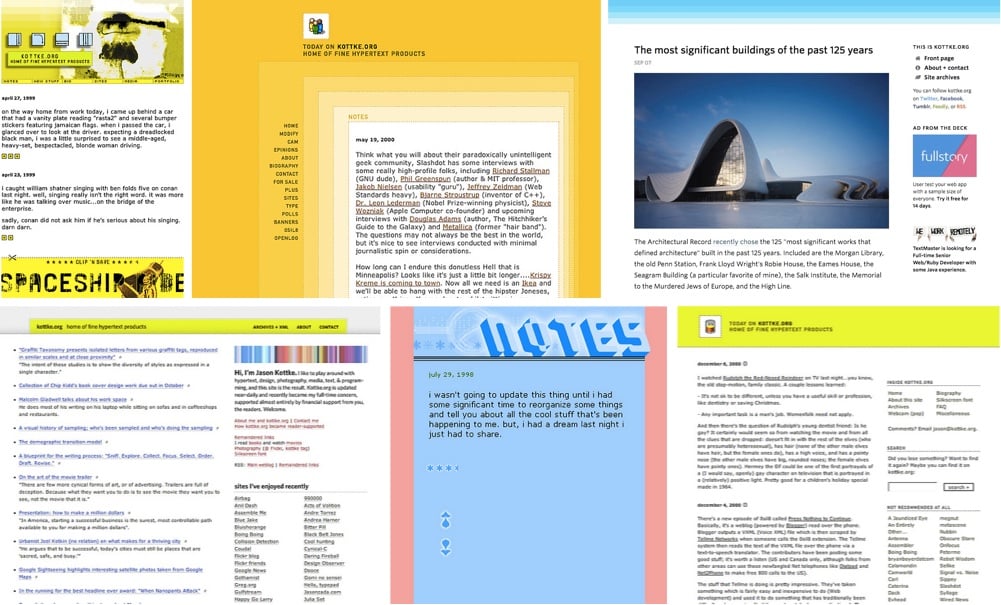
Three cities, two serious relationships, one child, 200,000 frequent flier miles, at least seven jobs, 14,500 posts, six designs, and ten years ago, I started "writing things down" and never stopped. That makes kottke.org one of a handful of the longest continually updated weblogs on the web...something to be proud of, I guess. The only thing I've done longer than kottke.org is sported this haircut. (Perhaps not something to be proud of...the hair-in-stasis, I mean.)

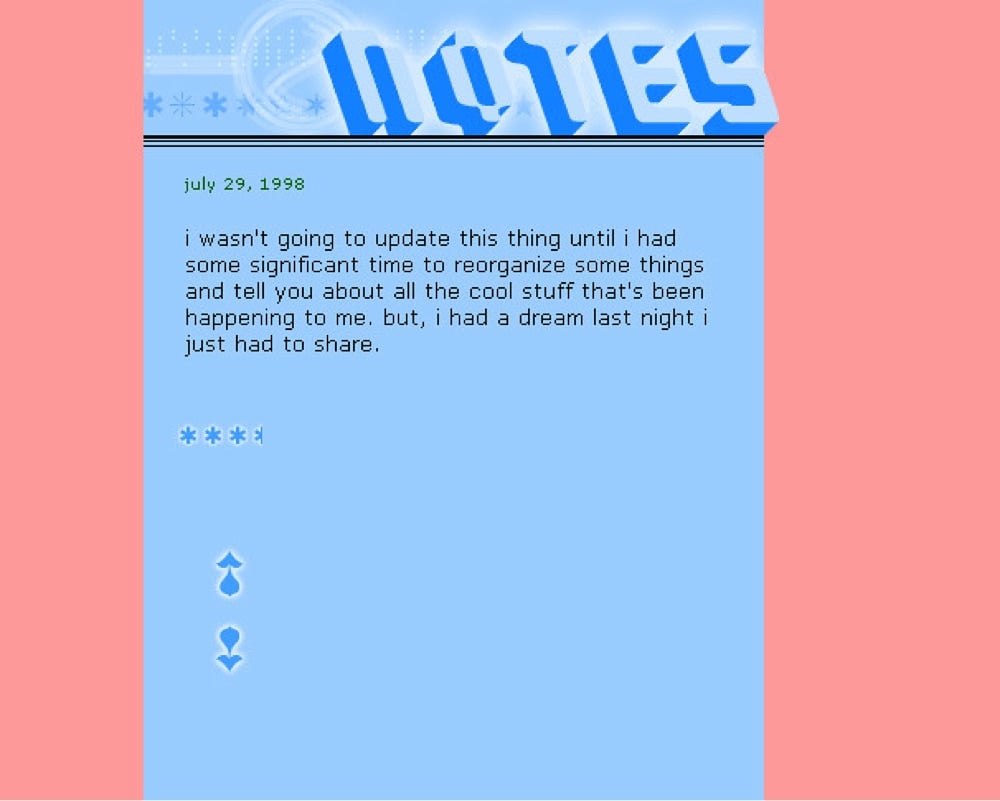
Being a digital packrat, I have screenshots of all the past designs the site has had. When I started, the posts were actually hosted on another site of mine, 0sil8, that I'd been doing since 1996. I didn't know at the time that kottke.org would eventually kill 0sil8. This was the first design (full size):

kottke.org, initial design, 1998

It's a little misleading because there's only one post shown on the page...there were usually more, displayed reverse chronologically. The stars were a rough rating of how well that day had gone called the fun meter.

When I moved the site to its own domain after a few months, I redesigned it to look like this (full size):

kottke.org, circa early 1999

The aesthetic was influenced by the pixel grunge style of Finnish designer Miika Saksi...you can see some of his older work here. The font in the navigation is Mini 7...Silkscreen was still several months away at that point. The fun meter is still present as is the all-lowercase text, a house style I thankfully dropped a few months later. The cringeworthy writing took a few more years to iron out...if it ever fully was.

This one's still my favorite; it turned a lot of heads back in the day (full size):

kottke.org, circa late 1999

With dozens of spacer gifs and five concentric tables, it was a bitch to code. There was also a capability to modify the look and feel of the site...you could choose between this design, the older design pictured above, and a text-only version. Inline permalinks were introduced on kottke.org in March 2000 and subsequently the idea was spread across the web by Blogger.

But it only lasted for about a year. In late 2000, I swapped it for this one (full size):

kottke.org, circa 2000

The familar burn-your-eyes-out yellow-green makes its first appearance. I never really meant to keep it or for it to become the strongest part of the site's identity. After this design launched, I cycled through a few colors (the old yellow, blue, red) before getting to the yellow-green...and then I just got lazy and left it. For 8 years and counting. The post style underwent several changes with this design. In June 2002, I switched to Movable Type after updating the site by hand for four years. Soon after that, I added titles to my posts. In late 2002, I added a frequently updated list of remaindered links to the sidebar. In late 2003, the remainders moved into the main column and have become an integral part of the site. I also started reviewing movies and books around this time...kottke.org became a bit of a tumblelog.

In July 2004, I refreshed the design a bit...tightened it up (full size):

kottke.org, circa 2004

After about a year, I changed it again to the current look and feel (full size):

kottke.org, circa 2005

Sorry, that got a little long...there's a lot I didn't remember until I started writing. Anyway, I didn't intend for this to become a design retrospective. Mostly I wanted to thank you very sincerely for reading kottke.org. Over the last ten years, I've poured a lot more of myself than I'd like to admit into this site and it's nice to know that someone out there is paying attention. [Cripes, I'm choking up here. Seriously!] Thanks, and I'll see you in 2018.

By Jason Kottke    Mar 14, 2008    203 comments    0sil8   design   Jason Kottke   kottke.org   weblogs   www

Puddleblog

Puddleblog documents the life and times of a persistent puddle in Brooklyn. I totally know that puddle and it is old. (via clusterflock)

Update: The Euston Puddle, another long-lived collection of water.

By Jason Kottke    Mar 12, 2008    NYC   weblogs

The Photoshop Disasters blog catalogs missteps in

The Photoshop Disasters blog catalogs missteps in photo retouching and graphic design. The most recent post shows the cover of a Nintendo DS game that has an embarrassingly invisible iStockPhoto watermark on it. The three-handed lady is my favorite.

By Jason Kottke    Mar 12, 2008    design   Photoshop   weblogs

The UK Sunday newspaper The Observer recently

The UK Sunday newspaper The Observer recently published a list of the world's 50 most powerful blogs. kottke.org is fourth on the list. "Powerful" seems to be a word used here for its succinct headline value...that adjective doesn't fit many of the blogs on the list. But The Observer has made an effort to build a wide-ranging list of blogs that you should be reading...it's very nice to be included.

By Jason Kottke    Mar 11, 2008    best of   kottke.org   lists   weblogs

In case you're wondering if Kottke is

In case you're wondering if Kottke is blogging this week.

(A nice addition to Jason's list of Single Serving Sites.)

Update: Brought to us -- ironically? -- by, Jason.

Apperceptive, the little engine that runs a

Apperceptive, the little engine that runs a large chunk of the professional blogosphere, gets a nice shout-out from Talking Points Memo's Josh Marshall.

One other point I should note: because of our size and resources, we've never been able to field close to the hardware resources behind the site as would be called for with the scale of traffic we get (to give you a sense, we now regularly get traffic equal to what we got on election night 2006, and almost four times what we got on election night 2004). That's required some custom tinkering to keep our blog train from going off the server rails. Now, we've gotten some nice praise recently for the stuff our team has published at TPM. But literally none of it would be possible without the engine the folks at Apperceptive have built for us that keeps the words streaming off our keyboards on to your computer screens.

An official decision has been reached in

An official decision has been reached in the Long Bet between Dave Winer and Martin Nisenholtz of the NY Times. The bet was made in 2002 when Winer asserted that:

In a Google search of five keywords or phrases representing the top five news stories of 02007, weblogs will rank higher than the "New York Times" Web site

Winer won the bet but it's worth noting that the Times has a growing stable of good blogs itself. (via workbench)

Let's talk Antarctica blogs.

Let's talk Antarctica blogs.

Antarctic Journal is one of the best; it's written by a grad student studying penguin ecology. Big Dead Place is also great (but not strictly a blog); check out the stories and interviews section. Also of note but of varying quality and timeliness are a blog by the British Antarctic Survey, John Bean's Antarctica blog, a U of Delaware blog, Antarctic Blog, and Antarctica Blog.

I'm still looking forward to the SOUTH expedition blog whenever that happens.

Update: One more: 75 Degrees South. Very nice photos, as in this post. (thx, pete)

Update: More Antarctica blogs and such: UAB in Antarctica, Blog Rogers (which includes info about the book, Antarctica: Life on the Ice), Nathan Duke, elisfanclub, Concordia Base, Base Dumont d'Urville, Mr Rose Géophy CZT45, and Andrill. (thx, everyone)

By Jason Kottke    Jan 21, 2008    Antarctica   south   weblogs

91-year-old NPR man Daniel Schorr has had

91-year-old NPR man Daniel Schorr has had it up to here with you kids and your internets. [Warning, print link to avoid stupid registration window.]

Q: In some commentaries, you touch on the latest journalistic trends, sometimes in not so complimentary a way. Such as blogs and citizen journalism. Is this a form of news gathering that you embrace?

A: I can't embrace it. Not after what I've been through at the hands of the copy editors' desks. I have suffered many, many arguments about what I've wanted to say -- whether it was grammatically correct, factually correct and all of that -- and I want everybody to have to experience what I experienced. But today, your blogger is totally free. He is his own reporter, his own editor, his own publisher, and he can do whatever he wants.

A person like me who believes in the tradition of a discipline in journalism can only rue the day we've arrived at where we don't need discipline or anything. All you need is a keyboard.

He suffered, so you should too, you undisciplined mouthers-off! Update: A reader writes: "You are not giving the man the respect he deserves. He did not suffer--he honed his craft in an environment that expected professionalism, balance and honesty. What is unfortunate today is that today's professional media are not held to the same standards. Most, if not all bloggers, do not rise to the quality of a Daniel Schorr. Unfortunately, neither do most of his younger colleagues."

By Choire Sicha    Jan 15, 2008    complaints   journalism   NPR   weblogs

Useful Incremental Advances In The State Of Journalism

When I go back and read journalism from the '70s and '80s, I can see that there has been little, if any, innovation in the form since. But! While they may not be drastically "new," there are at least two bits of excitement in internet journalism today that seem somewhat radical. First, Brian Lam at Gizmodo talks overtly about the twisted relationship between tech companies and journalists. ("As one reporter put it while chiding me, 'Journalists are guests in the houses of these companies.' Not first and foremost! We are the auditors of companies and their gadgets on behalf of the readers.") And over on another Gawker Media blog (my former employer, and one that I have deeply conflicted feelings about), Jezebel's Tracie Egan writes an astounding and reallly not for the faint-of-heart (or crotch) account of schtupping this guy she met in Vegas. It's BANANAS. And probably NSFW. And a great read.

For a long time, I wanted to write a profile of the designer Tom Ford—and I realized the only way to do so properly would be to have sex with him and write about it. I sent an emissary to him; he declined the opportunity. I was relieved.

Rogers Cadenhead has beaten me to the

Rogers Cadenhead has beaten me to the punch in calculating the winner of the Dave Winer/Martin Nisenholtz Long Bet pitting the NY Times vs. blogs to see who ranks higher in end of the year search results for the 5 most important news stories of 2007. The winner? Wikipedia.

The Times has really improved their position in Google since 2005...opening up their archives helped, I bet.

Best blogs of 2007

Rex has released his list of the Best Blogs of 2007 That You're (Maybe) Not Reading over at Fimoculous. Like last year, he's focused his best-of-blogs list on lesser-known sites instead of the biggies, a strategy I applaud. In fact, he doesn't even need to qualify the list as the best unknown blogs; many of the well-known blogs that usually make best-of lists, much of the Technorati Top 100, and most multi-author plastered-with-ads blogs are unremarkable...too much volume, too calculated, too focused on filling post and pageview quotas, and limited passion. If you look at the sites on Rex's list, you'll see a lot of blogs done by people who are passionate about something, not writing for a paycheck.

Rex's #1 choice is an inspired one and absolutely right on...Twitter and Tumblr revitalized personal publishing in the eyes of many who had either tired of blogging or had never seen the point in it in the first place. My only complaint about the list is that there are too many one-hit wonders on it, sites that are worth a chuckle or squee! when you first see them but don't hold up over time unless you really really like, say, snowclones. Oh, and Vulture...I really wanted to like it but really didn't get it. (Oh oh, and and Jezebel? Being against a thing is not the same as standing for something.)

Anyone in a coining mood? If one

Anyone in a coining mood? If one doesn't already exist, there needs to be a term for writing a blog comment or Twitter update, thinking better of it, and then discarding it by closing the browser tab without clicking "Post". As in: "Jason, I would have responded to this post in the comments, but I ________ it instead." Any ideas?

By Jason Kottke    Dec 18, 2007    155 comments    language   weblogs

Feed reading

Warning, RSSoterica and kottke.org sausage-making to follow. Matt Wood has a post up on 43Folders about how he groups his RSS feeds in Google Reader for easier reading. I use pretty much the same system as Matt, but with a few more folders. I have several folders for reading long-form blogs:

Always
Often
Sometimes
Pending
Food and Drink
Frippery
Infoglut

Always, Often, and Sometimes are self-explanatory. The Pending folder is for blogs that I'm trying out, Frippery is stuff that is non-kottke.org-related to be read during non-work hours (ha!), and the Infoglut folder contains a bunch of blogs that have a low signal-to-noise ratio and are too high volume to keep up with unless everything else is read (any multi-author pro blogs that I read (not many) are in here). For organizing non-long-form blogs, I use these folders:

Links
Yummy
Photos
Tumble

Links contains link blogs, Yummy has a bunch of stuff from del.icio.us, Photos are photoblogs, and Tumble contains tumblelogs, FFFFOUND!, and other Randomly Curated Other People's Images White Background Sites. And then for news, I have an NY Times folder, a Sci/Tech News folder, and a Keywords folder for Google News keyword searches.

All this folder business might seem overcomplicated, but I find that grouping feeds by mode helps greatly. And by mode, I mean when I'm reading link blogs, that's a different style than reading/skimming long-form blogs in the Always folder. Posts from link blogs usually take a few seconds to read/evaluate/discard while the Always folder posts take longer. If they were all lumped together, I couldn't get through them as quickly and thoroughly as I can separately. A juggling analogy will help -- Wait! Don't leave, I'm almost done! -- it's easier to juggle balls or clubs or knives than it is to juggle balls, knives, and clubs at the same time...same thing with different kinds of blog posts.

By Jason Kottke    Dec 2, 2007    kottke.org   RSS   weblogs

Entire Blogosphere Stunned By Blogger's Special Weekend Post.

Entire Blogosphere Stunned By Blogger's Special Weekend Post.

By Jason Kottke    Dec 1, 2007    weblogs

Cartoonist Scott Adams is going to be

Cartoonist Scott Adams is going to be blogging a lot less on The Dilbert Blog because it's bad for business.

I hoped that people who loved the blog would spill over to people who read Dilbert, and make my flagship product stronger. Instead, I found that if I wrote nine highly popular posts, and one that a reader disagreed with, the reaction was inevitably "I can never read Dilbert again because of what you wrote in that one post." Every blog post reduced my income, even if 90% of the readers loved it. And a startling number of readers couldn't tell when I was serious or kidding, so most of the negative reactions were based on misperceptions.

(thx, hurty elbow)

Your Daily Awesome, one of my favorite

Your Daily Awesome, one of my favorite new blogs of the past few months, has ceased publication. Alas. But I can identify with the reason behind the shuttering:

I am a writer first and an artist second (or vice versa, it's hard to keep track): Blogging is not my main gig, and for the past several months, I've been unable to devote myself to my real work so that I can noodle around on the internet every night, hunting for something appropriately awesome to blog. Those (substantial) daily chunks of time need to be applied to other projects that are more significant to me, creatively and professionally.

By Jason Kottke    Nov 21, 2007    weblogs

This blog is collecting pictures of men

This blog is collecting pictures of men who look like old lesbians. More amusing than I thought it would be.

By Jason Kottke    Nov 14, 2007    GLBT   weblogs

Andy Baio is leaving Upcoming and Yahoo

Andy Baio is leaving Upcoming and Yahoo to blog full-time at waxy.org. Huzzah and good luck!

There are indications that Google is changing

There are indications that Google is changing their PageRank algorithm, possibly to penalize sites running paid links or too many cross-promotional links across blog networks. Affected sites include Engadget, Forbes, and Washington Post. Even Boing Boing, which I think had been at 9, is down to 7. You can check a site's PR here.

Depending on the site, 30-40% of a site's total traffic can come from search engines, much of that from Google. It will be interesting to see how much of an impact the PR drop will have on their traffic and revenue. (thx, my moon my mann)

Update: Just got the following from the editor of a site that got its PR bumped down. He says:

Two weeks ago I lost 80% of my search traffic due to, I believe, using ads from Text-Link-Ads, which does not permit the "nofollow" attribute on link ads. That meant an overall drop of more than 44% of my total traffic. It also meant a 65%-95% drop in Google AdSense earnings per day and a loss of PageRank from 7 to 6.

He has removed the text links from his site and is negotiating with Google for reinstatement but estimates a loss in revenue of $10,000 for the year due to this change. And this is for a relatively small site...the Engadget folks must be freaking out.

By Jason Kottke    Oct 24, 2007    Google   PageRank   search   weblogs

RU Sirius asks: Is the net good

RU Sirius asks: Is the net good for writers? Ten professional writers weigh in.

I like to develop topics, approach them from different, often contradictory angles, and most of all, I like to polish the shit out of them so that the flow and the prose shine and bedazzle. On and offline, I find the internet-driven pressure to make pieces short, data-dense, and crisply opinionated -- as opposed to thoughtful, multi-perspectival, and lyrical -- rather oppressive, leading to a certain kind of superficial smugness as well as general submission to the forces of reference over reflection. I do enjoy writing 125-word record reviews though!

My favorite aspect of the piece is the interspersed American Apparel ads...they add a little texture to the discussion.

Impressionism, Realism, and blogging

I'm intrigued by Marc Hedlund's differentiation of Impressionist bloggers from Realist bloggers. My interpretation of this difference (which might not be what Marc meant by it) is that Realist blog posts are self-contained, -explanatory, and -evident entities while a post on an Impressionist blog serves to complement the whole, much like the dots making up a Seurat painting aren't that interesting until you stand back to see the whole thing.

The downside for Impressionist blogs is that their individual posts don't work that well outside of their intended context. If you run across a single post from an Impressionist blog in your River of News, a remixed Yahoo Pipes RSS feed, in del.icio.us, or an item in a Google search results set, it might not make a whole lot of sense. Impressionist blog posts are less likely to get Dugg or bookmarked in del.icio.us or linked around much at all. Fewer incoming links, big or small, to individual pages means fewer pageviews, which makes it more difficult to run an Impressionist blog as a business that relies on advertising revenue. If you look at most of the big blog sites, they're all non-Impressionist blogs. All the sites whose posts are featured on the front page of Digg are non-Impressionist...those posts/articles are designed to float self-contained around the web. The blogosphere is dominated by non-Impressionist blogs and the sort of content they produce...which is sad for me because, like Marc, I value Impressionism in a weblog.

By Jason Kottke    Sep 13, 2007    14 comments    art   marchedlund   weblogs

Where did that number come from?

Meg and I were getting ready to go out to breakfast at some obscenely early hour on Sunday morning. I retrieved a pair of jeans from the floor.

J: Hey, there's some change in these pants.
M: Breakfast is on you, then.
J: Yeah, if we're going to eat, like, 68 cents-worth of breakfast.

Then I reached into the pocket to find out how much was actually in there...from some purchase I don't recall making. 68 cents exactly. In olden times, that would have been taken as a harbinger of something, that virgins would need to be sacrificed on mountaintops to appease the gods. Meg shrugs and says, "you should post that to your blog."

Also, Grey Dog on University has the best hash browns I've ever eaten.

By Jason Kottke    Sep 11, 2007    food   NYC   weblogs

My Boring Ass Life by Kevin Smith

My Boring Ass Life

Kevin Smith has bundled his weblog up into a book of the same title, My Boring Ass Life: The Uncomfortably Candid Diary of Kevin Smith. Smith's an engaging writer about himself, family, and circle of friends; I've linked to his weblog several times in the past. His tale of actor Jason Mewes' (he played Jay in Clerks) drug addiciton and subsequent rehab is especially fine. Available at Amazon or through Smith himself, signed.

Aw, man...Eliot is ceasing publication on

Aw, man...Eliot is ceasing publication on slower.net, one of my favorite photoblogs. Ended on a great note though.

New web site for Hoefler & Frere-Jones,

New web site for Hoefler & Frere-Jones, the noted and celebrated typeface designers, including a weblog. Subscribed. Oh, and the browser fonts of choice for the meticulous duo? "Lucida Grande, Lucida Sans, Verdana, Georgia, Helvetica, Arial" (thx, jonathan)

Biologists Helping Bookstores is a guerilla effort

Biologists Helping Bookstores is a guerilla effort to reshelve pseudo-scientific books (books on intelligent design, for instance), taking them from the Science section and moving them to a more appropriate area of the store, like Philosophy, Religion, or Religious Fiction. (via mr)

Line items under "Skills" in my future

Line items under "Skills" in my future resume: refreshing all feeds, making things unbold, tab management, pressing cmd-z, scrolling, and posting to the future.

100 blogs they love so much that they're

100 blogs they love so much that they're not going to link to a single one.

Update: Several people pointed out that the original list is available with links at PC World. Of course, it's a pageview-pumping multiple page situation, so you'll want the print version instead. (Yes, this is me punching a gift horse in the mouth, or whatever that expression is.)

By Jason Kottke    Jun 26, 2007    best of   lists   weblogs

According to a recent poll, folksonomy tops

According to a recent poll, folksonomy tops the list of annoying words spawned by the internet, followed by blogosphere, blog, netiquette, and blook. Also of note: an mp3 of a religious service is referred to as a godcast.

By Jason Kottke    Jun 22, 2007    language   weblogs

Digg policies from Lifehacker and Gizmodo, which

Digg policies from Lifehacker and Gizmodo, which state that the only Digg-worthy posts of theirs are those with "original content, new reporting, treatment, or photos" because "it's not fair when we get the Digg for someone else's work." This seems inconsistent on the part of Gawker Media. One of their main innovations (if you'd like to call it that) regarding the blog format was the idea of linking to things in such a way that readers don't need to actually leave the site to get the full (or nearly full) story. Why let all those readers (and the associated ad revenue) go to some other site to read the story...they might never return. Due in part to Gawker's influence as first mover in the pro blog space, this practice is unfortunately standard procedure for most similar blogs.

kottke.org tags

After working on this -- on again and off again, mostly off -- for much too long, I'm pleased to say that a significant chunk of kottke.org now has tags (around 5,100 entries are tagged, out of ~13,000). Right now, the only way to access them is through individual tag pages, but after all the bugs are ironed out, I'll be putting them in different places around the site (front page, main archive page, etc.).

Each tag page lists all the entries1 on the site that are tagged with that particular word...some good examples to start you off are: photography, economics, lists, infoviz, food, nyc, cities, restaurants, video, timelapse, interviews, language, maps, and fashion. Each page also has a list of tags related to that particular tag and further down in the sidebar, you'll find lists of recently popular tags, all-time popular tags, a few favorite tags of mine, and some random tags...lots of stuff to explore.

I've tweaked the design as well: the main column is a little wider, the post metadata look/feel is consistent among short posts and long posts, faint dotted lines now separate all entries, and per-entry tags were added to the post metadata. I'm testing all that out for eventual site-wide use. Questions, comments, bug reports, etc. are welcome...send them on in.

Update: I almost forgot, the nsfw tag.

[1] Not all the entries exactly. Until I figure out how to do some pagination, I've limited the number of entries to 100 for each tag page. The movies page was more than 1 Mb when all the entries were listed.

Blog to watch: Madame Royale, a blog

Blog to watch: Madame Royale, a blog about notable women from the past. (via cyn-c)

By Jason Kottke    Jun 7, 2007    history   weblogs

David Plotz has finished his Blogging the

David Plotz has finished his Blogging the Bible series at Slate...he wrote about each book of the Old Testament. "While I've been blogging the Bible, I have tried not to take myself too seriously and not to pretend more insight than I actually have. I just wanted to read the book and write about what it's like to read it. No essays, no philosophy, no experts."

Meant to post about this last week,

Meant to post about this last week, but going on right now in NYC: Postopolis. "Postopolis! is a five-day event of near-continuous conversation about architecture, urbanism, landscape, and design. Four bloggers, from four different cities, will host a series of live discussions, interviews, slideshows, panels, talks, and other presentations, and fuse the informal energy and interdisciplinary approach of the architectural blogosphere with the immediacy of face to face interaction." More about the event from City of Sound and BLDGBLOG.

The BLDGBLOG book will likely be as

The BLDGBLOG book will likely be as interesting as the BLDGBLOG blog. Topics will include "plate tectonics and J.G. Ballard to geomagnetic harddrives and undiscovered New York bedrooms, by way of offshore oil derricks, airborne utopias, wind power, inflatable cathedrals, statue disease, science fiction and the city, pedestrianization schemes, architecture and the near-death experience, Scottish archaeology, green roofs..."

Jonathan Rauch on politics, journalism, and mistakes

This recent interview of journalist Jonathan Rauch is full of good stuff. On bad predictions and making mistakes:

Everybody makes [mistakes]; it's par for the course. What I have learned is not to be too sure I'm right. The world is much more surprising than we give it credit for. That's part of my political philosophy, my philosophy of life. That's really fundamental to it: Trial and error is really the only thing in life that works ultimately over the long term. Journalism is like that, too, so we need to be honest about our mistakes. We often aren't enough. Everybody makes mistakes. And we need to be a little bit cautious about making predictions.

On real journalism vs. opinion:

There's a very talented, hard-working press corps and, of course, it represents only a small fraction of the people who are doing [journalism]. I think all the major newspapers are doing it well. Not a single one is doing it badly, the ones that are committing resources to it. The larger fraction are the parasites, the bloggers, commentators, opinionizers -- I don't exempt myself -- who are feeding off of the real news that the press is providing. That larger sort of commentariat is not doing a very good job.

The future of real journalism:

What I worry about is what everyone in my business worries about: Who's going to fund the real reporting? The magazine and newspaper business was a cross-subsidy. You had the advertising, particularly classified, and you had a local market, which subsidized the gathering of news. That model is breaking down because the bundle is breaking into pieces and it's hard to see in the long run who funds the kind of large-scale news reporting operations that the major papers have run if the advertising is all going online and if people can all get the news for free at Yahoo.

On extremism in American politics:

The [political] system has been rigged by partisan activists to their advantage. They participate in primaries. General elections don't matter because they've gerrymandered the congressional districts. They have the advantages of energy and being single-minded and they use these wedge issues which they're very good at and which both sides conspire in using in order to marginalize the middle. The result of that is the turnout among moderates and independents is down; turnout on the extremes is up. The parties are increasingly sorted by ideology so that all the liberals are in one party and all the conservatives are in another. That is a new development in American history.

On getting out of the way of a story:

I'm not a fan of the idea that the journalist and the journalist's attitude should be front and center. I think that a good journalist's duty is to get out of the way. The hardest thing about journalism -- the hardest thing, a much higher art than being clever -- is just to get out of the way, to show the leader of the world as the reader would see it if the reader were there. Just to be eyes and ears. Calvin Trillin, another writer I greatly admired who steered me towards journalism, once said that getting himself out of his stories was like taking off a very tight shirt in a very small phone booth. He's right.

And lots more...I recommend reading the entire thing, especially the exchange between Rauch and the interviewer about personal political identities that was too long/difficult to excerpt here. Much more from Rauch here.

Odd jobs

Heather Armstrong, on meeting her new neighbors and having to explain what she does for a living:

Over the last few weeks several neighbors have stopped by to introduce themselves, and invariably they are older than we are, more established, and have careers in medicine or law. And when they ask what we do, both Jon and I sort of flinch and exchange a quick look that says IT'S YOUR TURN TO LIE. We're web developers, we say, and that is never enough, they just can't leave it alone, and one of us will try to explain that I have a website. This thing. That I do. And because we're being all coy about it I just know, from the very worried expressions on their faces, that these neighbors think that we run a porn site.

This is the exact interaction I have with most people that I've met in the past couple of years, right down to the "we're web developers, we say, and that is never enough, they just can't leave it alone" part. I imagine professional mimes, phone sex operators, and people who make a living selling other people's stuff on eBay have the same sorts of awkward conversations with their new neighbors.

Remember the guys humping the ottoman video

Remember the guys humping the ottoman video from Friday? There's a sequel of sorts: how to blog. (via dens)

By Jason Kottke    May 14, 2007    parody   sex   video   weblogs

Clive Thompson on the new way to

Clive Thompson on the new way to make it big in the music biz: spend hours a day communicating with your fans via the web. "Virtually everyone bemoaned the relentless and often boring slog of keyboarding. It is, of course, precisely the sort of administrative toil that people join rock bands to avoid."

Update: Related: How to Be a Star in a YouTube World.

Street artist Banksy gets the New Yorker

Street artist Banksy gets the New Yorker treatment with a profile in this week's issue. "The graffitist's impulse is akin to a blogger's: write some stuff, quickly, which people may or may not read. Both mediums demand wit and nimbleness. They arouse many of the same fears about the lowering of the public discourse and the taking of undeserved liberties." Complex tracked down the alleged photos of Banksy mentioned in the article. Print magazine recently wrote a piece on Banksy as well.

By Jason Kottke    May 11, 2007    art   Banksy   graffiti   weblogs

Twitter vs. Blogger redux

Regarding the Twitter vs. Blogger thing from earlier in the week, I took another stab at the faulty Twitter data. Using some educated guesses and fitting some curves, I'm 80-90% sure that this is what the Twitter message growth looks like:

Blogger vs. Twitter cumulative messages

Twitter cumulative messages

These graphs cover the following time periods: 8/23/1999 - 3/7/2002 for Blogger and 3/21/2006 - 5/7/2007 for Twitter. It's important to note that the Twitter trend is not comprised of actual data points but is rather a best-guess line, an estimate based on the data. Take it as fact at your own risk. (More specifically, I'm more sure of the general shape of the curve than with the steepness. My gut tells me that the curve is probably a little flatter than depicted rather than steeper.)

That said, most of what I wrote in the original post still holds, as do the comments in subsequent thread. Twitter did not grow as fast as the faulty data indicated, but it did get to ~6,000,000 messages in about half the time of Blogger. Here are the reasons I offered for the difference in growth:

1. Twitter is easier to use than Blogger was and had a lower barrier to entry.
2. Twitter has more ways to update (web, phone, IM, Twitterific) than did Blogger.
3. Blogger's growth was limited by a lack of funding.
4. Twitter had a larger pool of potential users to draw on.
5. Twitter has a built-in social aspect that Blogger did not.

And commenters in the thread noted that:

6. Twitter's 140-character limit encourages more messages.
7. More people are using Twitter for conversations than was the case with Blogger.

What's interesting is that these seeming advantages (in terms of message growth potential) for Twitter didn't result in higher message growth than Blogger over the first 9-10 months. But then the social and network effects (#5 and #7 above) kicked in and Twitter took off.

By Jason Kottke    May 11, 2007    Blogger   nostalgia   statistics   Twitter   weblogs   www

kottke.org banned from Technorati top 100?

Since swearing off Technorati a couple of years ago, I've been checking back every few months to see if the situation has improved. The site is definitely more responsive but their data problems seemingly remain, at least with regard to kottke.org; Google Blog Search gives consistently better results and easy access to RSS feeds of searches.

Technorati recently introduced something called the Technorati Authority number, which is a fancy name for the number of blogs linking to a site in the last six months. Curious as to where kottke.org fell on the authority scale, I checked out the top 100 blogs list. Not there, so I proceeded to the "Everything in the known universe about kottke.org" page where a portion of that huge cache of kottke.org knowledge was the authority number: 5,094. Looking at the top 100 list, that should put the site at #47, nestled between The Superficial and fishki.net, but it's not there. Technorati also currently states that kottke.org hasn't been updated in the last day, despite several updates since then and my copy of MT pinging Technorati after each update.

Maybe kottke.org has been intentionally excluded because I've been so hard on them in the past. Or maybe it's just a glitch (or two) in their system. Or maybe it's an indication of larger problems with their service. Either way, as the company is attempting to offer an authentic picture of the blogosphere, this doesn't seem like the type of rigor and accuracy that should send reputable media sources like the BBC, Washington Post, NY Times, and the Wall Street Journal scurrying to their door looking for reliable data about blogs.

Update: As of 3:45pm EST, the top 100 list has been updated to include kottke.org. The site also picked up this post right away, but failed to note a subsequent post published a few minutes later..

Directory of the earliest Blogger users from 1999.

Directory of the earliest Blogger users from 1999. A surprising number of those blogs are still regularly published, although few of them still use Blogger.

By Jason Kottke    May 8, 2007    Blogger   weblogs

Twitter's not growing so fast after all

This morning I posted a comparison of the growth in messages with both Blogger and Twitter. The Twitter data was based on information collected by Andy Baio in a post that was widely read in the blogosphere. In the course of looking at the Twitter data, neither of us noticed that from Nov 21, 2006 to Feb 4, 2007 and March 9, 2007 to the present, the Twitter post IDs had the same last digit, indicating that the data is not strictly sequential. If you look at Twitter's public timeline, the Twitter post IDs skip around by multiples of 10.

Anil suggested via email that could be an artifact of database sharding and lo and behold, if you take off the last digit of the post ID, they seem to become sequential again, more or less. He's going to ask the Twitter gang about it.

For right now though, the parts of this morning's post that rely on Twitter data from the above dates is incorrect. Basically, all of it. Here it is in all caps: WRONG WRONG WRONG ERROR ERROR, F-----, WOULD NOT BUY DATA ANALYSIS FROM AGAIN. In hindsight, it seems obvious that the data was incorrect...that sort of growth seems impossible, especially when Twitter was having all sorts of scaling problems. Anyway, good thing this is just a blog and not a refereed journal, eh? Big thanks to the commenters in the other post for pointing me toward the error. More as I have it.

Update: Email from Biz Stone, who works for Twitter. He says:

There's truth in the essence of what you're talking about here -- Twitter updates *are* coming in faster and furiouser than Blogger updates. However, the way we number Twitter updates has switched back and forth a few times which pretty much screws up the exactness of your analysis.

We have been doubling the number of active users about every three weeks for a sustained period of months now which is definitely contributing significantly to more and more updates. Also, active users of Twitter a measured by how many times they update per day (at Blogger it was per month). So activity in general at Twitter is crazy by comparison.

We're going to start digging in to more data visualization, user patterns, etc in the coming weeks so if there's anything you think we should be looking at specifically please let us know!

So we'll have to wait a few weeks for an accurate look at this stuff. (thx, biz)

Important update: I've re-evaluated the Twitter data and came up with what I think is a much more accurate representation of what's going on.

By Jason Kottke    May 8, 2007    Andy Baio   Blogger   dataviz   Twitter   weblogs

Growth of Twitter vs. Blogger

Important update: I've re-evaluated the Twitter data and came up with what I think is a much more accurate representation of what's going on.

Further update: The Twitter data is bad, bad, bad, rendering Andy's post and most of this here post useless. Both jumps in Twitter activity in Nov 2006 and March 2007 are artificial in nature. See here for an update.

Update: A commenter noted that sometime in mid-March, Twitter stopped using sequential IDs. So that big upswing that the below graphs currently show is partially artificial. I'm attempting to correct now. This is the danger of doing this type of analysis with "data" instead of data.
--

In mid-March, Andy Baio noted that Twitter uses publicly available sequential message IDs and employed Twitter co-founder Evan Williams' messages to graph the growth of the service over the first year of its existence. Williams co-founded Blogger back in 1999, a service that, as it happens, also exposed its sequential post IDs to the public. Itching to compare the growth of the two services from their inception, I emailed Matt Webb about a script he'd written a few years ago that tracked the daily growth of Blogger. His stats didn't go back far enough so I borrowed Andy's idea and used Williams' own blog to get his Blogger post IDs and corresponding dates. Here are the resulting graphs of that data.1

The first one covers the first 253 days of each service. The second graph shows the Twitter data through May 7, 2007 and the Blogger data through March 7, 2002. [Some notes about the data are contained in this footnote.]

Blogger vs. Twitter cumulative messages (first 253 days)

Blogger vs. Twitter cumulative messages

As you can see, the two services grew at a similar pace until around 240 days in, with Blogger posts increasing faster than Twitter messages. Then around November 21, 2006, Twitter took off and never looked back. At last count, Twitter has amassed five times the number of messages than Blogger did in just under half the time period. But Blogger was not the slouch that the graph makes it out to be. Plotting the service by itself reveals a healthy growth curve:

Blogger cumulative posts

From late 2001 to early 2002, Blogger doubled the number of messages in its database from 5M to 10M in under 200 days. Of course, it took Twitter just over 40 days to do the same and under 20 days to double again to 20M. The curious thing about Blogger's message growth is that large events like 9/11, SXSW 2000 & 2001, new versions of Blogger, and the launch of blog*spot didn't affect the growth at all. I expected to see a huge message spike on 9/11/01 but there was barely a blip.

The second graph also shows that Twitter's post-SXSW 2007 growth is real and not just a temporary bump...a bunch of people came to check it out, stayed on, and everyone messaged like crazy. However, it does look like growth is slowing just a bit if you look at the data on a logarithmic scale:

Blogger vs. Twitter cumulative messages, log scale

Actually, as the graph shows, the biggest rate of growth for Twitter didn't occur following SXSW 2007 but after November 21.

As for why Twitter took off so much faster than Blogger, I came up with five possible reasons (there are likely more):

1. Twitter is easier to use than Blogger was. All you need is a web browser or mobile phone. Before blog*spot came along in August 2000, you needed web space with FTP access to set up a Blogger blog, not something that everyone had.

2. Twitter has more ways to create a new message than Blogger did at that point. With Blogger, you needed to use the form on the web site to create a post. To post to Twitter, you can use the web, your phone, an IM client, Twitterrific, etc. It's also far easier to send data to Twitter programatically...the NY Times account alone sends a couple dozen new messages into the Twitter database every day without anyone having to sit there and type them in.

3. Blogger was more strapped for cash and resources than Twitter is. The company that built Blogger ran out of money in early 2001 and nearly out of employees shortly after that. Hard to say how Blogger might have grown if the dot com crash and other factors hadn't led to the severe limitation of its resources for several key months.

4. Twitter has a much larger pool of available users than Blogger did. Blogger launched in August 1999 and Twitter almost 7 years later in March 2006. In the intervening time, hundreds of millions of people, the media, and technology & media companies have become familiar and comfortable with services like YouTube, Friendster, MySpace, Typepad, Blogger, Facebook, and GMail. Hundreds of millions more now have internet access and mobile phones. The potential user base for the two probably differed by an order of magnitude or two, if not more.

5. But the biggest factor is that the social aspect of Twitter is built in and that's where the super-fast growth comes from. With Blogger, reading, writing, and creating social ties were decoupled from each other but they're all integrated into Twitter. Essentially, the top graph shows the difference between a site with social networking and one largely without. Those steep parts of the Twitter trend on Nov 21 and mid-March? That's crazy insane viral growth2, very contagious, users attracting more users, messages resulting in more messages, multiplying rapidly. With the way Blogger worked, it just didn't have the capability for that kind of growth.

A few miscellaneous thoughts:

It's important to keep in mind that these graphs depict the growth in messages, not users or web traffic. It would be great to have user growth data, but that's not publicly available in either case (I don't think). It's tempting to look at the growth and think of it in terms of new users because the two are obviously related. More users = more messages. But that's not a static relationship...perhaps Twitter's userbase is not increasing all that much and the message growth is due to the existing users increasing their messaging output. So, grain of salt and all that.

What impact does Twitter's API have on its message growth? As I said above, the NY Times is pumping dozens of messages into Twitter daily and hundreds of other sites do the same. This is where it would be nice to have data for the number of active users and/or readers. The usual caveats apply, but if you look at the Alexa trends for Twitter, pageviews and traffic seem to leveling out. Compete, which only offers data as recently as March 2007, still shows traffic growing quickly for Twitter.

Just for comparison, here's a graph showing the adoption of various technologies ranging from the automobile to the internet. Here's another graph showing the adoption of four internet-based applications: Skype, Hotmail, ICQ, and Kazaa (source: a Tim Draper presentation from April 2006).

[Thanks to Andy, Matt, Anil, Meg, and Jonah for their data and thoughts.]

[1] Some notes and caveats about the data. The Blogger post IDs were taken from archived versions of Evhead and Anil Dash's site stored at the Internet Archive and from a short-lived early collaborative blog called Mezzazine. For posts prior to the introduction of the permalink in March 2000, most pages output by Blogger didn't publish the post IDs. Luckily, both Ev and Anil republished their old archives with permalinks at a later time, which allowed me to record the IDs.

The earliest Blogger post ID I could find was 9871 on November 23, 1999. Posts from before that date had higher post IDs because they were re-imported into the database at a later time so an accurate trend from before 11/23/99 is impossible. According to an archived version of the Blogger site, Blogger was released to the public on August 23, 1999, so for the purposes of the graph, I assumed that post #1 happened on that day. (As you can see, Anil was one of the first 2-3 users of Blogger who didn't work at Pyra. That's some old school flavor right there.)

Regarding the re-importing of the early posts, that happened right around mid-December 1999...the post ID numbers jumped from ~13,000 to ~25,000 in one day. In addition to the early posts, I imagine some other posts were imported from various Pyra weblogs that weren't published with Blogger at the time. I adjusted the numbers subsequent to this discontinuity and the resulting numbers are not precise but are within 100-200 of the actual values, an error of less than 1% at that point and becoming significantly smaller as the number of posts grows large. The last usable Blogger post ID is from March 7, 2002. After that, the database numbering scheme changed and I was unable to correct for it. A few months later, Blogger switched to a post numbering system that wasn't strictly sequential.

The data for Twitter from March 21, 2006 to March 15, 2007 is from Andy Baio. Twitter data subsequent to 3/15/07 was collected by me.

[2] "Crazy insane viral growth" is a very technical epidemiological term. I don't expect you to understand its precise meaning.

Mystery graph

I'm working on a longish post for later today (or early tomorrow) about this graph:

Teaser

More soon.

Update: The long post is done...the above graph is (roughly) the growth of Blogger (in orange) to the growth of Twitter (in blue).

By Jason Kottke    May 7, 2007    Blogger   infoviz   Twitter   weblogs

A map of online communities. Notable features

A map of online communities. Notable features include the Blogipeligo, the Bay of Trolls, the Sea of Memes, and the Viral Straits. (thx, kayhan)

By Jason Kottke    May 2, 2007    maps   weblogs   www

Ways in which working on kottke.org is like gardening

- Pruning the list of RSS feeds I follow.
- Digging.
- Writing about hoes.
- Keeping deer out of the <p>s.
- Growing my traffic.
- Worrying about bees.
- (Com)posting links?
- Weeding out spam from comment threads.
- ^s.
- There's never enough thyme.
- Wondering about the weather.

By Jason Kottke    Apr 27, 2007    Digg   gardening   kottke.org   RSS   weblogs

Might be a little slow today on

Might be a little slow today on the ol' kottke.org. It's raining, some dude died and a bunch of techy/copyrighty blogs are sorta trying not to dance on his grave, and I'm wishing a long walk off a short pier to a bunch of alpha male, loudmouth, know-it-all bloggers who are calling the kettle black to a degree way past insanity (or is that inanity?). Isn't it time you all shipped off to the Grey Havens or something? Sometimes I really don't like this blogos-whatever that we've all built for ourselves...don't we deserve better? That and the internet appears to be completely empty today, devoid of any new information. Melodramatically yours,

Mike Monteiro mocks up a cover for

Mike Monteiro mocks up a cover for Post & Permalink, my suggested fake blogging magazine from last night's post about the should-be-fake Blogger & Podcaster.

I'm still recovering from the shock upon

I'm still recovering from the shock upon learning last week that Blogger & Podcaster magazine is in fact real. I thought it was a not-so-clever parody. I mean, look at that cover, it's just so over the top! (If I were to start a fictional magazine about blogging, I'd call it Post & Permalink in homage to Field & Stream).

In addition to a just-launched redesign, outside.

In addition to a just-launched redesign, outside.in took a look at their data for the past six months and came up with a list of the "bloggiest neightborhoods" in the US. "The results below are based on a number of variables: total number of posts, total number of local bloggers, number of comments and Technorati ranking for the bloggers." Interestingly (but upon reflection, not surprisingly), most of the places listed are in the process of gentrifying. Disclosure: I am an advisor to outside.in.

By Jason Kottke    Apr 23, 2007    best of   lists   outside.in   weblogs

The blogger code

The NY Times published an article this morning on the efforts to develop a code of conduct for online discourse. The code is a reaction to recent comments made about blogger Kathy Sierra. Three things bother me about the proposed rules.

We take responsibility for our own words and for the comments we allow on our blog.

I don't want to take one bit of responsibility for someone else's words. A person's words are their own. By taking responsibility for them, you open yourself up to all sorts of problems, mostly legal in nature. Why should someone get sued for slander or libel because someone else posts something on your site? Of course, I also believe that Google isn't responsible for people posting copyrighted videos to YouTube, that Napster wasn't responsible for people trading copyrighted material via its service, and that ISPs aren't responsible for what their customers publish to the web.

We do not allow anonymous comments.

There has to be a mechanism for anonymous comments, even if they need to be approved before being posted. As the EFF says, "anonymous communications have an important place in our political and social discourse".

The missing piece in this discussion so far is: who's going to police all this misconduct? Punishing the offenders and erasing the graffiti is the easy part...fostering "a culture that encourages both personal expression and constructive conversation" is much more difficult. Really fucking hard, in fact...it requires near-constant vigilance. If I opened up comments on everything on kottke.org, I could easily employ someone for 8-10 hours per week to keep things clean, facilitate constructive conversation, coaxing troublemakers into becoming productive members of the community, etc. Both MetaFilter and Flickr have dedicated staff to perform such duties...I imagine other community sites do as well. If you've been ignoring all of the uncivility on your site for the past 2 years, it's going to be difficult to clean it up. The social patterns of your community's participants, once set down, are difficult to modify in a significant way.

For now, my blogger code remains "B9 d+ t+ k++ s u= f++ i o x+ e++ l- c--".

Pentagram's Paula Scher illustrates the typical lifecycle

Pentagram's Paula Scher illustrates the typical lifecycle of a blog discussion for the NY Times. More and more, I'm seeing threads skip immediately to steps 9 & 10: "Impugn the character of thesis author" and "Impugn character of anyone who even considered agreeing".

Pieces for the Left Hand by J. Robert Lennon

Pieces for the Left Hand

The temptation these days for those of us with our heads buried online all day is to call any collection of short text pieces "blog-like". I'm going to stay on-message here and refer to J. Robert Lennon's Pieces for the Left Hand as being rather like a Diaryland diary written by someone who is particularly clever, smart, and funny. So maybe not so blog-like after all. (Burn!)

Anyway, Pieces is a collection of 100 or so 1-to-2 page stories, both fiction and non, about, well, nothing in particular, which is why I enjoyed them so much. Many of the stories are surreal, but not in the obvious David Lynch midgets-talking-backwards kind of way. They're more subtle, a small-town kind of surreality. And for me, the perfect thing to read on the train or plane, literary snacks to have with your pretzels.

Shorpy, the 100-year-old photoblog, is pulling photos

Shorpy, the 100-year-old photoblog, is pulling photos from just after the turn of the century and posting them. This one's going right in the daily reads pile.

Twitter

As I mentioned the other day, I recently joined Twitter. I've been poking around its nooks and crannies ever since. Here are some observations, presented in Twitter-sized chunks:

Playing with Twitter reminds me of blogging circa 2000. Back then, all weblogs were personal in nature and most people used them to communicate with their friends and family. If I wanted to know what my friends were up to back then, I read their blogs. Now I follow Twitter (and Flickr and Vox).

The reaction to Twitter mirrors the initial reaction to weblogs...the same tired "this is going to ruin the web" and "who cares what you ate for dinner" arguments.

Also like blogs, everyone has their own unique definition of what Twitter is (stripped down blogs, public IM, Dodgeball++, etc.), and to some extent, everyone is correct. Maybe that's when you know how you've got a winner: when people use it like mad but can't fully explain the appeal of it to others. See also: weblogs, Flickr.

For people with little time, Twitter functions like an extremely stripped-down version of MySpace. Instead of customized pages, animated badges, custom music, top 8 friends, and all that crap, Twitter is just-the-facts-ma'am: where are my friends and what are they up to?

Twitter's like Flickr without the images.

When one thing (i.e. Twitter) is easier than something else (i.e. blogging) and offers almost the same benefits, people will use it.

Twitter brings back the "type words in one box and press submit" thing that made Blogger so popular back in the day. Compare with current blogging systems. To publish a post in MT, I've got to fiddle with 7-9 different text boxes and options. See immediately above.

Let's not forget Dodgeball here, which was used extensively at SXSW in 2006. (In other words, all the Twittering at SXSW 2007 was not unprecedented. Chill.) It's more focused on location and SMS though...by allowing updates in more ways and being more flexible about the type of message allowed, Twitter is attractive to a wider group of people.

If your friends are not on Twitter, I can't imagine it would be that interesting.

Twitterholic tracks the top 100 Twitter users in terms of followers. I know, let's not turn absolutely everything on the web into a popularity contest!! We already know Scoble is a big blowhard and has weak ties to lots of people...let's move on, shall we?

I wonder what the average number of followers per person is? The folks with 5 zillion followers get all the attention, but as with blogging, those posting updates for their 20 friends form the bulk of the activity.

Lists of friends and followers are presented alphabetically. Does Anil attract more friends, on average, than Veen because he always shows up near the top of the listings?

I can see why Obvious dropped Odeo for Twitter. With podcasts, you've got all that data locked up in binary format (no easy cut-and-paste) and it takes you 20 listening minutes before you can react to it (by commenting, by linking, etc.). With blogs, the reaction time to a post is 1-2 minutes, with Flickr it's 5 seconds, and Twitter is 2-3 seconds. The barrier to entry for reacting to and remixing podcasts is just so much higher.

Twitter is the first thing on the web that I've been excited about in ages. Like years. The last thing was probably Flickr. (Talk about burying the lede.) It's just so damn simple but useful. Again, reminds me of weblogs in that way.

If you're on a Mac and using Twitter, download Twitterific, a little app that sits on your desktop and displays updates from your friends. My only complaint: it doesn't completely show updates, forcing you to the web to read the last 2-3 words of a longish message. Come on...it's only 140 characters, show them all!

Twittermap displays recent Twitter messages on Google Maps. All you do is send Twitter a message with your location -- like so...the "L:10003" is the important part -- and Twittermap will pick it up.

Even more mesmerizing is Twittervision...a world tour of recent Twitter messages. Just sit back and watch the updates come in one at a time, displayed on a world map. (This is in beta and Twitter's having some downtime issues right now, so the data may be less than fresh when you go.)

Twitter seems to work equally well for busy people and not-busy people. It allows folks with little time to keep up with what their friends are up to without having to email and IM with them all day. Those with a lot of time on their hands can spend a lot of time finding new people to follow, having back-and-forths with friends all day, and updating their status 40 times a day. Too many web apps fail because they only appeal to those with abundant free time.

I'm fascinated to see where Obvious takes this app once they get their scaling issues under control.

The default display of recent messages plus your own messages is genius. Makes it feel more like a conversation. The "with friends" display is great too...perfect for discovering other people to follow.

"Friends" still isn't the right word.

By Jason Kottke    Mar 20, 2007    46 comments    Twitter   weblogs

The WTFCNN blog takes CNN to task

The WTFCNN blog takes CNN to task for their increasingly non-news news headlines. I'd highlight quite a few more things...all the Britney and Anna Nicole headlines for a start.

By Jason Kottke    Mar 19, 2007    cnn   journalism   weblogs

Vogue is adding blogs to their site

Vogue is adding blogs to their site but editor Anna Wintour hates the word "blog" so much that she's got her staff working on alternate language. Wintour's a little late to the party...everyone I know has been hating that word since 1999. (via fashionologie)

Bruce Sterling: not many blogs will be

Bruce Sterling: not many blogs will be around in 10 years. Listen to Sterling's entire rant here. ps. Seven years ago on Bruce Sterling's porch.

Wired's cover feature for the March 2007 issue

Wired's cover feature for the March 2007 issue is Snack Culture. "Movies, TV, songs, games. Pop culture now comes packaged like cookies or chips, in bite-size bits for high-speed munching. It's instant entertainment - and boy, is it tasty." Even though kottke.org is a part of this culture, I still prefer a full meal.

The seminal photography collective Magnum has a new blog.

The seminal photography collective Magnum has a new blog.

Tea Birds is a blog of nothing

Tea Birds is a blog of nothing but cute girls having tea. (via bb)

By Jason Kottke    Feb 23, 2007    beverages   food   tea   weblogs

Nomination for the most useless new word

Nomination for the most useless new word of 2007: beme. A beme is a meme that spreads via blogs and those that create and spread them are called bemerz.

By Jason Kottke    Feb 19, 2007    language   memes   weblogs

This is puzzling: former Gizmodo editor Joel

This is puzzling: former Gizmodo editor Joel Johnson wrote a terrific, blistering, spot-on rant about how bad the technology coverage of Gizmodo (and by association, many of the other gadget sites) is and how stupid their readers are for lapping it up...and they printed the whole thing on their web site. "And you guys just ate it up. Kept buying shitty phones and broken media devices green and dripping with DRM. You broke the site, clogging up the pipe like retarded salmon, to read the latest announcements of the most trivial jerk-off products, completely ignoring the stories about technology actually making a difference to real human beings, because you wanted a new chromed robot turd to put in your pocket."

The effects of blogging

Tyler Cowen:

Blogging makes us more oriented toward an intellectual bottom line, more interested in the directly empirical, more tolerant of human differences, more analytical in the course of daily life, more interested in people who are interesting, and less patient with Continental philosophy.

Truehoop, a basketball blog that's one of

Truehoop, a basketball blog that's one of the best out there on any topic, has been purchased by ESPN. Congrats, Henry.

By Jason Kottke    Feb 13, 2007    basketball   espn   NBA   sports   sports   truehoop   weblogs

Anthony Bourdain critiques Food Network and some

Anthony Bourdain critiques Food Network and some its stars on Michael Ruhlman's blog. "SANDRA LEE: Pure evil. This frightening Hell Spawn of Kathie Lee and Betty Crocker seems on a mission to kill her fans, one meal at a time. She Must Be Stopped. Her death-dealing can-opening ways will cut a swath of destruction through the world if not contained. I would likely be arrested if I suggested on television that any children watching should promptly go to a wooded area with a gun and harm themselves." Blogging may well be Bourdain's natural medium...it suits his vitriolic style.

David Shenk is writing a book about

David Shenk is writing a book about genius, specifically "how science is unveiling a rich new understanding of talent, 'giftedness,' and brilliance -- and the lessons we can all apply to our own lives", and he's using a blog to help him while he researches and writes it.

By Jason Kottke    Jan 29, 2007    books   davidshenk   science   weblogs

Some RSS and remaindered links changes

As promised, I've made some long overdue changes to the kottke.org RSS feeds and the remaindered links. I've combined the two kottke.org feeds -- previously one contained main posts, movie posts, and book posts and the other contained the so-called remaindered links -- into one feed, located here:

http://feeds.kottke.org/main

If you're already subscribed to the main feed, you shouldn't have to change a thing. If you're subscribed to the remaindered feed, your newsreader (if it's smart enough) should automatically and permanently redirect you to the new feed. If not, just change the subscription to point at the above feed. If you're subscribed to both, unsubscribe from the remaindered feed. The new combined feed will mirror the front page of the site...whatever appears there will appear in the feed.

Second thing: the remaindered links are dead. Long live the remaindered links. Oh, they're still here on the site, but it's been a long time since they were just links...they're more like mini posts with no titles -- some of them are actually longer than the non-mini posts. The distinction made sense when they were included in the sidebar on the front page, but not anymore. Functionally that means no separate RSS feed, no separate archives, and no separate index page...they're all gone (or will be soon). All the remaindered links posts are still available, but they're in the main monthly archives now. The point is, you don't need to worry about any of this. Just subscribe to the above feed or come to the front page each day and you'll get everything that's new on kottke.org everyday. Simple.

Things should have worked this way for, oh, the past two years, but I just never got around to changing it. What finally kicked my butt into action were two things that happened in the past two weeks. I had coffee with Cory Doctorow last weekend. He asked how things were going with kottke.org and remarked that I'm not posting nearly as much as I used to. I replied that I had been posting as much as ever, but got the feeling that Cory was only subscribed to the main RSS feed, which only accounted for about 15-20% of my total effort on the site. I wondered how many other people out there were only subscribed to the main feed and started to, oh, I guess "fret" is the right word.

Fret turned to panic when I checked my server logs. Bloglines sends along how many people are subscribed to an RSS feed in the user-agent string that's deposited in the referer logs on the server, like so:

Bloglines/3.1 (http://www.bloglines.com; 200 subscribers)

When I compared the number of subscribers to the main feed to the number subscribing to the remaindered feed, the main feed number was nearly 3 times higher. Even worse is when I looked at my server logs for the feeds (I stopped looking at my stats months ago)...visits to the main feed are outpacing visits to the remaindered feed 5:1. Which means that somewhere between 75-85% of the people who are reading kottke.org via RSS aren't even getting most of what's on the site! Which was dumb, dumb, dumb of me to let happen for all these months and why I've now corrected the situation. Interestingly, the stats from Rojo indicate the opposite situation...way more people are subscribed to the remaindered links feed than the main feed. Weird. (Another RSS stats tidbit: I've served up 58 gigabytes of RSS so far this month. That's crazy!)

As always, your bug reports, questions, and concerns are appreciated and may be directed to jason@kottke.org.

By Jason Kottke    Jan 29, 2007    kottke.org   RSS   weblogs

Ben Brown has a built a little

Ben Brown has a built a little site that takes the content from kottke.org's RSS feeds and adds the ability to comment on them. "Unfortunately, for a variety of reasons, Jason does not allow readers to leave comments. Kottke Komments contains the same stuff as Kottke.org, but with comments turned on!" Here's more from Ben on the why/how. "The site [...] is already built to parse, combine, and remix multiple sources of content. BoingBoingBlurbs, anyone?"

By Jason Kottke    Jan 23, 2007    benbrown   kottke.org   RSS   weblogs

Choire Sicha is returning to edit Gawker.

Choire Sicha is returning to edit Gawker. What's the line from Godfather 3? "...but they keep pulling me back in." Here's a post about it on the big G itself.

The best niche blog yet: it's devoted

The best niche blog yet: it's devoted to the use of the lowercase "L" in otherwise uppercase text. "WHAT THE HEll? WHY DO PEOPlE WRITE lIKE THIS?"

By Jason Kottke    Jan 18, 2007    language   weblogs

On the site for his new novel,

On the site for his new novel, The End As I Know It, Kevin Shay is blogging pre-Y2K internet postings. "On This Day Pre-Y2K is updated daily with one or more verbatim quotations drawn from a variety of online sources, from today's date, eight years ago." One of my favorite posts describes "the great geek exodus from the cities late next year".

By Jason Kottke    Jan 16, 2007    books   kevinshay   weblogs   y2k

Mena Trott: "If you aren't going to

Mena Trott: "If you aren't going to say something directly to someone's face, then don't use online as an opportunity to say it".

Gawker has a list of blog-media cliches.

Gawker has a list of blog-media cliches. I'm especially tired of "Best. Thing. Evar!" and "teh". They also forgot "Internets" and "the Google". Then again, I'm partial to "wait for it" so whatever.

By Jason Kottke    Dec 18, 2006    cliche   Gawker   language   lists   weblogs

The blog commentor's gaze

The cover story of the December 9th issue of Science News, The Predator's Gaze, is about psychopathy. The whole article is worth a read, but the brief description of psychopathy at the beginning got me thinking about something that Anil Dash wrote the other day. He highlighted a review of a B&B made by a potential guest that was upset that his many attempts to persuade the owners to accept his expired gift certificate. Anil labeled this person a sociopath:

As a public service, I offer you my analysis. This quote is how you can tell this guy is a sociopath. Not that he merely went online and vented to random strangers about his greediness. No, rather, that he was willing to concede his own willful ignorance (or illiteracy?) while complaining. The web is littered with these chuckleheads who point out their own sociopathic behavior while complaining about others.

At dinner the other night, a group of us were talking about a particularly irksome message board contributor and the subject of sociopathy came up again. This particular person seemed to be oblivious to the rules of the board, didn't pick up on the social cues of other participants or moderators to modify his behavior, and was making public personal attacks against others while complaining that others were doing the same to him, even though they were not. Anyone who runs a community site, has comments on their blog, or participates on a message board knows this guy -- and it usually is a guy. He's the fly in everyone else's ointment, screaming in the middle a quiet conversation, and then says things like "if you hate me, I must be doing something right".

With that in mind, some quotes from the Science News article:

Psychopaths lack a conscience and are incapable of experiencing empathy, guilt, or loyalty.

People with psychopathy don't modify behaviors for which they're punished and don't learn to avoid actions that harm others, Blair proposes in the September Cognition. As a result, they fail to develop a moral sense, in his view. Blair's theory fits with previous observations that psychopaths have difficulty learning to avoid punishments, show weak physiological responses to threats, and don't often recognize sadness or fear in others.

He views psychopathic personalities as the product of an attention deficit. Psychopaths focus well on their explicit goals but ignore incidental information that provides perspective and guides behavior, Newman holds. Most other people, as they take action, unconsciously consult such information, for instance, rules of conduct in social settings and nonverbal signs of discomfort in those around them.

Sounds a lot like the fellow we were discussing at dinner. I don't think most of the people that demonstrate antisocial behavior in comment threads are actually psychopaths or sociopaths (there is a difference) in real life. Rather, interacting via text strips out so much social context and "incidental information" that causes some people to display psychopathic behavior online and fail to develop an online moral sense.

Thinking about disruptive commenters in this way presents an interesting challenge. According to the article, psychopathy seems to be genetic in nature and curing people of this extreme antisocial behavior can be difficult. An Australian study cited in the article found that boys with behavioral problems reacted better to rewards for good behavior than to punishments for bad behavior. Maybe looking for ways to reward bad online community members for their good behavior as well as trying to replace some of the stripped away social context is the way forward. (A quick idea for replacing some social context: add a graphic of eyes to the text-posting interface?)

This is exactly how my day goes everyday. (thx, dianne)

This is exactly how my day goes everyday. (thx, dianne)

By Jason Kottke    Nov 29, 2006    video   weblogs

Why blogs suck. "i am afraid of

Why blogs suck. "i am afraid of the analagous phenonena happening: blog as signifier for experience, rather than experience itself."

By Jason Kottke    Nov 20, 2006    weblogs

Steven Johnson has a new blog over

Steven Johnson has a new blog over at the NY Times on "the perils and promise of increasing urban density" but it's TimesSelect which sucks both generally and for me specifically.

Buzzfeed launches

Jonah Peretti, late of Eyebeam and currently of Huffington Post, and his fine team have launched Buzzfeed. From the about page:

BuzzFeed distinguishes what is actually interesting from what is merely hyped. We only feature movies, music, fashion, ideas, technology, and culture that are on the rise and worth your time.

The content territory that Buzzfeed aims to fill is an interesting one. The site is not Digg with 125 new items to read on the front page every day. Neither is it an historical record of what people thought was interesting at a certain point in time. It's more like a water cooler conversation with velocity, a moving snapshot of what the media and blogosphere is talking about. As a result, the stuff you see on Buzzfeed is not the absolute newest, freshest thing...there's no truly breaking news on the site because to have buzz around something, people already need to be talking about it somewhere. But unless you're completely obsessive about keeping up with everything going on in all corners of the world, it's likely that Buzzfeed will show you something new and interesting every day, especially if it's in an area you don't normally pay attention to. That's the goal, anyway.

I think it's a great approach, an attempt to cut through a bit of the hype and look past the memes you might chuckle at and then completely forget about and instead, as the about page says, "aggregate authentic excitement that captures what real people are saying about the things they find most interesting". The Borat trend is an example of something that really works with this approach. Unlike most films released these days, there's a surprising number of different things around Borat to talk about. There's the movie itself. There's the surprise popularity of it. And the almost universal great reviews. Then came the lawsuits. Now there's a bit of a backlash. And there's the Snakes on a Plane angle...Borat is a movie that succeeded through viral marketing where SoaP largely failed. A bit of something for everyone there, even for the hardcare Borat fan.

Warning Disclosure: I am an advisor to Buzzfeed.

By Jason Kottke    Nov 17, 2006    borat   Buzzfeed   Digg   Jonah Peretti   weblogs

Are you ready? I said, ARE YOU

Are you ready? I said, ARE YOU READY? End-of-the-year list season has begun!! Woo! Let's get it started with Information Leafblower's list of the top 40 bands in America as chosen by a bunch of music bloggers. Lots of guitar music that the indie rock kids like so much.

By Jason Kottke    Nov 16, 2006    best of   best of 2006   lists   music   weblogs

Blogs are so new in Saudi Arabia

Blogs are so new in Saudi Arabia that the local term for blogging, tadween, was just coined earlier this year. Pretty soon the Saudi kids will be weening on their weens and forming a weenosphere.

Popular posts

Philipp Lenssen recently asked some bloggers what their most popular post was:

I asked several bloggers about their most popular, or one of their most popular, blog posts -- the kind that made an impact on people, had skyrocketing traffic numbers, or triggered a meme or changes.

I was asked to answer the question, but didn't get my response in on time. Here's what I would have answered. In terms of pure traffic, it wasn't the biggest, but my 9/11 post and the resulting 2-3 weeks of posts subsequent to that probably had the biggest relative impact on the site. My traffic immediately doubled and didn't go back down after things settled down a little. You might say that those two weeks made kottke.org, just like they gave birth to the war/political blogs. That day opened a lot of bloggers' eyes to the cynical truth that the traditional news media already knew: other people's tragedy and pain sells.

I don't regret covering 9/11 the way that I did because it came from the heart and I got so much email from people, even weeks and months afterward, who genuinely appreciated my small contribution. But following 9/11, I've been increasingly wary of covering similar situations in the same way because, knowing that cynical truth, a part of me would be doing it for selfish reasons: writing for hits, attention, and glory. I posted a few things early on about the Indonesian tsunami and the London Tube bombings, and hardly anything about Katrina (I took a week off instead, writing about anything else during that time seemed trivial and ridiculous). In some ways, 9/11 was the defining editorial moment for kottke.org. After that experience, I took more care in why I was writing about certain topics and when the answer was "to get attention" or "because it's a hot issue" or "if I piss off [big blogger], he'll link back to me in rebuttal and boost traffic" or "if I kiss [big blogger's] ass, he'll link to me" or "I need to cover this issue for kottke.org to remain relevant in the global news conversat-blah-blah-blah", I usually take a pass. That editorial stance has probably cost kottke.org a lot of traffic over the years, but that's a trade-off I'm completely comfortable with.

By Jason Kottke    Nov 14, 2006    9/11   kottke.org   weblogs

The brand new Brand New blog identifies

The brand new Brand New blog identifies and critiques new logos and other brand identity work.

By Jason Kottke    Nov 10, 2006    branding   design   logos   weblogs

Slashdot recently crossed 16,777,216 (that's 2^24) comments, after which

Slashdot recently crossed 16,777,216 (that's 2^24) comments, after which no more could be added because of a database misconfiguration. (via waxy)

An organization called Scholarships Around the US

An organization called Scholarships Around the US is offering a $5000 scholarship to a college student who blogs. It's free to apply...all you need to do is write a 300-word essay (and meet a few requirements).

By Jason Kottke    Oct 27, 2006    school   weblogs

Richard Dawkins is keeping a journal while

Richard Dawkins is keeping a journal while he tours around in support of The God Delusion. "This Washington signing was remarkable for the number who bought not just one copy of The God Delusion but up to half a dozen. 'Christmas presents?' I inquired of one man. 'Winter solstice', he instantly corrected me."

outside.in is a hyperlocal blog/newspaper/

outside.in is a hyperlocal blog/newspaper/information aggregator that Steven Johnson is heading up. Here's his announcement post on his blog. "Type in a zip code or address, and you'll instantly see the conversations that the natives are having about their community."

Time's White House photographers have a daily

Time's White House photographers have a daily photoblog. A good look at the stuff that doesn't make it into the newspapers or magazines. (thx, pablo)

Kodak has a pretty good corporate weblog

Kodak has a pretty good corporate weblog called A Thousand Words where employees share their photos and discuss photography.

A collection of excuses for not blogging

A collection of excuses for not blogging more. "I haven't had the internet and I have been drunk or busy alot."

By Jason Kottke    Oct 23, 2006    lists   weblogs

PopTech, day 3 wrap-up

Notes from day 3 at PopTech:

Chris Anderson talked about, ba ba baba!, not the long tail. Well, not explicitly. Chris charted how the availability of a surplus in transistors (processors are cheap), storage (hard drives are cheap), and surplus in bandwidth (DSL is cheap) has resulted in so much opportunity for innovation and new technology. His thoughts reminded me of how surplus space in Silicon Valley (in the form of garages) allowed startup entrepreneurs to pursue new ideas without having to procure expensive commercial office space.

Quick thought re: the long tail...if the power law arises from scarcity as Matt Webb says, then it would make sense that the surplus that Anderson refers to would be flattening that curve out a bit.

Roger Brent crammed a 60 minute talk into 20 minutes. It was about genetic engineering and completely baffling...almost a series of non sequiturs. "Centripital glue engine" was my favorite phrase of the talk, but I've got no idea what Brent meant by it.

Homaro Cantu gave a puzzling presentation of a typical meal at his Chicago restaurant, Moto. I've seen this presentation twice before and eaten at Moto; all three experiences were clear and focused on the food. This time around, Cantu didn't explain the food as well or why some of the inventions were so cool. His polymer box that cooks on the table is a genuinely fantastic idea, but I got the feeling that the rest of the audience didn't understand what it was. Cantu also reiterated his position on copyrighting and patenting his food and inventions. Meg caught him saying that he was trying to solve the famine problem with his edible paper, which statement revealed two problems: a) famines are generally caused by political issues and therefore not solvable by new kinds of food, printed or otherwise, and b) he could do more good if he open sourced his inventions and let anyone produce food or improve the techniques in those famine cases where food would be useful.

Richard Dawkins gave part of his PopTech talk (the "queerer than we can suppose" part of it) at TED in 2005 (video).

Bob Metcalfe's wrap-up of the conference was a lot less contentious than in past years; hardly any shouting and only one person stormed angrily out of the room. In reference to Hasan Elahi's situation, Bob said that there's a tension present in our privacy desires: "I want my privacy, but I need you to be transparent." Not a bad way of putting it.

Serena Koenig spoke about her work in Haiti with Partners in Health. Koening spoke of a guideline that PIH follows in providing healthcare: act as though each patient is a member of your own family. That sentiment was echoed by Zinhle Thabethe, who talked about her experience as an HIV+ woman living in South Africa, an area with substandard HIV/AIDS-related healthcare. Thabethe's powerful message: we need to treat everyone with HIV/AIDS the same, with great care. Sounds like the beginning of a new Golden Rule of Healthcare.

2.7 billion results for "blog" on Google. Blogs: bigger than Jesus.

If God didn't want us to blog,

If God didn't want us to blog, he wouldn't have created Movable Type, am I right? "Let me emphasize that no one -- including adults -- should have a blog or personal website."

By Jason Kottke    Oct 13, 2006    religion   weblogs

Joel Johnson used to work for Gawker,

Joel Johnson used to work for Gawker, recently quit, and started a smart blog about guy stuff called Dethroner. Matt Haughey noticed the quality and low level of desperation in the tone of the site (I find many of the blogs that are attempting to make money are clingy and nearly pathological in their need for attention) and interviewed Joel about the site. "So I'm just saying, I wish more people would just be happy making a modest living on the web, because I think that it's pretty neat that it can be done."

Chad and Dave over at ScienceBlogs concocted

Chad and Dave over at ScienceBlogs concocted an experiment to compare the SAT results of high school students with those of bloggers. The result? Short answer: the bloggers lost. More results here.

By Jason Kottke    Oct 2, 2006    education   sat   science   weblogs

Michael Kinsley: do newspapers have a future? "

Michael Kinsley: do newspapers have a future? "Newspapers on paper are on the way out. Whether newspaper companies are on the way out too depends."

Space tourist Anousheh Ansari is Flickring photos

Space tourist Anousheh Ansari is Flickring photos from the International Space Station. NASA reportedly spent 250,000 man-hours building a module to upload snapshots from space via the Flickr API.

Update: That NASA man-hours stat is a joke, sorry. NASA is not that absurdly wasteful. I have no idea how she's getting the photos on Flickr. Do they have web access on the ISS?

Update: Ansari called Larry Page today and reported that there's no internet access on the ISS. Email is delivered in batches...so she's either emailing them to Flickr or someone's uploading them for her. BTW, the first kottke.org reader in space...could you give me a call when you get there? (thx, terrell)

Update: According to Ansari's blog (from space!), email is sent from the ISS three times per day.

From Anya Kamenetz's recent HuffPo piece on

From Anya Kamenetz's recent HuffPo piece on The Wire, we learn about a group blog on The Wire called Heaven and Here, a pretty meaty exploration of the show. Show creator David Simon checked in recently.

Lewis and Clark: What Else Happened is

Lewis and Clark: What Else Happened is a contemporary reblogging of Lewis and Clark's expedition of the Louisiana Purchase. The blog finishes up this Saturday, on the 200 year anniversary of the end of their trip.

Scott McCloud, who wrote Understanding Comics, is

Scott McCloud, who wrote Understanding Comics, is taking an unusual approach to the education of his two daughters. Over the next year, the family will be traveling the US doing talks and presentations, with the daughters taking an active role in speaking, doing research, and recording the talks in various formats. Here's their travel blog on LJ. (via snarkmarket)

A weblog about "architectures of control in

A weblog about "architectures of control in design", an ongoing exploration of products "designed with features that intentionally restrict the way the user can behave, or enforce certain modes of behaviour".

By Jason Kottke    Sep 18, 2006    design   weblogs

Like a babysitter for your weblog. "blogsitter.

Like a babysitter for your weblog. "blogsitter.net is the platform for bloggers who need caring people to sit their blogs." (thx, drx)

By Jason Kottke    Sep 13, 2006    weblogs

What happens to a blog when its

What happens to a blog when its editor goes on vacation? Glenn Reynolds: "I need a vacation more than I care about the traffic."

By Jason Kottke    Sep 12, 2006    travel   weblogs   working

Fun list of typical blog posts from

Fun list of typical blog posts from some well-known blogs. The kottke.org one is pretty spot on.

Gladwell says that some bloggers "believe that

Gladwell says that some bloggers "believe that a reaction is the same thing as an argument". Amen, brother.

The NYC premiere of Blogumentary is August 30

The NYC premiere of Blogumentary is August 30 at the Pioneer Theatre in the East Village. More info and tickets here.

By Jason Kottke    Aug 22, 2006    blogumentary   movies   NYC   weblogs

Geoffrey Chaucer writes on his blog about

Geoffrey Chaucer writes on his blog about playing the Exboxe CCCLX video game system. Donkeye-Kynge sounds pretty fun, as does Tyger Woodses Huntinge and Hawkinge. (And I love that the commenters stay in character.) (via rb)

Rebecca Blood posted the interview she did

Rebecca Blood posted the interview she did with me for her Bloggers on Blogging series. It's a nice change of pace to be interviewed about blogging by someone who knows as much or more than I do about it.

Kevin Burton looks at the Technorati "data"

Kevin Burton looks at the Technorati "data" and discovers that since the number of daily postings is growing linearly, the number of active blogs is probably growing lineary too...which means that the exponential growth of the blogosphere touted repeatedly by Technorati and parroted by mainstream media outlets is actually the growth of dead blogs.

How I Blog

Seth Godin, who ruminates for a living, wrote a little something about how ideas are transmitted last year:

For an idea to spread, it needs to be sent and received.

No one "sends" an idea unless:
a. they understand it
b. they want it to spread
c. they believe that spreading it will enhance their power (reputation, income, friendships) or their peace of mind
d. the effort necessary to send the idea is less than the benefits

No one "gets" an idea unless:
a. the first impression demands further investigation
b. they already understand the foundation ideas necessary to get the new idea
c. they trust or respect the sender enough to invest the time

Seth hits the nail right on the head with this. When I'm deciding what links to post here, I'm essentially curating ideas, collecting them to "send" to you (and to myself, in a way). And unconsciously, these seven points factor into my decision on what to post here.

a. they understand it - I read everything I post and attempt to understand an article enough to represent it accurately when linking to it.

b. they want it to spread - I pick links and write posts based on ideas that I think are in some way important, meaningful, relevent, or good for the soul. And sure, I want those ideas to be more widely known or enjoyed, even if it's something as simple as someone getting a needed chuckle from a video of a monkey teasing a dog.

c. they believe that spreading it will enhance their power (reputation, income, friendships) or their peace of mind - This factors into anyone's motivations for anything. In George Orwell's 1947 essay Why I Write, his #1 reason is "sheer egoism".

d. the effort necessary to send the idea is less than the benefits - If I wanted to, I could post 30 links or more a day without too much more effort on my part, but in this case, part of sending the idea is making sure the reader has enough attention to consider it.

a. the first impression demands further investigation - I spend a lot of time on getting the description of some linked text, photo, or video just right, so that the reader has a good idea of what they're getting into. Choosing a 1-2 sentence pull-quote that accurately represents the idea of an article is key in getting people's attention in a productive way. "This is an awesome link" is only going to cut it so many times; you need to tell people what the link is and give people an honest reason to click.

b. they already understand the foundation ideas necessary to get the new idea - I assume visitors to the site are regular readers and that they have a good sense of what happens here, but I try to limit my reliance on jargon or "in-crowd" references so that everyone can follow along.

c. they trust or respect the sender enough to invest the time - If I do all that other stuff right, hopefully you'll trust me enough to be receptive to the ideas I'm sending you. And if not, you probably won't trust me for long.

Like I said, all this was pretty much happening unconsciously. I've worked consciously on bits and pieces of it, but until I read Seth's post, I didn't know that this was the end-to-end process.

Steven Johnson lists Five Things All Sane

Steven Johnson lists Five Things All Sane People Agree On About Blogs And Mainstream Journalism (So Can We Stop Talking About It Now?) Like Steven, I get frustrated with the rehashing of the same old points around this issue.

Jill Greenberg's End Times photography project depicts

Jill Greenberg's End Times photography project depicts young children who are quite upset; the photos themselves are somewhat upsetting to look at. The photos were made by snatching lollipops from their hands and mouths and shooting the resulting anguish. Inevitably, the cliche was too much for some and it started a classic blogosphere tempest in a teapot, with calls for Ms. Greenberg's arrest for child abuse.

Henry Abbott: bloggers give credit, journalists typically

Henry Abbott: bloggers give credit, journalists typically don't. "When Sports Illustrated breaks a story that blogs catch on to, SI gets its name and inbound links all over the blogosphere. When blogs break stories, I don't see why mainstream media shouldn't reciprocate."

Slate looks at street fashion photo blogs.

Slate looks at street fashion photo blogs. Includes a well-deserved shout-out to The Sartorialist.

Stream of consciousness notes from Matt Haughey's

Stream of consciousness notes from Matt Haughey's talk (I don't know the exact title, but he said it was something like "how to make money from your blog without being an asshole") at Webvisions.

Update: Paul has more about Matt's talk (+ other observations).

Back in 9/2000, over a hundred bloggers recorded

Back in 9/2000, over a hundred bloggers recorded their day in photos and text...alas, most of those galleries are gone; only the listings remain. It's funny, bloggers are their own paparazzi and archivists, but they're not doing a very good job of it; there's little material publicly available from those early days.

By Jason Kottke    Jul 18, 2006    nostalgia   weblogs   www

The IHT compiles a list of the

The IHT compiles a list of the best and worst moments and memories from the 2006 World Cup.

By Jason Kottke    Jul 15, 2006    2006 World Cup   best of   lists   soccer   sports   weblogs

List of the top 5 most popular blogs

List of the top 5 most popular blogs written by scientists. Here's the top 50 and a list of popular science blogs written by non-scientists. What's clear is that the blog reading public doesn't care that much for science...more people probably read Engadget than all of the top 50 science blogs combined.

By Jason Kottke    Jul 7, 2006    best of   lists   science   weblogs

Kathleen Connally's A Walk Through Durham Township,

Kathleen Connally's A Walk Through Durham Township, Pennsylvania is a fine-looking photoblog. (via hal)

Accidental Tech Entrepreneurs Turn Their Hobbies Into

Accidental Tech Entrepreneurs Turn Their Hobbies Into Livelihoods, including Dooce, the Trotts, Josh Schachter, and the Digg folks.

My Beating Heart is a blog matching

My Beating Heart is a blog matching personal experiences with data from a GPS-enabled heart-rate monitor. Meg hooked herself up to a heart-rate monitor for the 2004 AFC Championship.

Jeopardy king Ken Jennings has a blog. (thx, matt)

Jeopardy king Ken Jennings has a blog. (thx, matt)

By Jason Kottke    Jun 27, 2006    Jeopardy   kenjennings   TV   weblogs

Nice to be mentioned on BBC News,

Nice to be mentioned on BBC News, but what's up with the disparaging "peppered with annoying links"? Especially when Boing Boing is mentioned as "cool" in the same sentence...their links are at least as annoying as mine. And in May, four of those "annoying links" went to the BBC News site. Up yours, BBC!

By Jason Kottke    Jun 26, 2006    BBC   Boing Boing   weblogs

Nice little profile of Language Log in

Nice little profile of Language Log in the NY Times. "There is a group of very smart and very well-read people out there who like to read about language and who can put together arguments based on evidence from sources and background knowledge which is not made up or nuts." Hey, that doesn't sound like blogs!

By Jason Kottke    Jun 21, 2006    language   weblogs

Screencast showing how you can post to

Screencast showing how you can post to your blog from TextMate. Wow.

Design Observer redesigns...looks a bit smarter

Design Observer redesigns...looks a bit smarter than before. They joined The Deck too.

Vox's Question of the Day

Six Apart recently launched a preview version of their new Vox blogging service. When you log in to Vox, one of the first things you notice on the front page is the Question of the Day followed by a quick posting box. Answer the question, press "continue", and you've got yourself a blog post. I asked Six Apart president Mena Trott how the feature came about.

Jason: Everyone loves the Question of the Day feature on Vox. The QotD cleverly formalizes the memes that travel through LiveJournal and the blogosphere at large, making it OK for the kind of people who hate email joke forwards to participate collectively in something on a regular basis. Who is responsible for generating these questions? Are they recycled memes from LJ or do you have some meme genius working for 6A?

Mena: Question of the Day actually started in a design comp I did -- meaning it hadn't been specified in any product requirements docs. I was creating the Vox dashboard and realized that the one thing really missing from the page was a call to action. So, I tried to think what would be the one thing that would make me want to post and the Question of the Day made total sense.

You're exactly correct in saying that we're wanting to legitimize the behavior we've seen in email (forwards). It's all about trying to figure out the behavior that would make my mom feel comfortable posting or make someone not feel overwhelmed by a big white posting box.

If you remember the Four Things meme that floated around a couple months ago, you'll recall that this simple meme got people (like me) to post on their blogs after significant absences. We wanted to capture that sort of motivator.

And of course, LiveJournal is the inspiration for all of this.

As far as who creates the questions, we have a scratchpad that is generated by various members of the staff as well as suggestions that come in from our feedback forms. We're still in such an early stage of Vox that these questions are evolving daily. One thing we've seen, however, is that the two topics that people most like to answer questions about are nostalgia (favorite childhood candy, childhood fears, etc...) and media-based (favorite movie, song that makes you happy, anything television).

Some questions, surprisingly bomb in an unexpected way. In April, I posed the question "If you had a time machine and could travel anywhere in time, where would you go and why?" It's a difficult question for those who don't obsess about time travel as much as I do. And, I have to admit, I made it question of the day since *I* had my own answer. Still, I'd love to try this one again now that more people are in Vox.

--

Thanks, Mena. Sometimes it's these little things, tiny addictive hooks, that make the difference between a product taking off, and Vox's QotD is a nice hook indeed. (Also, I'm totally with you on the time travel question.)

Update: Mena posted some more info about the QotD on Vox.

By Jason Kottke    Jun 6, 2006    design   livejournal   memes   Mena Trott   Six Apart   vox   weblogs

kottke.org isn't a "particularly confessional site",

kottke.org isn't a "particularly confessional site", so I'll let the New Yorker's Rebecca Mead fill you in on what Meg and I have been up to for the past 6 years or so. Here's the illustration that appears with the print version of the article. Rebecca's original article from November 2000 (mirror). Here's a small interview I did with Rebecca in 2001 concerning her take on weblogs. Oh, and I quite liked Gawker's piece on what you'll be reading in the New Yorker for the next 40 years.

This has got to be in the

This has got to be in the running for the strangest blog post ever: "Our hearts are aching as we have learned that the young woman we have been taking care of over the past five weeks has not been our dear Laura, but instead a fellow Taylor student of hers, Whitney Cerak." It's a case of mistaken identity; Laura died 5 weeks ago and was buried as Whitney. I can't imagine what that would feel like for either family.

By Jason Kottke    Jun 2, 2006    weblogs

Meg blasts the NY Times for keeping

Meg blasts the NY Times for keeping blogs behind the Times Select paywall. "Michael Pollan is doing some of the most interesting and important writing about food right now. He's doing it frequently and it's being published in the easiest possible manner for massive distribution and influence. But only the Select few can see it. Even if I paid to access it, I couldn't share it with my readers. So much potential unrealized."

Captain Picard's blog. With guestbloggers Seven of

Captain Picard's blog. With guestbloggers Seven of Nine, Will Riker, Worf, and Data.

By Jason Kottke    May 31, 2006    Star Trek   TV   weblogs

World Cup fever, who has it? World

World Cup fever, who has it? World Cup Blog has it; they've got a blogger covering each team in the Cup and even one covering just the referees.

Ben Saunders and Tony Haile are in

Ben Saunders and Tony Haile are in Greenland training for an Antarctic expedition later this year. Here's how they'll be sending photos and blog posts back to their server along the way.

Megnut redesigns and refocuses full-time on food.

Megnut redesigns and refocuses full-time on food. I helped with the design and I can't wait to see how the site evolves over the next few months as Meg finds her stride.

By Jason Kottke    May 19, 2006    food   Meg Hourihan   megnut   weblogs

kottke.org, quickly...

The best way to get a sense of what kottke.org is all about is to head to the front page or check out some random entries from the archives.

Tags related to weblogs:

journalism (176)    photography (817)    design (610)    www (140)    TV (367)    language (272)    business (381)    Twitter (57)    NYC (693)    video (734)    music (402)    writing (49)    heatherarmstrong (6)    Mad Men (28)    Dooce (6)

Looking for work?

See more on the Job Board.

Tags, tags, tags

Many posts on kottke.org have been "tagged" with keywords, which activity results in collections of related posts like sports, infoviz, or best of.

Recently popular tags (last 3 weeks)

this is a metaphor for something (5)    The 2000s (8)    post updates (37)    video (734)    science (629)    photography (817)    books (731)    food (659)    art (387)    music (402)    lists (638)    movies (1062)    weblogs (354)    sports (484)    NYC (693)

All-time popular tags

movies (1062)    photography (817)    video (734)    books (731)    NYC (693)    food (659)    lists (638)    science (629)    design (610)    sports (484)    music (402)    art (387)    business (381)    best of (368)    TV (367)

Useful favorites

photography (817)    economics (199)    lists (638)    best of (368)    infoviz (163)    food (659)    NYC (693)    firstworldproblems (4)    cities (135)    restaurants (187)    video (734)    timelapse (2)    interviews (255)    language (272)    maps (231)    fashion (162)    NSFW (62)    remix (204)

Random tags

trademarks (4)    SXSW 2007 (5)    1984 (4)    Meg Hourihan (25)    Flash (21)    painting (5)    thomyorke (5)    americanvertigo (2)    barnesandnoble (3)    Stewart Butterfield (6)    williamgibson (3)    Africa (8)    New Orleans (7)    Vermont (6)    jillgreenberg (2)