“it’s what everyone wants in the year 2023: 8000 words on david foster wallace” ⬅️ That’s how Patricia Lockwood shared her piece about the complicated legacy of David Foster Wallace on Bluesky. Turns out, it is what we want; this piece is brilliant. But it’s also unexplainable, so I’ll just post these three snippets and let you work out whether you want to read the rest of it or not.
As I read, I thought Wallace must have been taken by something very simple, the smallest sensual fact: that as an IRS worker you are issued a new social security number, in essence a new identity, a chance to start over. The old number, the old life, ‘simply disappeared, from an identification standpoint’. A whole novel could take flesh from that fact, one about the idea of bureaucratic identity as opposed to individual identity: memories, mothers, sideburn phases, the way we see ourselves. That we are, at our core, a person; in the bed of our family, a name; and out in the world, a number. Of course, as so often with Wallace, on actual investigation this turns out not to be true. The fact withdraws itself, and only the epiphany remains.
—-
Infinite Jest — man, I don’t know. Perhaps I would have enjoyed it more had the rhetorical move not so often been ‘and then this little kid had a claw.’ It’s like watching someone undergo the latest possible puberty. It genuinely reads like he has not had sex. You feel not only that he shouldn’t be allowed to take drugs, but that he shouldn’t be allowed to drink Diet Pepsi. The highlights remain highlights: the weed addict Ken Erdedy pacing back and forth while reciting ‘where was the woman who said she’d come,’ the game of Eschaton, the passages where Mario is almost the protagonist, the beatified ex-thug Don Gately being slowly swept out to sea over the course of a hundred pages. Every so often Wallace offers you a set piece that’s as fully articulated as a Body Worlds exhibit — laminated muscles pinwheeling through the air, beads of plasticine sweat flying — or pauses the action to deliver a weather bulletin that approaches the sublime. The rest is Don DeLillo played at chipmunk speed. You feel it in your hands: too heavy and too light, too much and not enough. In the end, it is a book about the infiltration of our attention that was also at the mercy of itself, helpless not to watch itself, hopelessly entertained.
—-
Time will tell who is an inventor and who is a tech disruptor. There was ambient pressure, for a while, to say that Wallace created a new kind of fiction. I’m not sure that’s true — the new style is always the last gasp of an old teacher, and Infinite Jest in particular is like a house party to which he’s invited all of his professors. Thomas Pynchon is in the kitchen, opening a can of expired tuna with his teeth. William Gaddis is in the den, reading ticker-tape off a version of C-Span that watches the senators go to the bathroom. Don DeLillo is three houses down, having sex with his wife. I’m not going to begrudge him a wish that the world was full of these wonderful windy oddballs, who were all entrusted with the same task: to encompass, reflect, refract. But David, some of these guys had the competitive advantage of having been personally experimented on by the US military. You’re not going to catch them. Calm down.
If you are bored and disgusted by politics and don’t bother to vote, you are in effect voting for the entrenched Establishments of the two major parties, who please rest assured are not dumb, and who are keenly aware that it is in their interests to keep you disgusted and bored and cynical and to give you every possible psychological reason to stay at home doing one-hitters and watching MTV on primary day. By all means stay home if you want, but don’t bullshit yourself that you’re not voting. In reality, there is no such thing as not voting: you either vote by voting, or you vote by staying home and tacitly doubling the value of some Diehard’s vote.
The notion that the women’s stories about his behavior were somehow a nuisance, though — the notion that things would be so much simpler, macrocosmically, had they kept their experiences to themselves — remains with us. I know that because, shortly before The New Yorker published its story about Eric Schneiderman, the poet and memoirist and essayist Mary Karr published her own story on Twitter. This one was about David Foster Wallace. It was about the writer stalking her and abusing her and, in general, refusing to take no for an answer. As Karr elaborated, in one tweet that reads, in the #MeToo context, as its own form of starkly tragic poetry: “tried to buy a gun. kicked me. climbed up the side of my house at night. followed my son age 5 home from school. had to change my number twice, and he still got it. months and months it went on.”
The added tragedy of all this — kicked, climbed, son, gun, months — is the fact that Karr was not, specifically, making allegations. As Jezebel’s Whitney Kimball pointed out, “The fact that [Wallace] abused [Karr] is not a revelation; this has been documented and adopted by the literary world as one of Wallace’s character traits.” D.T. Max’s 2012 biography of Wallace, Every Love Story Is a Ghost Story, documented those abuses: Wallace, Max alleges, once pushed Karr from a vehicle. During another fight, he threw a coffee table at her. Karr, in her tweets, was merely repeating the story she has told many times before. A story that has been treated — stop me if this sounds familiar — largely as a complication to another story. In this case, the story of the romantically unruly genius of one David Foster Wallace.
You can read Karr’s thread for more stories…many more chimed in there (and elsewhere online) to share that Wallace slept with his students and was a serial womanizer.
I don’t know where to start in writing about this. But as someone who has written about his books, stories, and essays extensively for more than a decade — no writer’s work has been more important and influential to me than Wallace’s has — I think it’s important to state plainly for the record that David Foster Wallace, for a significant portion of his adult working life, was physically abusive and terrible to women.
In this 27-minute video, Bismuth explains how fellow speedrunner Kosmic achieved the world record for the fastest Super Mario Bros game ever. 27 minutes may sound daunting, but if you’ve ever played SMB more than casually, it’s fascinating. As Craig Mod said, “it’s like watching a swiss clock maker explain his machine”.
Heck, even if you aren’t into video games it’s pretty interesting. Here’s why. One of the reasons for the popularity of sports and sports media (analysis, etc.) is that, unlike many other human endeavors, it’s relatively easy for spectators to judge and compare and analyze athletes’ performances, to see how & why they fail, where they might improve, and how they stack up against past performances and records. This is similar to a point David Foster Wallace made in his piece about tennis player Tracy Austin (collected in Consider the Lobster):
Top athletes are compelling because they embody the comparison-based achievement we Americans revere — fastest, strongest — and because they do so in a totally unambiguous way. Questions of the best plumber or best managerial accountant are impossible even to define, whereas the best relief pitcher, free-throw shooter, or female tennis player is, at any given time, a matter of public statistical record. Top athletes fascinate us by appealing to our twin compulsions with competitive superiority and hard data.
In the video analysis of this speedrun, if you forget the video game part of it and all the negative connotations you might have about that, you get to see the collective effort of thousands of people over more than three decades who have studied a thing right down to the bare metal so that one person, standing on the shoulders of giants in a near-perfect performance, can do something no one has ever done before. Progress and understanding by groups of people happens exactly like this in manufacturing, art, science, engineering, design, social science, literature, and every other collective human endeavor…it’s what humans do. But since playing sports and video games is such a universal experience and you get to see it all happening right on the screen in front of you, it’s perhaps easier to grok SMB speedrun innovations more quickly than, say, how assembly line manufacturing has improved since 2000, recent innovations in art, how we got from the flip phone to iPhone X in only 10 years, or how CRISPR happened.
Anyway, that video is interesting & well done, you should watch it, the end.
While the piece is a time capsule of circa 2000 Republican politics — which politics seem totally quaint by today’s standards; for instance, Wallace describes McCain as one of the most right-wing members of Congress — what makes it so great and relevant is the timelessness of Wallace’s conclusions about politics, why politicians run, why people vote (and don’t vote), and why anyone should care about all of this in the first place.
There are many elements of the McCain2000 campaign — naming the bus “Straight Talk,” the timely publication of Faith of My Fathers, the much-hyped “openness” and “spontaneity” of the Express’s media salon, the message-disciplined way McCain thumps “Always. Tell you. The truth” — that indicate that some very shrewd, clever marketers are trying to market this candidate’s rejection of shrewd, clever marketing. Is this bad? Or just confusing? Suppose, let’s say, you’ve got a candidate who says polls are bullshit and totally refuses to tailor his campaign style to polls, and suppose then that new polls start showing that people really like this candidate’s polls-are-bullshit stance and are thinking about voting for him because of it, and suppose the candidate reads these polls (who wouldn’t?) and then starts saying even more loudly and often that polls are bullshit and that he won’t use them to decide what to say, maybe turning “Polls are bullshit” into a campaign line and repeating it in every speech and even painting Polls Are Bullshit on the side of his bus….Is he a hypocrite? Is it hypocritical that one of McCain’s ads’ lines South Carolina is “Telling the truth even when it hurts him politically,” which of course since it’s an ad means that McCain is trying to get political benefit out of his indifference to political benefits? What’s the difference between hypocrisy and paradox?
That’s just one of the many passages that reminded me of the 2016 election and the appeal to voters of Donald Trump and Bernie Sanders (and also of a certain Barack Obama in 2008 & 2012) but also makes you think deeply about how and why millions of people decide to put their support and faith and trust into a single person to represent their interests and identity in our national government.
The first such national legislation of its kind in the world calls for a more humane death for lobsters: “rendering them unconscious” before plunging them into scalding water. Two methods are recommended: electrocution or sedating the lobster by dipping it into saltwater and then thrusting a knife into its brain.
The same law also gives domestic pets further protections, such as dogs can no longer be punished for barking.
The measure is part of the broad principle of “animal dignity” enshrined in Switzerland’s Constitution, the only country with such a provision. The Constitution already protects how various species must be treated and specifies that animals need socialization.
That means cats must have a daily visual contact with other felines, and hamsters or guinea pigs must be kept in pairs. And anyone who flushes a pet goldfish down the toilet is breaking the law.
But really, this is just an excuse to revisit a sublime piece of journalism that David Foster Wallace wrote in 2004 for Gourmet magazine called Consider the Lobster (later collected in a book of the same name). In it, Wallace travels to the Maine Lobster Festival and comes away asking similar questions that the Swiss had in formulating their law.
So then here is a question that’s all but unavoidable at the World’s Largest Lobster Cooker, and may arise in kitchens across the U.S.: Is it all right to boil a sentient creature alive just for our gustatory pleasure? A related set of concerns: Is the previous question irksomely PC or sentimental? What does “all right” even mean in this context? Is it all just a matter of individual choice?
Wallace being Wallace, he then dives deep into these questions at a length of several thousand words, a bunch of which are:
Since, however, the assigned subject of this article is what it was like to attend the 2003 MLF, and thus to spend several days in the midst of a great mass of Americans all eating lobster, and thus to be more or less impelled to think hard about lobster and the experience of buying and eating lobster, it turns out that there is no honest way to avoid certain moral questions.
There are several reasons for this. For one thing, it’s not just that lobsters get boiled alive, it’s that you do it yourself — or at least it’s done specifically for you, on-site. As mentioned, the World’s Largest Lobster Cooker, which is highlighted as an attraction in the Festival’s program, is right out there on the MLF’s north grounds for everyone to see. Try to imagine a Nebraska Beef Festival at which part of the festivities is watching trucks pull up and the live cattle get driven down the ramp and slaughtered right there on the World’s Largest Killing Floor or something — there’s no way.
The intimacy of the whole thing is maximized at home, which of course is where most lobster gets prepared and eaten (although note already the semiconscious euphemism “prepared,” which in the case of lobsters really means killing them right there in our kitchens). The basic scenario is that we come in from the store and make our little preparations like getting the kettle filled and boiling, and then we lift the lobsters out of the bag or whatever retail container they came home in …whereupon some uncomfortable things start to happen. However stuporous the lobster is from the trip home, for instance, it tends to come alarmingly to life when placed in boiling water. If you’re tilting it from a container into the steaming kettle, the lobster will sometimes try to cling to the container’s sides or even to hook its claws over the kettle’s rim like a person trying to keep from going over the edge of a roof. And worse is when the lobster’s fully immersed. Even if you cover the kettle and turn away, you can usually hear the cover rattling and clanking as the lobster tries to push it off. Or the creature’s claws scraping the sides of the kettle as it thrashes around. The lobster, in other words, behaves very much as you or I would behave if we were plunged into boiling water (with the obvious exception of screaming). A blunter way to say this is that the lobster acts as if it’s in terrible pain, causing some cooks to leave the kitchen altogether and to take one of those little lightweight plastic oven timers with them into another room and wait until the whole process is over.
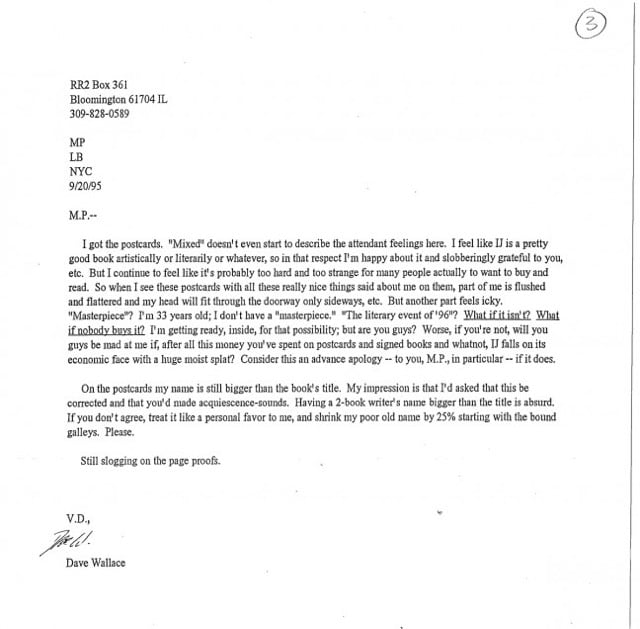
David Foster Wallace’s Infinite Jest turns 20 years old this month. To mark the occasion, the Harry Ransom Center, home of DFW’s archive of papers, is posting some of the more interesting findings by visiting scholars. Here, for instance, is a letter written by Wallace to his editor a few months before IJ’s publication.
In interviews, Wallace was explicit that art must have a higher purpose than mere entertainment: “Fiction’s about what it is to be a … human being.” And here, really, is the enigma of David Foster Wallace’s work generally and “Infinite Jest” specifically: an endlessly, compulsively entertaining book that stingily withholds from readers the core pleasures of mainstream novelistic entertainment, among them a graspable central narrative line, identifiable movement through time and any resolution of its quadrumvirate plotlines. “Infinite Jest,” in other words, can be exceedingly frustrating. To fully understand what Wallace was up to, the book bears being read, and reread, with Talmudic focus and devotion. For many Wallace readers this is asking too much. For many Wallace fans this is asking too much.
Here, in an anthology of some of the finest of the genre, brilliant creative minds in every sector offer their wisdom: David Foster Wallace on living a compassionate life, Debbie Millman on the importance of taking risks, Michael Lewis on the responsibility that good fortune merits — and so many other greats. Some of this advice is grand (believe in the impossible), and some of it is granular enough to check off a life list (donate five percent of your money or your time).
“The more people think you’re really great, the bigger the fear of being a fraud is.” That’s the most resonant line for me from the first trailer for The End of the Tour, the story of a five-day interview between reporter David Lipsky and David Foster Wallace that takes place in 1996, just after Infinite Jest came out.
The movie is based on a book Lipsky published called Although Of Course You End Up Becoming Yourself, which I read and thought was great.1 Jesse Eisenberg plays Lipsky and Jason Segel does as much justice to Wallace as one could hope for, I think. I am cautiously optimistic that this movie might actually be decent or even good. (via @jcormier)
The Atlantic has republished and reformatted Host by David Foster Wallace on their website. Originally published in 2005, Host was a profile of talk radio host John Ziegler and contained several layers of footnotes, which are beautifully handled in this new online version.
The Nick Berg beheading and its Internet video compose what is known around KFI as a “Monster,” meaning a story that has both high news value and tremendous emotional voltage. As is SOP in political talk radio, the emotions most readily accessed are anger, outrage, indignation, fear, despair, disgust, contempt, and a certain kind of apocalyptic glee, all of which the Nick Berg thing’s got in spades. Mr. Ziegler, whose program is in only its fourth month at KFI, has been fortunate in that 2004 has already been chock-full of Monsters — Saddam’s detention, the Abu Ghraib scandal, the Scott Peterson murder trial, the Greg Haidl gang-rape trial, and preliminary hearings in the rape trial of Kobe Bryant. But tonight is the most angry, indignant, disgusted, and impassioned that Mr. Z.’s gotten on-air so far, and the consensus in Airmix is that it’s resulting in some absolutely first-rate talk radio.
The point here is that I think this is one part of what teaching me how to think is really supposed to mean. To be just a little less arrogant. To have just a little critical awareness about myself and my certainties. Because a huge percentage of the stuff that I tend to be automatically certain of is, it turns out, totally wrong and deluded. I have learned this the hard way, as I predict you graduates will, too.
Where do you begin with a writer as original and brilliant as David Foster Wallace? Here — with a carefully considered selection of his extraordinary body of work, chosen by a range of great writers, critics, and those who worked with him most closely. This volume presents his most dazzling, funniest, and most heartbreaking work — essays like his famous cruise-ship piece, “A Supposedly Fun Thing I’ll Never Do Again,” excerpts from his novels The Broom of the System, Infinite Jest, and The Pale King, and legendary stories like “The Depressed Person.”
Wallace’s explorations of morality, self-consciousness, addiction, sports, love, and the many other subjects that occupied him are represented here in both fiction and nonfiction. Collected for the first time are Wallace’s first published story, “The View from Planet Trillaphon as Seen In Relation to the Bad Thing” and a selection of his work as a writing instructor, including reading lists, grammar guides, and general guidelines for his students.
If you’ve somehow been waiting to dig into Wallace’s writing but didn’t know where to start, this is where you start.
David Foster Wallace was at the center of late-20th-century American literature, Bryan A. Garner at that of legal scholarship and lexicography. It was language that drew them together. The wide-ranging interview reproduced here memorializes 67 minutes of their second and final evening together, in February 2006. It was DFW’s last long interview, and the only one devoted exclusively to language and writing.
It was Wallace’s piece featuring Garner in Harper’s, Tense Present, that cemented him as a favorite writer of mine, even before I tackled Infinite Jest. Wallace later expanded the essay to 62 pages in Consider the Lobster and Other Essays.
Just after Infinite Jest was published, David Foster Wallace came to Boston and did a radio interview with Chris Lydon. Radio Open Source recently unearthed that interview, probably unheard for the past 18 years, and published it on their site.
When I started the book the only idea I had is I wanted to do something about America that was sad but wasn’t just making fun of America. Most of my friends are extremely bright, privileged, well-educated Americans who are sad on some level, and it has something, I think, to do with loneliness. I’m talking out of my ear a little bit, this is just my opinion, but I think somehow the culture has taught us or we’ve allowed the culture to teach us that the point of living is to get as much as you can and experience as much pleasure as you can, and that the implicit promise is that will make you happy. I know that’s almost offensively simplistic, but the effects of it aren’t simplistic at all.
2. And is a conjunction; so is so. Except in dialogue between particular kinds of characters, you never need both conjunctions. “He needed to eat, and so he bought food” is incorrect. In 95% of cases like this, what you want to do is cut the and.
Story finds Lipsky accompanying Wallace across the country on a book tour promoting “Infinite Jest,” just as Wallace starts to become famous. Along the way, jealousy and competition bubbles up between the two writers as they discuss women, depression and the pros and cons of fame.
Reaction from the DFW fan club abut Segel playing DFW has been tepid, to say the least.
Given this article’s venue and my own lack of culinary sophistication, I’m curious about whether the reader can identify with any of these reactions and acknowledgments and discomforts. I am also concerned not to come off as shrill or preachy when what I really am is confused. Given the (possible) moral status and (very possible) physical suffering of the animals involved, what ethical convictions do gourmets evolve that allow them not just to eat but to savor and enjoy flesh-based viands (since of course refined enjoyment, rather than just ingestion, is the whole point of gastronomy)? And for those gourmets who’ll have no truck with convictions or rationales and who regard stuff like the previous paragraph as just so much pointless navel-gazing, what makes it feel okay, inside, to dismiss the whole issue out of hand? That is, is their refusal to think about any of this the product of actual thought, or is it just that they don’t want to think about it? Do they ever think about their reluctance to think about it? After all, isn’t being extra aware and attentive and thoughtful about one’s food and its overall context part of what distinguishes a real gourmet? Or is all the gourmet’s extra attention and sensibility just supposed to be aesthetic, gustatory?
Both Flesh and Not gathers 15 essays never published in book form, including “Federer Both Flesh and Not,” considered by many to be his nonfiction masterpiece; “The (As it Were) Seminal Importance of Terminator 2,” which deftly dissects James Cameron’s blockbuster; and “Fictional Futures and the Conspicuously Young,” an examination of television’s effect on a new generation of writers.
Wallace’s previous collections often included expanded articles with extra material cut from previously published pieces (like the cruise ship one and the state fair one). It would be wonderful to read a longer version of his NY Times piece on Federer but for obvious reasons I’m not holding my breath. Even just the first paragraph makes me want to sit down and read the whole thing for like a fifth time:
Almost anyone who loves tennis and follows the men’s tour on television has, over the last few years, had what might be termed Federer Moments. These are times, as you watch the young Swiss play, when the jaw drops and eyes protrude and sounds are made that bring spouses in from other rooms to see if you’re O.K.
In July, we mentioned Infinite Boston, a project from William Beutler to map and photo the Boston-related locations in Infinite Jest. Today Beutler announced Infinite Atlas, which expands nationally on this project, and Infinite Map, a limited edition print featuring 250 “of the most interesting locations” from Infinite Jest.
The story has been told so many times, of these early years, when Compton got used to the sight of the little girls who would always be playing tennis at the public park — or riding around in their faded yellow VW bus with the middle seat taken out to accommodate the grocery cart full of balls — but somehow the strangeness and drama of it retain a power to fascinate. The idea of this African-American family organizing itself, as a unit, in order to lay siege to perhaps the whitest sport in the world and pulling it off somehow. “I remember even talking to my sisters and brothers,” Oracene said, recalling a time before anyone had ever heard of the Williams sisters, “and telling them: ‘The girls are going to be professional. We’re going to need a lawyer, and we’re going to need an accountant.’ “
Isha, the middle daughter — sharply funny and practical, fiercely loyal to the family — told me: “Life was get up, 6 o’clock in the morning, go to the tennis court, before school. After school, go to tennis. But it was consistency. I hate to put it [like this], but it’s like training an animal. You can’t just be sometimey with it.” She still can’t sleep past 6.
My favorite observation from the story was actually from a behind-the-story piece that ran on the magazine’s blog.
One thing Venus talked about that was interesting was how easy it is for professional athletes to pick up other sports. So what they are good at is not the sport itself, but it’s just a way of being in the world. It’s a sense of their own bodies and an ability to manipulate their own bodies and have sort of a visual map in your head of what the different parts are doing. At one point she was talking about doing a benefit with Peyton and Eli Manning. They’d almost never played tennis before and they started out awful, and she said it was amazing to watch them. It was like watching a film. Every stroke they hit was noticeably better than the last. Every time they hit the ball. She said you could almost watch their brains working and by the end of it they were totally competent tennis players.
The Super Manning Bros anecdote hits because, as David Foster Wallace pointed out in his evisceration of tennis player Tracy Austin’s biography, it can be difficult for gifted athletes to talk about why and how they are able to do what they do. But Venus obviously can and I wish there’d been more of that in the main essay.
David Foster Wallace was the leading literary light of his era, a man who not only captivated readers with his prose but also mesmerized them with his brilliant mind. In this, the first biography of the writer, D. T. Max sets out to chart Wallace’s tormented, anguished and often triumphant battle to succeed as a novelist as he fights off depression and addiction to emerge with his masterpiece, Infinite Jest.
Since his untimely death by suicide at the age of forty-six in 2008, Wallace has become more than the quintessential writer for his time — he has become a symbol of sincerity and honesty in an inauthentic age. In the end, as Max shows us, what is most interesting about Wallace is not just what he wrote but how he taught us all to live. Written with the cooperation of Wallace’s family and friends and with access to hundreds of his unpublished letters, manuscripts, and audio tapes, this portrait of an extraordinarily gifted writer is as fresh as news, as intimate as a love note, as painful as a goodbye.
Infinite Boston is a photo tour of some of the Boston locations that inspired locations in David Foster Wallace’s Infinite Jest.
In July of what might have been Year of Glad, one year ago this week, I traveled to Boston, Massachusetts with the express purpose of visiting as many of the landmarks and lesser known precincts that appear in, or provide inspiration for, the late David Foster Wallace’s 1996 novel Infinite Jest as I could manage on a Thursday-Sunday trip. My reasons for doing so will become apparent at a later date, but for now I am pleased to present what I am calling “Infinite Boston”: a ruminative travelogue and photographic tour of some fifty or so of these locations, comprising one entry each non-holiday weekday, from now until sometime in early autumn.
The play is Infinite Jest. Yes, the 1,079-page David Foster Wallace novel. Germany’s leading experimental theater, Hebbel am Ufer, had the gall not only to stage the world theatrical premiere of an Infinite Jest adaptation, but to play it on the grandest stage possible: the city of Berlin itself. Over the course of 24 hours, the shell-shocked and increasingly substance-dependent audience is transported to eight of the city’s iconic settings, which serve as analogs for the venues to which the discursive novel continually returns.
But so we’re at this AA meeting in a Boston school cafeteria, which in this case is the cultural center of a city quarter that was drawn up from scratch in the 1960s in the far, far north of Berlin, like practically halfway to the Baltic, this sticks-of-the-sticks-type section of town. And the actor sharing his history of teen addiction to Quaaludes and Hefenreffer-brand beer is droning on far too long and starting to give me the howling fantods.
Every internet article about Wallace is required by law to include footnotes and this one is no exception. (thx, paul)
Beloved for his epic agony, brilliantly discerning eye, and hilarious and constantly self-questioning tone, David Foster Wallace was heralded by both critics and fans as the voice of a generation. BOTH FLESH AND NOT gathers 15 essays never published in book form, including “Federer Both Flesh and Not,” considered by many to be his nonfiction masterpiece; “The (As it Were) Seminal Importance of Terminator 2,” which deftly dissects James Cameron’s blockbuster; and “Fictional Futures and the Conspicuously Young,” an examination of television’s effect on a new generation of writers.
And the videophonic stress was even worse if you were at all vain. I.e. if you worried at all about how you looked. As in to other people. Which all kidding aside who doesn’t. Good old aural telephone calls could be fielded without makeup, toupee, surgical prostheses, etc. Even without clothes, if that sort of thing rattled your saber. But for the image-conscious, there was of course no answer-as-you-are informality about visual-video telephone calls, which consumers began to see were less like having the good old phone ring than having the doorbell ring and having to throw on clothes and attach prostheses and do hair-checks in the foyer mirror before answering the door.
“Patients come in with their iPhones and show me how they look on [Apple’s video calling application] FaceTime,” says Dr. Sigal. “The angle at which the phone is held, with the caller looking downward into the camera, really captures any heaviness, fullness and sagging of the face and neck. People say ‘I never knew I looked like that! I need to do something!’ I’ve started calling it the ‘FaceTime Facelift’ effect. And we’ve developed procedures to specifically address it.”
Using Jeffrey Eugenides’s newest book, The Marriage Plot, as a jumping-off point, Evan Hughes explores how the personal relationships and jealousies amongst a cadre of writers that included Eugenides, Rick Moody, Jonathan Franzen, Mary Karr, and David Foster Wallace pushed each of them to produce their best work and plumb the lowest depths of their self-loathing.
It was another novel-in-manuscript that had propelled Franzen toward his new phase — the thousand-plus pages of Infinite Jest. Almost all of what Franzen had read at the Limbo had been written in a kind of response to Wallace after getting an early look at his groundbreaking book. “I felt, Shit, this guy’s really done it.” As Franzen saw it, Wallace had managed to incorporate the kind of broad-canvas social critique that the great postmodernists did into a narrative “of deadly personal pertinence.” The pages Franzen produced then, he says, “came out of trying to feel good about myself as a writer after what an achievement Infinite Jest was.” His comments to Wallace weren’t all sunshine, though; he also “pointed toward some plot problems.” Wallace granted that the problems existed, Franzen told me, but said that he would thereafter deny ever having admitted it.
Nevertheless, Franzen knew it was “a giant book,” an end point of sorts. “It was clear that it was not going to be appropriate of me to try to compete at the level of rhetoric and the level of formal invention that he had achieved.” He turned instead to “a family story about a midwestern Christmas,” the beginning of which he read at the Limbo. The result was The Corrections.
In this week’s NY Times Magazine, Maud Newton tells us why she doesn’t like David Foster Wallace’s writing and blames DFW for the voice of the internet being too familiar. Maybe she’s not actually doing this, but the whole thing is really sort of annoying, too, because to me, it kind of seems like she kind of uses all of the DFW tropes she’s railing against. Then again, who am I, anyway? (Those previous 2 sentences are an example of the internet writing Newton claims DFW inspired. I think I’m a master and I probably should have written the whole post in this style.) I think I missed the point, Ms. Newton, I’m a lesser thinker.
Of course, Wallace’s slangy approachability was part of his appeal, and these quirks are more than compensated for by his roving intelligence and the tireless force of his writing. The trouble is that his style is also, as Dyer says, “catching, highly infectious.” And if, even from Wallace, the aw-shucks, I-could-be-wrong-here, I’m-just-a-supersincere-regular-guy-who-happens-to-have-written-a-book-on-infinity approach grates, it is vastly more exasperating in the hands of lesser thinkers. In the Internet era, Wallace’s moves have been adopted and further slackerized by a legion of opinion-mongers who not only lack his quick mind but seem not to have mastered the idea that to make an argument, you must, amid all the tap-dancing and hedging, actually lodge an argument.
When you love someone who suffers from the disease of addiction you await the phone call. There will be a phone call. The sincere hope is that the call will be from the addict themselves, telling you they’ve had enough, that they’re ready to stop, ready to try something new. Of course though, you fear the other call, the sad nocturnal chime from a friend or relative telling you it’s too late, she’s gone.
Frustratingly it’s not a call you can ever make it must be received. It is impossible to intervene.
Could help but think of Wallace while reading this, particularly this bit:
All addicts, regardless of the substance or their social status share a consistent and obvious symptom; they’re not quite present when you talk to them. They communicate to you through a barely discernible but un-ignorable veil. Whether a homeless smack head troubling you for 50p for a cup of tea or a coked-up, pinstriped exec foaming off about his “speedboat” there is a toxic aura that prevents connection. They have about them the air of elsewhere, that they’re looking through you to somewhere else they’d rather be.
No discernible voice/tone in this writing. Rambling descriptions. I, frankly, do not care where each and every person is seated. I don’t care what shoe you’re wearing. If you take out all the unnecessary details, you’d be left with about seven words.







Stay Connected