In case anyone saw the news that Lil Nas X ran a half-marathon last weekend and then thought, Hm I wonder if other celebrities have run marathons? (as I did), the answer is: Yes, a lot, and last fall Runners World put together a long list of them, with each of the runners’ times. Shoutout to Bryan Cranston for running a 3:20! 🔥
Elsewhere in marathon news, Romper has a good story about a marathoner recovering from a birth injury. (“I’m losing my mind a little bit.”)
Winter is winding down here in the northern hemisphere (though you wouldn’t know it from the foot of new snow outside my window), but for practitioners of wild ice skating, spring can bring favorable conditions.
But the problem with Nordic skating or any kind of wild skating — which is defined as outdoors and on naturally formed ice, regardless of the style of skate used — is finding good ice. Wild-ice seekers extol late fall and sometimes spring for freezing conditions without snowfall, which degrades ice.
A doctor trained in wilderness emergencies (and who has summited Everest three times) explains all the different ways Mt. Everest can kill you — in a refreshingly no-nonsense way.
Mt. Everest is a famously inhospitable environment for humans — if someone from sea level was dropped at the very top they’d be unconscious within minutes. Many dangers await those brave enough to make an attempt at the summit, and Dr. Emily Johnston visits WIRED to break down each and every way Mt. Everest can prove fatal.
Avalanches, ice axes on the loose, high-altitude edemas, “this is what people call ‘the death zone’” — sounds fun, let’s go! 🫠 (via @thenoodleator)
A small number of shuttered golf courses around the country have been bought by land trusts, municipalities and nonprofit groups and transformed into nature preserves, parks and wetlands. Among them are sites in Detroit, Pennsylvania, Colorado, the Finger Lakes of upstate New York, and at least four in California.
“We quickly recognized the high restoration value, the conservation value, and the public access recreational value,” said Guillermo Rodriguez, California state director with the nonprofit Trust for Public Land, which bought the San Geronimo course, in Marin County, for $8.9 million in 2018 and renamed it San Geronimo Commons.
The article also shares this startling fact: “The United States has more golf courses than McDonald’s locations.” WAT.
YouTuber Casey Neistat has achieved a lot in life, including several “impossible goals” he set for himself. But one of his longest-running goals seemed to be slipping out of his reach and, well, I don’t want to spoil what happens.
I will say however that I think it’s good and healthy to let go of your goals and dreams if they do not serve the person you have become since setting them. I’ve never been much of a goal person, but I’ve definitely had thoughts about directions I’ve wanted to head or things I’d like to have had happen that just aren’t relevant for what’s important to me right now. If it’s not working for you, chalk it up to sunk cost and let it go.
I got this link via Andy, who said, “I allow myself one link to a Casey Neistat video every ten years, and this is that video.” Lol.
Yesterday on her Instagram story, cognitive scientist Lera Boroditsky posted a short clip of a lecture in which she posed an intriguing question: if she switched brains with LeBron James, which of them would win in a 1-on-1 game? Some relevant facts: LeBron is 6’8”, 250 pounds, a 4-time NBA champion, 19-time All-Star, 4-time league MVP, and is the all-time NBA points leader. He also possesses a singular basketball mind:
“I can usually remember plays in situations a couple of years back — quite a few years back sometimes,” James says. “I’m able to calibrate them throughout a game to the situation I’m in, to know who has it going on our team, what position to put him in.
“I’m lucky to have a photographic memory,” he will add, “and to have learned how to work with it.”
Boroditsky is 5’3”, 105 pounds, and by her own admission knows nothing about basketball and has “no hops”. So who would win? Boroditsky’s body with LeBron’s brain or LeBron’s body with Boroditsky’s brain? And why?
One of the best uses of technology is to make people laugh. In this three-part series, the Numerical YouTube channels uses some simple editing to increase the size of the goal until some laughably off-the-mark strikes by professional footballers Ousmane Dembélé, Harry Kane (his penalty miss vs France), and Nicolas Jackson finally find their targets. The misses just get more and more funny as the goal gets bigger.
This is pretty clever actually: Disney+ and ESPN+ will air a real-time, Toy Story-ified version of the Oct 1st Jacksonville Jaguars and Atlanta Falcons NFL game. From Deadline:
Using the NFL’s Next Gen Stats and on-field tracking data, every player and play will be presented in “Andy’s Room,” the familiar, brightly colored setting for the Toy Story franchise. The action will be virtually simultaneous with the main game telecast, with most plays recreated after an expected delay in the neighborhood of about 30 seconds. Woody, Buzz Lightyear and many other characters will be visible throughout, and a press release notes they will be “participating from the sidelines and in other non-gameplay elements.” Along with game action, the announcers, graphics, scoreboard, referees’ penalty announcements, celebrations and other parts of the experience will all be rendered in a Toy Story-centric fashion.
I stopped watching the NFL years ago, but I might tune in to see how this works.
For the role of a teacher/coach in her new film Bottoms (about a pair of queer girls who start a fight club in their high school in order to get laid), director Emma Seligman made the unorthodox decision to cast former NFL player Marshawn Lynch. It turned out to be an inspired choice — according to an interview with Seligman, he was a natural.
He was one of the best improvisers I’ve ever worked with. I’m not overstating that. He improvised most of his stuff in the movie that ended up in the final cut! We couldn’t ever write something that would be as funny as what he gave us. He’d spew out the most brilliant jokes ever. I kept on encouraging him to do more improv. He’d be like, “Ugh, that stuff’s easy! I wanna get your words right!” I told him that it was so much better than anything we could have written and he was like, “I don’t care about this. I want to honor your work.” I’m so glad I got to talk about him this much.
Here’s a short clip of Lynch doing his thing as Mr. G, “an air-headed high school teacher”:
Lynch also used the film as an opportunity to make some amends for how he reacted when his sister came out as queer:
This was a good opportunity for me because when I was in high school, my sister had came out as being a lesbian or gay — I did not handle it right. You feel me, as a 16-year-old boy, I didn’t handle it the way that I feel like I probably should have. So I told [Seligman] it was giving me an opportunity to correct my wrongs, to rewrite one of my mistakes.
From that interview with Seligman again:
In our first conversation, he told me that his sister is queer and when they were in high school, he didn’t necessarily handle it super well. He felt like this movie coming into his hands was the universe giving him a chance to right his wrongs. That’s what he said. He walked her down the aisle. He felt like they were all good, you know? But his sister thought it’d be really cool if he did this.
If you have never seen this old interview with Lynch about the value of persistence, buckle up because you’re in for a treat:
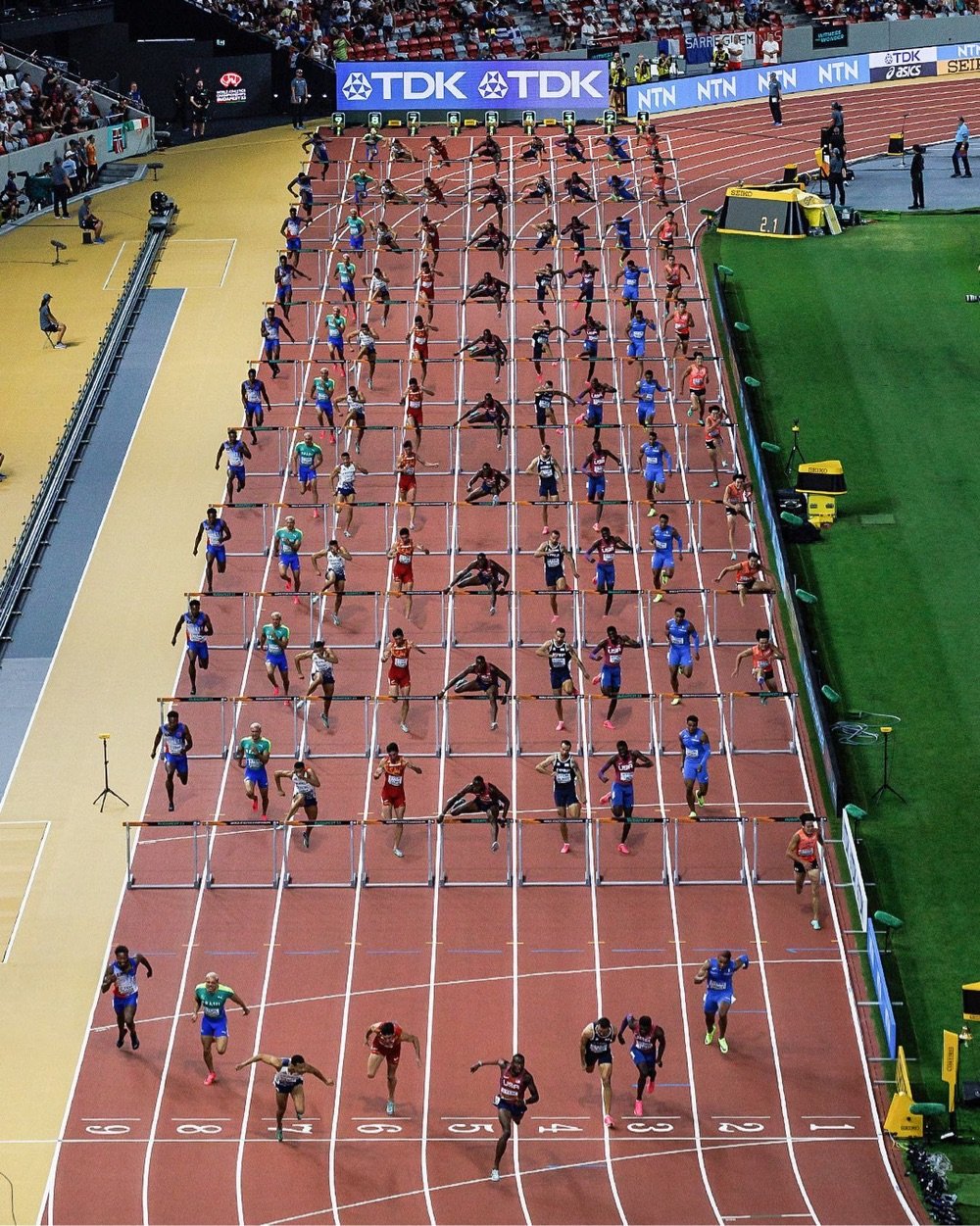
What an amazing, info-dense composite photograph taken by Casey Sims of the semi-finals of the men’s 110-meter hurdles at the 2023 World Athletics Championships in Budapest from last month. You can see and analyze the entire race, just from this one image. Eventual finals winner Grant Holloway is in lane 5 and led from start to finish.
As a girl, Ay Ay loved playing sports at school. But, when she asked her parents’ permission to go out and play after school, they would say no — that only boys could do so. The custom in Hondzonot was that girls would stay busy inside, get married (some as young as twelve or thirteen), and have a family. Ay Ay always thought differently, she told me, but she had no choice but to obey her parents, and later her husband. One day, a mobile health unit came to town, and the doctor taught some local women to play softball with a wooden stick and a tennis ball, as a way to combat the risks of diabetes and hypertension. After the doctor left, the women kept playing, and the health benefits of the sport eased the community stigma. Little by little, Ay Ay asked permission from her husband to go out every day. “I felt it was necessary. I wanted to distract myself,” she told Fajardo, “from the routine at home.”
The women purposely wear the traditional huipil tunic as their uniform and play with an infectious spirit of camaraderie. Major League Baseball made their own short documentary about Las Diablillas:
“The question isn’t, ‘Who will give me permission?’ It’s, ‘Who’s going to stop me?’” says Geimi Santa Ofelia May Dzib, the team’s left fielder, in the opening scenes of MLB Originals’ latest short film, “Las Diablillas,” which explores how these women have found empowerment through sport.
“Here a woman serves the home and is not supposed to go out and play sports,” said Fabiola May Chulim, the team captain and manager of the Little Devils, known here as Las Diablillas, their name in Spanish. “When a woman marries, she’s supposed to do chores and attend to her husband and kids. We decided a few years ago that’s not going to impede us anymore from playing a sport when we want.”
Alexey Molchanov, one of the best freedivers of all time, recently set two new world records at a competition at Dean’s Blue Hole in the Bahamas:
An FIM dive that took 4m 42s and went to a depth of 133 meters (442 feet). Molchanov pulled himself down and up using a guide rope without fins.
A CWT dive that took 4m 13s and went to a depth of 133 meters (442 feet). CWT is when the diver uses a monofin and weight belt to dive and return to the surface.
His complete record-breaking dives are embedded above and are completely suspenseful to watch even though you know the outcome. They’re almost like watching someone meditate instead of compete in an extreme sport. Molchanov needs to expend some energy and oxygen getting down and back, but also can’t over-exert himself. A lot of it is just being relaxed and calm — this is truly a mind-over-matter discipline.
When Alexey was younger, his mother, Natalia Molchanova, was the world’s best freediver, a distinction that she held for many years. She was a pioneer in the sport and the practitioner of a mind-and-body-control technique called “attention deconcentration.” She passed her secrets to her son, who perfected them and uses the regimen to reach a state of intense calm. By doing so, he can slow his heart rate, his metabolic rate, while simultaneously slowing the activity of his brain and his body. His focus deepens. He relaxes to the point of seeming asleep. He takes deep, drowsy breaths, like a summer breeze filling a sail.
Produced by Venus & Serena Williams and US soccer star Alex Morgan and directed by Rachel Ramsay & James Erskine, Copa 71 is a forthcoming documentary about a women’s soccer tournament that took place in Mexico City in 1971 that was the first, albeit unofficial, Women’s World Cup. A short teaser trailer is above. From a piece in Variety about the film:
In August 1971, more than 100,000 football fans packed Mexico City’s Azteca Stadium for a historic tournament. Teams from England, France, Denmark, Argentina and Italy flew in for 21 days of matches alongside Mexico’s national team, while eager sponsors lined up for a piece of the action. The players, who received a hero’s welcome wherever they went, might as well have been the Rolling Stones.
They were, in fact, a group of around 100 women — many of them teenagers — taking part in a pioneering unofficial Women’s World Cup. And just as quickly as they tasted fame, it was snatched away as the tournament was all but erased from football history.
Many of the competitors were just teenagers — from Wikipedia:
England’s team included 13-year-old Leah Caleb, 14-year-old Gill Sayell, and 15-year-old Chris Lockwood; their captain was 19-year-old Carol Wilson and they were accompanied by referee Pat Dunn as a chaperone and trainer. 15-year-old Susanne Augustesen scored a hat-trick for Denmark as they beat Mexico 3-0 in the final.
Copa 71 is premiering at the Toronto Film Festival in September and then hopefully will find its way into theaters and onto streaming. (thx, meg)
In the 1994 Caribbean Cup qualifying group stage match between Barbados and Grenada, the 90 minutes of normal time ended with an intentional own goal by Barbados and then with Grenada trying to score either a goal or an own goal and Barbados defending both nets. Say what?! How did this happen?
Well, it was the confluence of a few things:
The match would go into overtime in case of a tie.
The “golden goal” rule was in effect for overtime…the first goal wins and the match is immediately over. Oh, and the goal is worth 2 goals, not just one.
To qualify for the next round, Barbados not only needed to win the match, they needed to win it by two goals…a one-goal difference would not be enough.
The match started off routinely and Barbados scored the first two goals, establishing the two-goal winning margin they required: in the 83rd minute, the game changed when Grenada scored a goal, which would take Grenada through to the finals unless Barbados could score again.
Barbados attempted to score for the next few minutes, but as time ran out they switched to a different strategy: tying the game so they could attempt to achieve the two-goal margin with the golden goal in extra-time. In the 87th minute, they stopped attacking, with Barbados defender Terry Sealey and goalkeeper Horace Stoute passing the ball between each other before Sealey intentionally scored an own goal to tie the game at 2-2.
With just three minutes of normal time left, the Grenadian players caught on to the Barbadians’ plan, and realised that they would advance in the tournament by scoring a goal in either net, since they would still qualify for the finals with a 1-goal loss. This saw normal time finish in a highly unusual manner, with Grenada trying to score a goal in (and Barbados trying to defend) both nets. For the next three minutes, Barbadian players successfully defended both sides.
As 90 minutes had expired with the score at 2-2, the game went on to extra time, where the winning “golden goal” would count double — thus, Barbados only had to score once to qualify for the 1994 Caribbean Cup. Trevor Thorne scored the winning goal for Barbados to advance to the next round with a score of 4-2.
In 1910, a group of inexperienced climbers claimed to have summited Denali, the highest peak in what is now the United States. Their story was greeted with skepticism.
So when I found out that the first people to reach the highest point in North America (Denali, the mountain formerly known as McKinley) were just a bunch of Average Joes with no climbing experience who went up on a bet, I was flabbergasted. How had I never heard this story? The more I looked into it, the more fantastic the story became. When these guys descended from the mountain, nobody believed they really even made it. And they wouldn’t be the first people to fraudulently claim to have reached the top, with no evidence to offer that they succeeded. This story has all the makings of a blockbuster action comedy. It’s almost unbelievable.
But later evidence suggests that they just might have made it to the top.
Many baseball players have minor control issues at one point or another. Sometimes it happens after an injury, when a player is relearning how to throw, over-attending to discrete motions that used to feel fluid and natural. “Overthinking” is the simple way to put it: the brain’s prefrontal cortex trips up the sensory cortex and the motor cortex. In other cases, the mind can essentially go blank. Players usually snap out of it, the way Bard had years before. But the brain can get stuck in certain patterns, and the yips can take over in a way that no one fully understands.
I used to write quite a bit about the sort of practiced autopilot that’s necessary to perform at a high level and what happens when the wheels come off the wagon and you start overthinking and second-guessing. From a 2021 post about Simone Biles’ case of the twisties:
This phenomenon goes by many names — performance anxiety, stage fright, choking, the yips, cueitis (in snooker), and target panic (for archers) - and the world-class are not immune. Daniel Day-Lewis had stage fright so bad he quit the stage decades ago — an affliction he shared with Laurence Olivier, Barbra Streisand, and Mikhail Baryshnikov. If you’ve read anything at all about this stuff, Biles’ case of the twisties doesn’t seem so unusual or mysterious — it’s just one of those things that makes her, and the rest of us, human.
Back to Bard, who tried a bunch of different fixes for his pitching problems:
Once Bard acknowledged the problem, he tried every available fix. He met with sports psychologists; he saw a hypnotist; he meditated. He whispered mantras, which he found counterproductive — athletes “don’t think in words, we think in shapes, feelings, and visions,” he told me. He had a rib removed, to help with the blood-flow problem caused by thoracic-outlet syndrome. He tried different arm slots. Adair posted inspirational messages around their house. At one point, she and Bard drove to a Holiday Inn to meet a woman who used eye-movement therapy to treat soldiers with P.T.S.D. Bard also tried a technique called tapping: you tap your fingers on certain places on your head, in a certain order, to reframe traumatic memories. It didn’t work.
I don’t know if anyone else has felt like this, but I think I might have the yips — not for a sport but for my life. I feel like I have forgotten how to naturally be myself. My preferences, what I enjoy doing, what I think about certain things, how I feel, how I feel about how I feel — it all feels forced right now, overthinking and second-guessing galore. What Would Jason Do? The hell if I know…but I do know that if you’re asking yourself what you would do in a certain situation instead of just doing it, you’ve already lost.
Like Bard, I’ve tried a bunch of different things recently to fix this, to seemingly little avail. Perhaps thinking about it as the yips but for my life will help me address it?
Microsoft Excel is an extremely powerful, complex, and useful software program that millions of people know how to use, at least a little bit. For those who are experts, there are now esports competitions in Microsoft Excel that pit the best spreadsheet jockeys against each other. Here’s what that looks like:
It’s….a little confusing to watch if you aren’t that good at Excel yourself. From a piece in the Atlantic late last year:
Yes, we are talking about people competing in Microsoft Excel, the famous (and famously boring) spreadsheet software that you may have used in school or at work or to track your finances. In competitive Excel, players square off in test-taking showdowns, earning points each time they answer a question correctly. Players’ screens are a whirlwind of columns and keystrokes and formulae; if the terms XLOOKUP, RANDBETWEEN, and dynamic array don’t mean anything to you, you are unlikely to understand what’s going on. The commentators help, but only to a point. Even so, you can always follow the scoreboard, which tends to change suddenly and drastically. With just over three minutes to play, Ngai nailed a set of questions and jumped out to a 416-390 lead. GolferMike1 began to rethink his earlier assessment: “Uh oh. We got a game.”
There’s a pretty good explanation of what some of the challenges are like starting at the 6-minute mark in this video:
If you’d like more information, check out the Microsoft Excel World Championship for 2023 — the finals are in Las Vegas this year, they’re gonna show it on one of ESPN’s channels, and there’s more than $15,000 in prize money at stake.
No one disputes that referees are as fit as they’ve ever been. The problem, according to many observers, is that referees are also worse than they’ve ever been. In 2017, then-Arsenal manager Arsène Wenger claimed that English referees’ level “drops every season”. The next season, Cardiff manager Neil Warnock despaired at how the “best league in the world” could possibly have “the worst officials”.
Today, that story of perpetual decline has given way to one of full-blown crisis. Every week brings a new wave of anger — from fans, players, managers and pundits — about alleged errors, inconsistencies and incompetence. This is at the polite end of the spectrum. On social media, referees’ mistakes are often blamed not on inevitable human error, or even simple ineptitude, but on elaborate conspiracies to derail this or that club. (The fact that every fanbase believes there is a conspiracy against their particular club does not seem to give people pause.)
There is no statistical evidence to support this story of decline. In fact, all such evidence suggests that referees are making fewer mistakes a match, with accuracy rising each season. (However, these statistics themselves are difficult to assess, given that they are collected not by a truly independent body, but by PGMOL and the Premier League, and very little of this data has ever been made public.) Instead, the critics point to a large, often indisputable, collection of individual errors and baffling decisions. These errors amount to only a tiny percentage of all decisions, but having been replayed and discussed over and over, they are the ones etched into memory.
In season one of his podcast Against the Rules, Michael Lewis explored the disconnect between how referees are perceived and their actual performance, not just in sports but also in governance, business, and even the arts.
There are interesting bits throughout the piece, many of which deal with human psychology (esp. of groups) and even philosophy. I found this bit worth quoting:
On the next day I spent with England, 5 November, he was refereeing the champions, Manchester City, at home to Fulham. In a room at a swanky hotel on the outskirts of Manchester, England and his team gathered for their pre-match meeting. His usual assistants had been replaced, because they support Manchester clubs. (Every official must declare their allegiances, and will not be assigned that team’s matches or those of their closest rivals. Other factors that determine appointments include how many times an official has refereed each club that season, how close they live to the stadium, and which teams their family members support.)
Fascinating! Do any of the sports leagues in the US do this? Or is, as I suspect, the support for one’s team in England just so much more intense and foundational to one’s personal identity than in America?
The other day on the chair lift, my kids and I were talking about our top skiing speeds (me: low 40s, them: 50+) and one of us mentioned that it would be cool if your current speed was shown on a heads-up display in your goggles. So this morning I went looking for AR ski goggles and of course they exist. Here are a pair of demo videos from Sirius (made by Oostloong) and Rekkie.
These googles include features like real-time speed, clock, temperature, friend finding/tracking, wayfinding (directions, compass, elevation), HD recording, and phone notifications. Skiing is a natural use for AR — you’re wearing the bulky goggles for safety anyway, so you can hide all the necessary tech in there without lookingridiculous, and taking your mittens on and off to check the time or send/read texts is annoying.
I’d love to try some of these, to see how the interface and notifications work — I worry that it would be unsafe because it requires too much of the skier’s attention. Being on anything but the bunniest slopes with people who are reading text messages and clocking their speed as they’re skiing is not something I’d be into — the idiots with the GoPros on selfie sticks are bad enough. I’m also skeptical that the electronics and control buttons on these devices will be able to withstand the beating that ski goggles undergo over the course of a season, especially if they’re subjected to any skiing in the woods. If they could get it right though, I could see these being fun and useful.
A beautiful scene from the 2014 Mauritanian film Timbuktu (which was recently included on Slate’s New Black Film Canon), in which young men under the rule of Islamic extremists quietly and defiantly play a forbidden football match with an imaginary ball. (thx, caroline)
Ok this video from The Pudding is cool for two different reasons. First, you learn about which NBA player had the most unexpectedly great performance since 1985 (e.g. when a guy who is usually good for 6-8 pts inexplicably drops 50). But, you also get a fun little tutorial in how statistical analysis works and the importance of paying attention to the right data in order to get an answer that’s actually meaningful and relevant. How to interpret data in this way is an under-appreciated aspect in the bombardment of data and statistics we see in the media these days and teaching more people about it doesn’t have to be boring or stuffy.
This will probably get taken down soon, but in the meantime… This is the ASL performance of Rihanna’s Super Bowl halftime show by Justina Miles. So good — I love how her long fingers and fingernails accentuate and amplify her signing.
Miles, a Philadelphia native and current nursing student at HBCU Bowie State University, is hard of hearing, according to reporting from Billy Penn. Her mom is deaf, and her family is mixed with hearing people.
Miles was also part of the USA team that went to the 2021-22 Deaflympics in Brazil and won a silver medal as part of the 4x100 women’s track relay team. She was the valedictorian at the Model Secondary School for the Deaf in Washington D.C., according to the National Association of the Deaf.
Yesterday, Fox aired a very short, very good Rihanna concert, preceded and succeeded by a football game — you can watch it in its entirety on YouTube (possibly US-only). I caught this live and loved every second of it. The set design, choreography, costumes, the baby bump, and, of course, the music & singing: all pitch-perfect.
Update: I took out the embedded video because for some dumb reason the NFL doesn’t allow embeds on that video.
Last night, in the third quarter of an eventual loss to the Oklahoma City Thunder (a team name that didn’t even exist when James made his NBA debut), LA Lakers forward LeBron James broke the once-untouchable all-time NBA scoring record, formerly 38,387 points and held by the great Kareem Abdul-Jabbar. Afterward, James had this to say about the moment:
Everything just stopped. It gave me an opportunity to embrace it and look around and seeing my family, the fans, my friends. It was pretty cool. I probably can count on my hands how many times I have cried in 20 years, either in happiness or in defeat. So that moment was one of them when I kind of teared up a little bit. It was ‘I can’t believe what’s going on’ tears.
James’ path to the all-time scoring record will look much different than his predecessor, and it’s quite obvious why: 3-pointers.
The impact of long-range shooting within the NBA has grown since the league embraced 3-pointers during the 1979-80 season. How has that affected James’ path to the top of the NBA’s scoring list? During Abdul-Jabbar’s final season in 1988-89, NBA teams averaged 6.6 3-point attempts per game. This season, James is averaging 6.7 3-point attempts on his own.
Guided by the footsteps of Jackie Robinson and Bill Russell, Abdul-Jabbar pushed forward, stretching the limits of Black athlete identity. He was, among other qualities, brash and bookish, confident and shy, awkward, aggressive, graceful - and sometimes an immense pain to deal with. He could come off as simultaneously square and the smoothest, coolest cat in the room.
In other words, he was a complete human being, not just the go-along-to-get-along, one-dimensional Black athlete much of America would have preferred him to be.
James has run with the branding concept that he is “More Than an Athlete.” Fifty-plus years ago, Abdul-Jabbar, basketball’s brightest young star, was already living that ideal.
LeBron James opened his NBA career on Oct. 29, 2003, scoring 25 points in 42 minutes in a loss to the Sacramento Kings. On the Kings’ bench sat Jabari Smith, a 6-foot-11 center in his third year who wouldn’t remove his warmups that night.
Nineteen years, two months and 18 days later, James would be reminded of that matchup by another Smith, Jabari Smith Jr., a rookie with the Houston Rockets who is Jabari Smith’s son.
“Hey, you played against my dad in your first NBA game ever,” the rookie told LeBron.
“Why you do that to me,” a chuckling James said, to which Smith responded, “You feel old, don’t you?”
James had a head start on catching Abdul-Jabbar because he was drafted out of high school, which wasn’t allowed in Abdul-Jabbar’s day. Then known as Lew Alcindor, Abdul-Jabbar first spent four years at U.C.L.A., where he was one of the most dominant college basketball players in the country.
James, at 38, is one of the oldest players in the league and in his 20th season. When Abdul-Jabbar was 38, he was in just his 17th professional season. By the time he hit his 20th year, he was no longer as dominant as he had been. James, with the good timing of being able to start this journey at 18 years old, is still proving every day just how much he has left, scoring 40 points on several nights this season and almost reaching 50 in a January game against Houston. He could be the first player to score 40,000 points.
On a personal note, I’ve never been that excited about LeBron James. I don’t hate him, but I didn’t really root for him or enjoy watching him play. Part of my aversion was no doubt due to many people trying, far too early, to place James on the GOAT throne, ahead of the player I grew up watching and rooting for, Michael Jordan. If I were in charge of drafting players for an all-time team, I’d still select Jordan first — his unique combination of drive, athleticism, and skill is still, IMO, the best in the game, ever. But with his versatility and longevity, LeBron James has more than earned the status of the NBA’s greatest player of all time.
If you’ve watched a high-level basketball game in the last ten or so years (NBA, WNBA, NCAA), you’ve probably seen something a little strange. Instead of throwing the ball inbounds directly to a teammate, the inbounder will slowly roll the ball on the floor in their general direction… and then the ball handler will wait as long as possible before he picks it up and starts dribbling. Sometimes it’s just a few seconds, and sometimes it feels like an eternity. What is this, and why do they do it?
It’s called “walking the dog,” and it exploits a rule that’s as old as the shot clock itself. The shot clock (24 seconds long in the NBA) begins counting down as soon as a team takes possession of the ball after an inbounds pass. If you don’t shoot and make contact with the rim within 24 seconds, the other team takes possession of the ball.
The shot clock is designed to speed up play. Walking the dog is a loophole designed to slow it down. You use it for two reasons: to delay starting the shot clock (giving you longer to get down court and set up a play) and to run time off the game clock (giving your opponent less time to control the ball and score).
Walking the dog is very old — the 60s Celtics used to use it after the other team scored to give them more time for their legendary center Bill Russell to get down court and set up the offense. And generally, that’s been how it’s used in the modern NBA, to get more time back on the shot clock. But in recent years, more ball handlers have been walking the dog to run time — sometimes, lots of time — off the game clock. So it’s becoming more controversial.
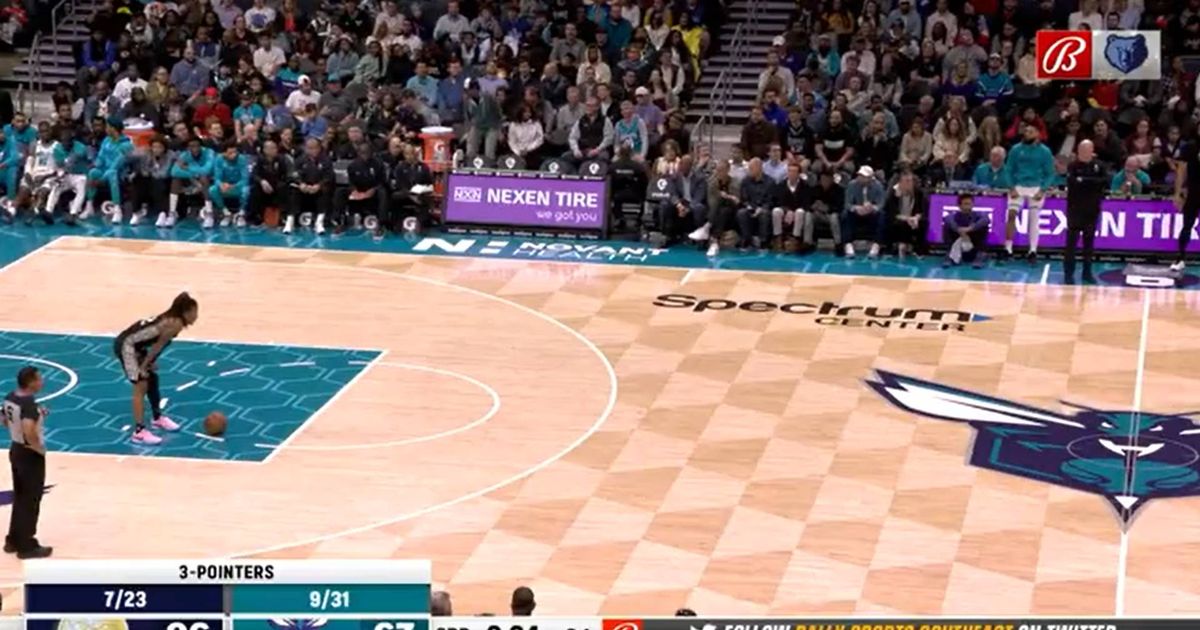
Two years ago, Morant became a regular dog walker in his sophomore season and quickly got his team to buy in. He’s utilized the move 41 times across all quarters and has been the ball handler on 23 of those 34 plays in crunch time, wasting over three minutes of game clock. In just over half this season, Morant has wasted more time walking the dog than any team had in an entire year and holds three of the longest dog walks recorded in the NBA this season (his teammate Desmond Bane has one of the others)…
The Grizzlies don’t discuss this in practice or plan these plays in advance. Morant often motions to his inbounder to roll the ball in slowly in these situations right as they materialize, especially when leading late in a game. The guy will do anything to shave a few seconds off. He’ll leap out of the way instead of catching the ball if the inbounder throws it too hard in his direction. If Morant finds himself inbounding, he’ll play dumb and misplace the ball as the game clock keeps running.
How has Morant become so good at walking the dog? He declined to speak with ESPN for this story, but his teammates think it boils down to his speed and athleticism. Opponents are hesitant to really press him 75-plus feet from their own hoop. If they make a mistake, he could have a huge runway with a numbers advantage. Others think it’s more a combination of fatigue and a never-ending game of chicken.
How do you stop a player from walking the dog? It’s so simple that it’s stupid: send a defender to make them pick up the ball. There’s some risk on either side here: an inattentive ball handler might allow an aggressive defender to steal a rolling ball. But an overaggressive defender might accidentally foul the ball handler in the back court while trying to steal the ball. That’s exactly what happened to Ben Simmons in a recent game against Morant:
As the Grizzlies’ star guard makes his way up the court, he lets the basketball roll alongside him, slowly, slowly, slowly, an inch at a time, untouched. Morant only needs to maintain a slow walk to keep up as he scans the court, uncontested by any Nets defender.
The ball rolls another inch, another inch, another inch. Morant is almost at half court. He keeps letting the ball roll alongside him, knowing the 24-second shot clock won’t start until he touches it — burning precious game clock at the same time, almost 21 seconds now.
As he crosses half court, Morant finally picks up the ball and glances over to his bench. His defender, Ben Simmons, suddenly closes on him and lunges at the ball, looking for a steal — but he’s too late. Morant sees it coming and protects the ball. Simmons hits him in the arm. Whistle. Foul. That’s Simmons’ sixth; he’s out of the game.
Thanks in part to that play, Memphis wins by 10. Afterward, Morant explains that he was baiting Simmons, knowing he’d bite based on past experience. Clips of the play soon go viral.
Personally, I like it when clever players find ways to play games-within-a-game in sports, especially basketball. So I have no problem with walking the dog. Other people think it’s boring, unfair, or it slows down the game too much. It definitely seems like if a lot of games come to a literal standstill, then the league office might step in and make a rules change. But until then, it’s worth enjoying the players who play this game — and all of its wrinkles — the best.
Jonathan Mehring’s short documentary Walls Cannot Keep Us From Flying follows two young Palestinians who have found freedom in skateboarding while surrounded by walls & barbed wire and facing harassment from Israeli authorities and their own families & communities.
What do I feel when I skate? What do I imagine? I imagine there’s no occupation, there’s no wall. I feel freedom.
With every new trick, it’s like you become aware of a new life, new ideas. It’s not something that I can describe, it’s something you feel in your heart. It’s like when something has been missing and you’re looking for it and slowly you find it.
According to one of the young skaters in the film, when a new skatepark opened in the West Bank, the Israeli army came and fired tear gas. And no wonder — when oppressed people start doing things like skateboarding and begin to feel like they are free, authoritarian regimes can’t have that — they’ve got to crack down.
As the first woman of color elected to Congress, Ms. Mink — and her path to office — was influenced by the discrimination she experienced in her personal and professional lives. Many doors were closed to her as a Japanese American woman, and she became an activist and later a politician to change the status quo.
As I learned more about the early history of Title IX in the 1970s, I found that lobbyists and legislators mounted a formidable campaign to dilute and erode the law. This effort would culminate in a dramatic moment on the House floor, where Ms. Mink was pulled away during a crucial vote on the future of the law.
People running “unconventional miles” is a thing now (see the beer mile) and during the pandemic, when meets and other usual track activities were cancelled, running a mile while dribbling a basketball became part of the human competitive story.
What started out as a curiosity-driven gimmick on YouTube eventually transpired into a competitive record among plenty of athletes, to the point where very experienced milers are now the only candidates that can pull this off.
The record for the basketball mile is 4:28, which also happens to be the current record for the aforementioned beer mile. It’s interesting that dribbling a basketball while running is equally as time-consuming as stopping to chug four beers and then running; I would have guessed the beer mile would take longer.
Since I’m probably not alone in wanting to hang onto the magic of the World Cup a little longer, here are the top 15 goals of the tournament, featuring the likes of Messi (twice!), Rashford, Mbappe, and of course Richarlison’s incredible effort against Serbia. See also this other take on the top goals.













Stay Connected