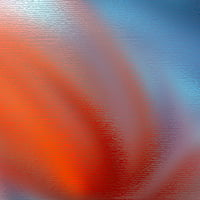
Cory Arcangel has a new show opening tonight at Team Gallery in Soho called Adult Contemporary. I got a peek at it last night and my favorite piece is called Photoshop CS: 110 by 72 inches, 300 DPI, RGB, square pixels, default gradient "Spectrum", mousedown y=1098 x=1749.9, mouse up y=0 4160 x=0. It's easy enough to whip up your own by following those instructions in Photoshop but the print itself is gorgeous. When you get up close to it, there is no discernible gradation between the colors and, because it's so uniform and smooth and glossy and big, you lose your sense of depth perception and you don't really know how close you are to it. I almost fell over looking at it because I was so disoriented.
Illustrator Bob Staake explains the process behind his cover on this week's politically themed New Yorker, including rejected alternatives and a video progression of the finished design. Staake still uses a copy of Photoshop 3.0 on MacOS 7 to do his illustrations. That was a great version of Photoshop...I remember not wanting to switch myself. (via df)
Update: Staake uses OS X with MacOS 9 running in the background:
Let me clear up today's rumor: I do NOT work in OS 7. I use OSX and run classic (9.0) in the background. Photoshop 3.0? Yes, STILL use that.
Dorothy Gambrell applies every Photoshop filter to an image in order and posted the results, including all the tweens. (via waxy)
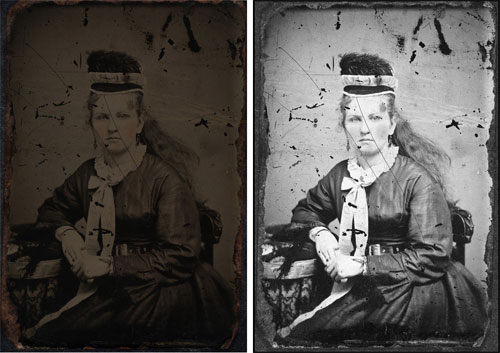
Photographer Sam Haskins, well known for doing in-camera montage, briefly describes how composite photos were made in the time before Photoshop.
Its a single exposure with the model viewed through optical glass at 45° and the fabric positioned to the side. At the time there was zero retouching after the event. Now of course I have the luxury of scanning the transparency to clean and refine the image in Photoshop - God bless its digital socks.
Fashion photo retouching (i.e. high-brow Photoshopping) gets the New Yorker treatment with this story on retoucher Pascal Dangin, one of the best in the business.
In the March issue of Vogue Dangin tweaked a hundred and forty-four images: a hundred and seven advertisements (Estée Lauder, Gucci, Dior, etc.), thirty-six fashion pictures, and the cover, featuring Drew Barrymore. To keep track of his clients, he assigns three-letter rubrics, like airport codes. Click on the current-jobs menu on his computer: AFR (Air France), AMX (American Express), BAL (Balenciaga), DSN (Disney), LUV (Louis Vuitton), TFY (Tiffany & Co.), VIC (Victoria's Secret).
The article touches too briefly on the tension between reality and what ends up in the magazines and advertisements. As Errol Morris points out on his photography blog, it is often difficult to find truth in even the most vérité of photographs. Even so, the truth seems to be completely absent from Madonna's recent photo spread in Vanity Fair that was retouched by Dangin, especially this one in which a 50-year-old Madonna looks like a recent college graduate who's never lifted a weight in her life.
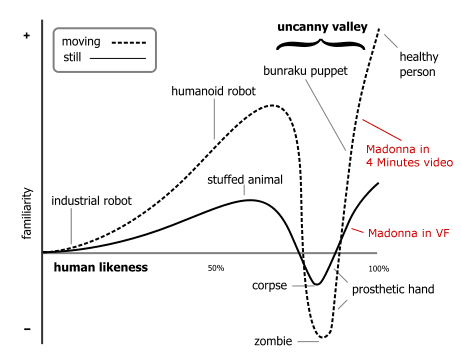
The uncanny valley comes into play here, which we usually think of in terms of robots, cartoon characters, and other pseudo anthropomorphic characters attempting and failing to look sufficiently human and therefore appearing creepy and scary. With an increasing amount of photo retouching, postproduction in film, plastic surgery, and increasingly effective makeup & skin care products, we're being bombarded with a growing amount of imagery featuring people who don't appear naturally human. People who appear often in media (film & tv stars, models, cable news anchors & reporters, miscellaneous celebrities, etc.) are creeping down into the uncanny valley to meet up with characters from The Polar Express. I don't know about you but a middle-aged Madonna made to look 24 gives me the heebie-jeebies. Perhaps the familar uncanny valley graph needs revision:
The Photoshop Disasters blog catalogs missteps in photo retouching and graphic design. The most recent post shows the cover of a Nintendo DS game that has an embarrassingly invisible iStockPhoto watermark on it. The three-handed lady is my favorite.
These half-n-half celebrity face mashups are unsettling. "The right half of a face has to be from one celebrity and the left half from another." The Bill/Hillary and the Cruise/Holmes ones are especially good.
Photoshopped series of photos of people kissing themselves. Sort of disturbingly erotic, in an erotically disturbing way.
Clever technique for pinching the colors from famous paintings using the Match Color tool in Photoshop. "The Old Masters of painting spent years of their lives learning about color. Why let all their effort go to waste on the walls of some museum when it could be used to give you a hand with color correction?"
Over the holidays, Mike Monteiro discovered there was a Nacho Libre game for the Nintendo DS. Thinking that an arbitrary choice for a movie tie-in game, he started the DS Tie-In Games I Wanna Play group on Flickr to showcase other possible odd media tie-ins for the DS. Some of my favorite submissions so far include: The Passion of the Christ, Birth of a Nation, Empire, Remains of the Day, My Dinner with Andre (Bon Mot controller sold separately), Super Mario Bros, Learning GNU Emacs, Requiem for a Dream, The Cremaster Cycle, and Getting Things Done.
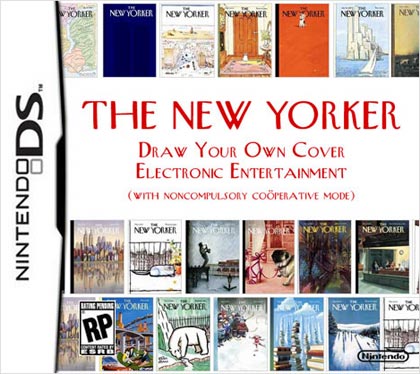
Here's a couple of ones that I've done: Dancer in the Dark and The New Yorker Draw Your Own Cover Electronic Entertainment (with noncompulsory coöperative mode), pictured below.

If you join the group, there's a Photoshop kit you can download to join in the fun.
It's fun Fotoshop Friday! (Phun Photoshop Phriday?) Anyway, here's a bunch of pictures of celebrities Photoshopped to look like Star Wars characters. I'm surprised there weren't more celebrities frozen in carbonite. (via fandumb)
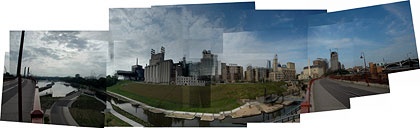
Here's my first attempt at a panorama of the Mill City Museum and the surrounding area:

Here's a larger version (3000 x 912, 312 KB).
I'm not entirely satisfied with this version. I used a shareware program for OS X called DoubleTake to stitch the images together and it's not suited for this kind of scene. Too much of the image turned out blurry & fuzzy and you have little control over which pieces of the image take precedent over the others. Some of this was probably user error and on some parts of the image (when there were less pieces involved), it did a wonderful job. I'm going to stitch a version in Photoshop by hand (and put a black background behind it) to see how it compares.
Update: Lots of photo stitching suggestions from people. Jake turned me onto Autostitch a few weeks ago, but alas it's not available for the Mac, nor do I have one of those fancy MacBooks on which to run Parallels. Calico is an OS X app that uses the Autostitch code, I may check that out. Photoshop CS has a built-in Photomerge tool that does panoramas. Hugin is a GPLed image stitcher that works on Windows and OS X. (thx galen, dan, jake, arlo, joe, glen, jason, and nicholas)
Browsing recent interestingness on Flickr, I ran across these photos of women photoshopped to include glass eyes, prostheses, eyepatches, and to look like amputees. This is a practice of devotees of amputee fetishism called Electronic Surgery. More examples here, here, and here. Probably a bit NSFW.
Update: Flickr has removed the users who posted those photos. Sorry.
Photoshop contest results: unretouched celebrity photos. Love the Botox-less Madonna.
Apple announces Aperture, professional-grade software for managing and manipulating photos. A little bit o' iPhoto mixed with Photoshop, it looks like. (Also, new Powerbooks...higher res, better battery life.)
Here's a sampling of the rest of the AIGA Design Conference, stuff that I haven't covered yet and didn't belong in a post of it's own:
- Juan Enriquez gave what was probably my favorite talk about what's going on in the world of genetics right now. I've heard him give a variation of this talk before (at PopTech, I think). He started off talking about coding systems and how when they get more efficient (in the way that the Romance languages are more efficient than Chinese languages), the more powerful they become in human hands. Binary is very powerful because you can encode text, images, video, etc. using just two symbols, 1 and 0. Segue to DNA, a four symbol language to make living organisms...obviously quite powerful in human hands.
- Enriquez: All life is imperfectly transmitted code. That's what evolution is, and without the imperfections, there would be no life. The little differences over long periods of time are what's important.
- Enriquez again: The mosquito is a flying hypodermic needle. That's how it delivers malaria to humans. We could use that same capability for vaccinating cows against disease.
- Along with his list of 20 courses he didn't take in design school, Michael Bierut offered some advice to young designers:
1. Design is the easy part.
2. Learn from your clients, bosses, collaborators, and colleagues.
3. Content is king.
4. Read. Read. Read.
5. Think first, then design.
6. Never forget how lucky you are. Enjoy yourself.
- Nicholas Negroponte: If programmers got paid to remove code from sofware instead of writing new code, software would be a whole lot better.
- Negroponte also shared a story about outfitting the kids in a school in Cambodia with laptops; the kids' first English word was "Google", and from what Negroponte said, that was followed closely by "Skype". He also said the children's parents loved the laptops because at night, it was the brightest light in the house.
- Christi recorded Milton Glaser's mother's spaghetti recipe. "Cook until basically all of the water is evaporated. Mix in bottle of ketchup; HEINZ ketchup."
- Ben Karlin and Paula Scher on the challenges of making America, The Book: Books are more daunting than doing TV because print allows for a much greater density of jokes. In trying to shoot the cover image, they found that bald eagles cannot be used live for marketing or advertising purposes. The solution? A golden eagle and Photoshop. And for a spread depicting all the Supreme Court Justices in the buff, they struggled -- even with the Web -- to find nude photos of older people until they found a Vermont nudist colony willing to send them photos because they were big fans of The Daily Show.
- Bill Strickland blew the doors off the conference with his account of the work he's doing in "curing cancer" -- his term for revitalizing violent and crime-ridden neighborhoods -- in Pittsburgh. I can't do justice to his talk, so two short anecdotes. Strickland said he realized that "poor people never have a nice day" so when he built his buildings in these poor black neighbohoods, he put nice fountains out front so that people coming into the building know that they're entering a space where it's possible to have a good day. Another time, a bigwig of some sort was visiting the center and asked Strickland about the flowers he saw everywhere. Flowers in the hood? How'd these get here? Strickland told him "you don't need a task force or study group to buy flowers" and that he'd just got in his car, bought some flowers, brought them back, and set them around the place. His point in all this was creating a place where people feel less dissimilar to each other...black, white, rich, poor, everybody has a right to flowers and an education and to be treated with respect and to have a nice day. You start treating people like that, and surprise!, they thrive. Strickland's inner city programs have produced Fulbright Scholars, Pulitzer Prize winners, and tons of college graduates.
- I caught 30 minutes of David Peters' presentation of Typecast: The Art of the Typographic Film Title and realized I should have gotten there in time to see the whole thing. I could sit and watch cool movie titles all day long. Among the titles he showed were Bullit, Panic Room, Dr. Strangelove, Barbarella, The Island of Dr. Moreau, and Superman. The title sequence for Napoleon Dynamite (which was discussed on Design Observer last year) was shown later in the main hall.
- At the closing party at the Museum of Science, we checked out the cool Mathematica exhibit that was designed by Charles and Ray Eames, two designers who were also pretty big science/math nerds.
- And some final thoughts from others at the conference. Peter Merholz says that "form-makers", which make up the vast majority of the AIGA audience, "are being passed by those who are attempting to use design to serve more strategic ends". (That's an interesting thought...) A pair of reviews from Speak Up: Bryony was a bit disappointed with the opening Design Gala but left, like everyone else, in love with emcee John Hockenberry while Armin noted that the preservation of digital files is a big concern for museums in building a collection of graphic design pieces...in 35 years, how are you going load that Quark file or run that Flash movie?
For more of what people are saying about the conference, check out IceRocket. There's a bunch of photos on Flickr as well.
Chris Anderson argues that media companies, unable to push the piracy rate to 0%, should live with the benefits of "just enough piracy". I've heard that in the (distant) past, Adobe turned a blind eye to piracy of Photoshop because it was getting their product out into the market. Tim O'Reilly's related essay entitled Piracy is Progressive Taxation, and Other Thoughts on the Evolution of Online Distribution is worth a read as well.